
“Integrated Development Plan in Support of the Socio-Economic Integration of Former Burundian Refugees in Tanzania,” Technical Assistance, 2015

Abstract

This World Bank-funded initiative assessed socio-economic investments, land regularization, and community engagement activities to facilitate the local integration of Burundian refugees in Tanzania. In 2014, the President announced that long-term refugees would be granted Tanzanian citizenship, becoming “New Tanzanians.” Many have lived in different settlements in two regions since 1972. As newly naturalized citizens, they gained rights such as land ownership and political participation, and local authorities needed to integrate these settlements into the governance framework.

The process and product of this assessment are based on the active engagement of the villages, districts, regions, and civil society, with the consultants acting as facilitators. The report: (1) provides a methodology to undertake a participatory and rapid spatial and technical planning assessment to identify priority socioeconomic investments; (2) determines how these priorities should be sequenced and integrated into existing development planning structures and processes.

See related I2UD projects below

Project Year:2015
Project Type:Technical Assistance
Geographic Regions:Tanzania
Reports:Integrated Development Plan in Support of the Socio-Economic Integration of Former Burundian Refugees in Tanzania (November 2015)
Authors:Maureen Moriarty-Lempke; John Driscoll
Sponsors:World Bank
Categories:Urban Finance
  
ID:2015_11_001

Keynote for City Debates 2015, American University of Beirut: “The Dynamics of Neighborhood Transformation: Long Term Trends and Immediate Responses to Turmoil and Civil Unrest,” Mona Serageldin

Abstract

Mona Serageldin prepared the keynote presentation “The Dynamics of Neighborhood Transformation Long Term Trends and Immediate Responses to Turmoil and Civil Unrest” for the 2015 City Debates program on Other Gentrifications: Urban Change Beyond the Core at the American University of Beirut.

The Keynote speech and presentation by Serageldin examine the impact of spatial segregation and social exclusion on gentrification in the Mashreq countries of Egypt, Syria, Lebanon, Iraq, Palestine, and Jordan. Documents include presentation slides and transcript.


[Excerpt: Key Note text, Dr. Mona Serageldin, Page 1]

“Gentrification, within or outside the urban core, conjures images of forced displacement, eviction and marginalization of poorer segments of society. However, when discussing gentrification it is important to distinguish between spatial segregation and social exclusion and between diversity and social mixity. Each of these concepts involves a different perspective on urban space. Furthermore, except in cases of clearance and redevelopment, changes in the structure and morphology of urban areas, entail longer term processes which start slowly, accelerate and reach a tipping point. Taking into consideration the time frame often alters perspectives and viewpoints.”

“Social and economic change at the neighborhood level is an inherent component of urban growth. Over time, the regional context has shaped the drivers of transformation processes. Historically, ruling elites eager to display their power, wealth, and status built exclusive precincts outside the urbanized area inhabited by the commoners, a diverse population with a wide range of economic means and social standing including different ethnicities and religions. Later, the desire of colonial expatriate communities to replicate their own living environment introduced a trend towards exclusive suburban extensions. The regulatory controls included in the charters and by laws of the companies which developed these suburbs and the boards running the select amenities tended to collapse from the mid-1960s on as the colonial era came to an end and massive capital infusion in urban real estate altered the dynamics of growth.”

“In labor sending countries, remittance-driven urbanization, formal and informal, sustained by high rates of household formation and pervasive housing shortages, sent land values skyrocketing beyond the affordability of many among the middle classes. It accelerated the proliferation and subsequent densification of informal settlements and sharpened class differentiation within them.”

See related I2UD projects below

Project Year:2015
Project Type:Presentation
Geographic Regions:Beirut, Lebanon (Program Location) / Egypt / Syria / Lebanon / Iraq / Palestine / Jordan
Reports:
Authors:Mona Serageldin; Barbara Summers
Sponsors:American University of Beirut
Categories:Informal Settlements and Urban Upgrading
  
ID:2015_03_001

Related I2UD Projects

“National Urban Strategy for Governorates in Iraq,” Development Strategy for Phase II of the United Nations Development Programme (UNDP) and Iraq Ministry of Planning Local Area Development Programme (LADP II), 2014-2018

Abstract

The 2014-2018 project “National Urban Strategy for Governorates in Iraq” was part of the UN-Habitat’s second phase of the United Nations Development Programme (UNDP) with the Iraq Ministry of Planning Local Area Development Programme (LADP II).

The goal of Iraq’s LADP II project was to increase the capacity for monitoring and coordination between all levels of Iraqi government, with an aim of localizing urban development strategies, sectoral/spatial planning, and structural planning at the Governorate level. These changes would ideally result in improved planning practices, higher budget execution and service delivery for Iraqi communities.

To facilitate the achievement of these goals, an I2UD team prepared a 5-part presentation for the Workshop on Strategic Urban Development Framework held from February-March 2016 in Erbil, Iraq. The project goals included analysis of the UN Sustainable Development Goals for 2030.

Documents include sections of preliminary, interim, and final reports from 2015 through 2018:

  • A summary presentation of the UN Habitat role in the Local Area Development Programme II project, followed by a GDP Computation Report and Presentation, and I2UD’s proposal for a National Urban Strategy Outline.
  • Parts 1-5 of the main Project elements: Participatory Planning Platform, Demographic Projections, Economic Analysis, Infrastructure Systems and Resource Management.
  • Interim reports, ending with a presentation to the UN Working Group from February 2017: “Presentation to the UN Working Group on Decentralisation and Service Delivery.”
  • Presentations and reports on Iraq’s Governorate “clusters”: Southern Cluster, Pilgrimage Cluster, and Central Cluster.
  • A final presentation from March 2018.

See related I2UD projects below

Project Year:2014-2018
Project Type:Development Strategy
Geographic Regions:Erbil, Southern Kurdistan, Iraq (Workshop Location) / Iraq Governorates
Reports:
Preliminary Reports:

Presentations Parts 1-5:

Interim Reports:

Cluster Reports:
Authors:Mona Serageldin; Daniel Tsai; Tarek Waly; Alejandra Mortarini; Saad Mahdi; Johann Friedl; Barbara Summers; Anna Soave; Bozhan Hawizy; Rania Kamel; Erfan Ali
Sponsors:UN Habitat; United Nations Development Programme (UNDP); European Union Local Area Development Programme (LADP-EU)
Categories:Urban Planning
  
ID:2014_11_001

Related I2UD Projects

“World Migration Report,” Background Papers on Displacement, Migration and Resettlement in MENA (Middle East and North Africa), International Organization for Migration, 2014

Abstract

In 2014, an I2UD research team produced a set of background research materials for the International Organization for Migration’s 2015 “World Migration Report,” addressing issues of displacement, migration and resettlement in the Middle East and North African (MENA) geographic region. In the Background Paper, the MENA region is further delineated as the Mashreq, Maghreb, Gulf Cooperation Council, and Southern Tier regions.

I2UD staff prepared of a series of case studies and facilitation of training course for Iraqi officials, discussing durable shelter solutions for internal displaced persons (IDPs) and returnees in Iraq, Syria, Spain, Italy, Sudan, and Yemen. The project aimed to: support local authority’s capacity to deal with migration patterns, review shelter needs for refugees, address reforms and challenges for accommodating migrants, and offer support for returnees.

Documents include a MENA Background Paper and a corresponding outline and work plan from 2014. Supporting materials include a display of “Project Statistics and Refugee Camps” in the region, a “Provincial Action Plan” for Van, Turkey, and an outline of “Durable Housing Solutions and Livelihoods for Georgian IDPs.”

Project Year:2014
Project Type:Research Paper
Geographic Regions:Middle East and North Africa / Van, Turkey / Georgia / France / Spain / Italy / Germany / United Kingdom
Reports:
Authors:Mona Serageldin; François Vigier; Maren Larsen; Barbara Summers; Sheelah Gobar
Sponsors:International Organization for Migration (IOM)
Categories:Reconciliation and Development
  
ID:2014_09_001

Related I2UD Projects

ICLRD Briefing Papers 2012-2016: “Implementation of River Basin Management Plans” and “Applying the Functional Territories Concept: Planning Beyond Borders”

Abstract

The International Centre for Local and Regional Development (ICLRD) published two short Briefing Papers in 2012 and 2016. The articles explored how various forms of urban planning, enacted at different spatial scales, could contribute to better collaboration on the pressing issues facing both the Republic of Ireland and Northern Ireland.

Documents include: “Implementation of River Basin Management Plans: Current Issues and Future Needs” (2012) and “Applying the Functional Territories Concept: Planning Beyond Borders” (2016).

See related I2UD projects below

Project Year:2012-2016
Project Type:ICLRD Project
Geographic Regions:Ireland / Northern Ireland
Reports:
Authors:Cormac Walsh; John Driscoll; Caroline Creamer; Patricia O’Hara; Karen Keaveney; Caitriona Mullan; Ainhoa González Del Campo; Pádraig Maguire
Sponsors:CroSPlaN, European Union INTERREG IVA
Categories:Reconciliation and Development
  
ID:2012_00_001

Related I2UD Projects

“Borderlands: The Journal of Spatial Planning in Ireland,” ICLRD Publication, 2011, 2013

Abstract

“Borderlands: The Journal of Spatial Planning” is Ireland ICLRD’s informative annual journal. The publication featured articles on cross-border and inter-jurisdictional cooperation on the island of Ireland, and beyond. John Driscoll of I2UD and Caroline Creamer of Maynooth University co-edited the first four editions of Borderlands, out of five issues published from January 2011 to 2016. Additionally, François Vigier and Christa Lee-Chuvala contributed an article to a sister organization’s annual publication, the Journal of Cross Border Studies in Ireland.

See related I2UD projects below

Project Year:2011-2013
Project Type:ICLRD Project
Geographic Regions:Ireland / Northern Ireland / Basel Metropolitan Area (Switzerland, France, and Germany)
Reports:
Authors:François Vigier; John Driscoll; Christa Lee-Chuvala
Sponsors:CroSPlaN, European Union INTERREG IIIA and IVA
Categories:Reconciliation and Development
  
ID:2011_00_001

Related I2UD Projects

ICLRD: Urban Reconciliation Case Studies for Public Housing Estates in Ireland and Northern Ireland, with Study Profile on the Basel Metropolitan Area, 2010-2012

Abstract

Between 2010 and 2012, I2UD contributed to a research series by ICLRD on public housing in Northern Ireland and the Republic of Ireland, where residents and local officials worked to improve housing and community in economically and socially segregated public housing estates.

I2UD generated regional planning profiles for six metropolitan estates in Ireland and Northern Ireland: Springfarm, Gobnascale, Carran Crescent, Cranmore, Mahon, and Adamstown. ICLRD featured these reports at its annual conference and published the profiles in the journal “Borderlands.” The Northern Ireland Housing Executive and the Housing Agency in Ireland also published the case studies. I2UD staff contributed roadmaps for developing shared services among local governments, training and education activities, and cross-border river basin research, including a comparative report on the Connecticut River Basin water quality in the northeastern United States.

Documents below begin with an Executive Summary “Shared Services Across Local Government” prepared for the Sixth Annual ICLRD Conference in January 2011, which focused on the theme of “Doing More with Less.” ICLRD contributed a detailed profile of the Basel Metropolitan Area developed in their research program on cross-border and inter-jurisdictional planning. A case study on the Boston Metropolitan Area is also included.

See related I2UD projects below

Project Year:2010-2012
Project Type:Case Studies; City Profile; Urban Reconciliation
Geographic Regions:Ireland / Northern Ireland / Basel Metropolitan Area (Switzerland, France, and Germany) / Boston Metropolitan Area (USA) / Connecticut River Valley (USA)
Reports:


Authors:John Driscoll; François Vigier; Kendra Leith; Paddy Gray; Erick Guerra; Ursula McAnulty; Peter Shanks; James Kostaras; Deborah Peel; Brendan O’Keeffe; Kina Shi; Kendra Leith; Karen Keaveney
Sponsors:CroSPlaN, European Union INTERREG IVA
Categories:Reconciliation and Development
  
ID:2010_05_001

Related I2UD Projects

“Shaping and Managing Cross-Border Development,” ICLRD Executive Training Program Materials, for Irish Border Cities: Newry-Dundalk Twin City Region & Northwest Region, Ireland, 2010-2014

Abstract

Between 2010 and 2014, ICLRD led executive training programs, funded by the European Union, that were seen as contributing to the long-term peace and reconciliation process in the Irish border region. The Newry–Dundalk Twin-City training program led to a Council Memorandum of Understanding, based on a model designed by John Driscoll and ICLRD colleagues. This has been acknowledged by the EU as a best practice outcome, leading to further mutual support on tourism, green energy, and economic development projects in Newry-Dundalk.

The second training program, Northwest Training Program (October 2010 to June 2011), achieved similar outcomes. From the Executive Training and Animation Program (September 2013 to July 2014), successful training of Council Executives, Councilors, and senior local government staff led to new agreements to deliver cross-border services and provided a framework for long-term cooperation in spatial planning. Programs were delivered to geographical groupings of border counties that shared functional relationships. The training programs were reinforced with technical assistance to help progress a particular priority identified by participants in the training program.

John Driscoll and Caroline Creamer (Maynooth University) were responsible for overseeing the development, design, and delivery of these professional education programs. ICLRD was an early adapter of web-based learning, and each a program had a corresponding website, developed by Daniel Tsai and maintained by I2UD staff, including Carolina Morgan and Christa Lee-Chuvala.


– Newry/Dundalk Twin City Region Training Programme (November 2009 to May 2010)
– Northwest Training Program (October 2010 to June 2011)
– ICBAN Region Training Program (October 2011 to December 2012)
– Executive Training and Animation Program (September 2013 to July 2014)


[Excerpt: “BACKGROUND TO MODULE 1,” Executive Training Programme, September 2013. CroSPlaN II – An INTERREG IVA Funded Programme. Module One. Visioning Local Government: Reform, Realisation, Responsibility. Post Module Report, p. 2.]

“The Executive Training and Animation Programme for cross-border region councils, using the successful ICLRD model linking training and animation developed under CroSPlaN I, targets the 22 Councils involved in the three local authority-led cross-border networks, namely:

– Irish Central Border Area Network (ICBAN);
– North West Region Cross Border Group; and
– East Border Region Ltd.

“The programme will be delivered through a programme of plenary sessions, seminars, discussion forums and working groups…this programme will improve the quality of cross-border cooperation and provide a critical forum to bring together cross-border councils, selected cross-border bodies and central government departments to support joint solutions supported by collaborative agreements. The programme will consist of 10 modules; with post module reports to be prepared for the initial five plenary sessions.”
See more at: https://iclrd.org/activities-2/training-and-capacity-building-2/

See related I2UD projects below

Project Year:2009-2010
Project Type:Executive Training Programs
Geographic Regions: Newry, Northern Ireland / Dundalk, Ireland
Reports:

Executive Training and Animation Program:
Authors:Kevin Murray; Ruth Taillon; Eimear Donnelly; Caroline Creamer; Peter Roberts; Jenny Pyper; Gaven Rafferty; Seán O’Riordáin; Sharon McNicholl; Louise McNeill; David Walsh; Linda McHugh; Juston Gleeson; Robin Hambleton; Tom Reid; Niall Cussen; John Fitzgerald; Connie Hanniffy; Kat Healy; Simin Davoudi; Neale Blair; Lorraine McCourt; Carrie Small; Andy Pollak; Joan Martin; Michael Curran; Jim Hetherington
Sponsors:CroSPlaN, European Union INTERREG IVA
Categories:Education
  
ID:2009_00_004

Related I2UD Projects

“The Atlas of the Island of Ireland: Mapping Social and Economic Change,” Publication by ICLRD, 2008 and 2015

Abstract

In 2008, the International Centre for Local and Regional Development (ICLRD) published the Atlas of the Island of Ireland in cooperation with the All-Island Research Observatory (AIRO), to illustrate similarities and contrasts between Northern Ireland (part of the United Kingdom) and the Republic of Ireland. While both jurisdictions on the Island of Ireland were undergoing rapid change, a common understanding of the major demographic, economic, and social trends was lacking and unavailable from the respective censuses.

The 2008 Atlas allowed readers to visualize the major social, economic, and demographic trends and interactions across the island of Ireland. Its publication helped to initiate evidence-informed dialogues among policy- and decision-makers on the functional space, where cooperation could bring mutual benefits, rather than the political space alone.

In 2015, ICLRD published a new print and digital edition of the Atlas. With European Union and cross-border funding support, ICLRD and AIRO continued to develop compatible data between the respective censuses.

Finally, a series of training programs and workshops were held to train government staff and community development practitioners on how to access and use all-island interactive data and mapping tools made available on the AIRO website. These ‘data days’ were introduced based on exchange visits, facilitated by I2UD, among senior staff of AIRO, the Boston Foundation, and the Boston Metropolitan Area Planning Council.

Documents include the Atlas of the Ireland of Ireland from 2015 and two versions from 2008–the full document as well as the same document divided into separate files by chapter.

See related I2UD projects below

Project Year:2008-2015
Project Type:ICLRD Project
Geographic Regions:Ireland / Northern Ireland
Reports:

2008 Atlas by Chapter:
Authors:Justin Gleeson; James Walsh; Chris Van Egeraat; Gavin Daly; Rob Kitchin; Mark Boyle; Andrew McClelland; Ronan Foley; Trutz Haaze; Johnathan Pratschke
Sponsors:ICLRD; All-Island Research Observatory (AIRO); Department of Environment, Local Government and Heritage (Government of Ireland); CroSPlaN, European Union INTERREG IIIA and IVA
ID:2008_00_001

Related I2UD Projects

ICLRD: Spatial Strategies for Peace and Reconciliation on the Island of Ireland – Collected Research Reports by the International Centre for Local & Regional Development, 2006-2013

Abstract

From 2006-2013, the International Centre for Local & Regional Development (ICLRD) published applied research on urban reconciliation, community regeneration, and inter-regional and cross-border co-operation for the Island of Ireland, specifically the border regions between the Republic of Ireland and Northern Ireland communities.

ICLRD’s research brought together universities, governments, and community groups to address the spatial aspects of peace and reconciliation on the Island of Ireland. ICLRD’s work details the challenges of building regenerative urban development across multiple contexts–political and economic dynamics within the Island of Ireland, between European Union councils in cross-border regions, and within local Irish communities. The project made a particular focus on encouraging communities to take a proactive role in creating a stable society in their regions.

Partners included CroSPlaN (European Union INTERREG IVA), the International Fund for Ireland, and the Higher Education Authority of the Irish Government. François Vigier contributed to this research for I2UD.

See related I2UD projects below

Project Year:2006-2013
Project Type:ICLRD Project
Geographic Regions:Ireland / Northern Ireland
Reports:
Authors:François Vigier; John Driscoll; Erick Guerra; Carolina Creamer; Karen Keaveny; Neale Blair; Cormac Walsh; Jim Hetherington; Lina Shi; Justin Gleeson; Andrew McClelland; Chris van Egeraat; Brendan O’Keeffe; Alastair Adair; Jim Berry; Stanley McGreal; Christopher Ryan; Karen Keaveney
Sponsors:CroSPlaN, European Union ITERREG IVA; International Fund for Ireland; Higher Education Authority (Government of Ireland)
Categories:Reconciliation and Development
  
ID:2006_06_001

Related I2UD Projects

“Romania Local Governance Bridge Program – Metropolitan Planning and Cooperation in Romania,” USAID-Romania Report for the Association of Romanian Municipal Chief Architects, Ploiesti Metropolitan Area, Romania, 2005

Abstract

Team members John Driscoll and François Vigier contributed to a USAID-Romania and ARD Inc. report from 2005 on the “Romania Local Governance Bridge Program: Metropolitan Planning and Cooperation in Romania,” by outlining technical assistance approaches to metropolitan development and governance used in Romania. The report identifies the development of approaches best suited to Romania, drawing upon technical assistance previously provided to the Municipality of Oradea and surrounding communes.


[Excerpt]: Introduction and Preface

This report was developed based on joint missions with John Driscoll, Institute for International Urban Development and Mr. Liviu Ianasi, Vice-Dean of the School of Urban Planning in Ion Mincu University of Architecture and Urban Planning and consultant to the Chief Architects Association and Ploiesti municipality.

“This report is based on a request to USAID to help the Municipality of Ploiesti to redefine its approach to implementing metropolitan development—spatial and metropolitan governance—and to assist the Romanian Chief Architects Association to identify different approaches to metropolitan development in Romania. This is part of a larger activity of the association to systematically highlight major challenges on various topics that are relevant to the planning activities of chief architects in Romanian cities.”

“This report is divided into the two major topics of the request for assistance: (a) an overview of metropolitan and inter communal planning approaches in the U.S., the EU and Romania; and (b) a review of current initiatives in Ploiesti and recommendations for subsequent activities. For the purposes of this report, the Association requested that an emphasis be put on reviewing U.S. experiences that could be relevant to the Romanian context. More extensive work on the EU dimension of metropolitan planning and inter-communal cooperation has been undertaken separately by the Chief Architects Association and covered in related work by Romanian consultants working on metropolitan initiatives in Romania. In the last five years, the concept of metropolitan and inter-communal cooperation and the emergence of specific proposals have gained momentum in Romania. There is an emerging body of experience and research within in both the fields of urban and public administration on the topic.”

“This report was developed based on joint missions with Mr. Liviu Ianasi, Vice-Dean of the School of Urban Planning in Ion Mincu University of Architecture and Urban Planning and consultant to the Chief Architects Association and Ploiesti municipality… Ms. Simona Munteanu, Chief Architect of the Municipality of Ploiesti, worked with the consultants to review current initiatives for the Ploiesti metropolitan area and develop proposals for further cooperation. The consultants would like to thank ARD-Romania for the assistance provided during the course of this assignment.”

“Professor Francois Vigier, (formerly) Professor Emeritus at the Harvard School of Design and President of the International Institute for Urban Development in Cambridge Massachusetts contributed advice and text to the summary of the experience of metropolitan development in the United States. Ms. Muneanu, Mr. Andrei Luncan, Dr. Arh. Radu Radoslav and other members of the Subcommittee on Metropolitan Cooperation of the Chief Architects Association provided important insights to the current efforts in metropolitan development in Romania. The work of the Association should receive continued support given the potential impact of positively shaping urban growth in Romania. Discussions with Dr. Nicolae Taralunga and Dr. Sorina Racoviceanu of the Institute for Housing and Urban Development.” [End excerpt]

(Reproduced for Education and Research Fair Use. Copyright Information: This publication was produced for review by the United States Agency for International Development. It was prepared by ARD, Inc. 2005. USAID Task Order 810: USAID Contract No. AEP-I-00-00-00016-00.)

Project Year:2005
Project Type:Policy Paper
Geographic Regions:Ploiești, Romania
Reports: Romania Local Governance Bridge Program: (Report, 2005)
Authors:François Vigier; John Driscoll; Liviu Ianasi
Sponsors:USAID-Romania
Categories:Urban Planning
  
ID:2005_07_001

ICLRD: Annual Conference Reports on Urban Planning for the Island of Ireland, with CroSPlaN, INTERREG IVA and InterTradeIreland, 2004-2017

Abstract

The International Centre for Local and Regional Development (ICLRD) hosted over a dozen annual conferences on urban planning for the Island of Ireland, starting in May 2004. Conferences were organized around timely themes, to promote practical cross-border cooperation and networking between policy makers, government leadership, academics, and practitioners from Northern Ireland, the Republic of Ireland, the European Union, and the United States.

Between 2004 and 2017, ICLRD’s conferences provided a venue to feature ongoing research projects and host international speakers and panelists on best practices in cross-border cooperation. Through these conferences, attended by over a hundred delegates each year, all participants gained an opportunity for networking among delegates. The conferences provided a safe and non-political place for senior government officials to consider cross-border cooperation.

A summary report published after each conference captured key messages, including links to the presentations and audio recordings of the proceedings. Sponsors included CroSPlaN, the European Union (INTERREG IVA), and InterTradeIreland. I2UD team members, including John Driscoll and Caroline Creamer (Maynooth University), had a major role in conference organizing.


[Excerpt: ICLRD Third Annual Conference, page 2]:

“A number of key issues were addressed during this 1-day event, and these included:

– The development of the collaborative framework to promote joined-up spatial planning on the island of Ireland;
– Financing collaboration: The role of the Irish National Development Plan (2007- 2013) and the Northern Ireland Executive’s Investment Strategy (2008- 2018);
– Implementing cross-border sub-regional strategies;
– Enhancing connectivity in small cross border towns;
– The role of housing in building sustainable communities; and
– Supporting evidenced-based spatial planning.”


“Implementing a Framework for Collaborative Action: Spatial Strategies on the Island of Ireland” (November 2006)

“Fostering Cooperation for Local and Regional Development through Cross-Border Spatial Planning” (January 2008)

“Achieving Balanced Regional Development: Dynamic Regions, Spatial Strategies and Collaboration” (January 2009)

“Preparing for Economic Recovery: Planning Ireland, North and South, Out of Recession” (May 2010)

“The Changing Business, Community and Spatial Planning Landscape: Doing More with Less” (August 2011)

“Planning for a New Future: “Can Planning and Cross-Border Cooperation Deliver Change in Ireland and Europe?” (April 2012)

“Cooperating Across Boundaries: Resilience, Imagination, Vision and Information” (February 2013)

“Celebrating Ten Years, Annual Conference on Place Making” (February 2017)

See related I2UD projects below

Project Year:2004-2017
Project Type:Conference Reports
Geographic Regions:Ireland / Northern Ireland / European Union
Reports:
Authors:John Driscoll; Tim O’Connor; John Fitzgerald; Jenny Pyper; Deborah Peel; Niall Cussen; Frank Gaffiken; Siobhan Coughlan; Seamus Neely; John Briggs; Brendan O’Keefe; Ciarán Cuffe; Rob Kitchin; Aiden Gough; Mary Bunting; Liam Nellis; Jim Berry; Brendan Bartley; Mike Thompson; Henry Elvin; Gerard O’Hare; Seán O Laoire; William Poole; Michael D’Arcy; Caroline Creamer; Tim O’Connor; Justin Cleeson; Feargal McCormack; Shaun Henry; Linda McElduff; Claire Davis; Diamaid Lawlor; Mary Corcoran; Peter Roberts
Sponsors:CroSPlaN, European Union INTERREG IVA; InterTradeIreland
Categories:Reconciliation and Development
  
ID:2004_05_001

Seminar on “Partnerships and Urban Development in Older Neighborhoods in Paris and Boston,” with Centre de Recherches sur l’Habitat (CRH), April 2004

Abstract

In collaboration with the Centre de Recherches sur l’Habitat (CRH) in Paris, the Center for Urban Development Studies (CUDS) at Harvard University’s Graduate School of Design documented community development strategies and neighborhood initiatives in La Goutte d’Or in Paris, France and the South End, Boston.

Activities included a seminar in Paris and a study tour of Boston community-based organizations for 21 French local governments and NGO representatives. The research was supported in part by PUCA (Le Plan Urbanisme, Construction et Architecture), an agency of the French Ministry of Infrastructure and Housing. Documents include a draft project summary, a project proposal in French, and bibliography.


[Excerpt: Proposal, “Partnerships and Urban Development in Older Neighborhoods in Paris and Boston,” 2002]

“Researchers from the two Centers have initiated joint activities to compare urban development in older and economically distressed neighborhoods in Paris and Boston and their respective economic, social and spatial manifestation. The research will provide a better understanding of the dynamics that drive urban development in older districts and their effect on neighborhood revitalization programs. Particular attention will be paid to the method local governments use to work in partnership with local communities in order to improve the quality of life and economic opportunities for lower-income residents. The research is focusing on older districts in transition including: La Goutte d’Or in Paris and St. Denis on the edge of Paris; and in Boston the South End and Dudley neighborhoods. In each city, the neighborhoods illustrate the challenges facing older districts today.”

See related I2UD projects below

Project Year:2004
Project Type:IEP; Education
Geographic Regions:South End, Boston, USA / Goutte d’Or, Paris, France
Reports:
Authors:John Driscoll; Marie Hélène Bacqué; Yankel Fijalkow
Sponsors:Ministry of Infrastructure and Housing, Ministry of Foreign Affairs (French Government); National Science Foundation
Categories:International Education Program; Executive Training Program; Education
  
ID:2004_00_001

Related I2UD Projects

“Svishtov: A Community-Based Investment Program for Municipal Development,” Technical Assistance for Capital Investment Strategy in Svishtov, Bulgaria, 2002

Abstract

A 2002 report “Svishtov: A Community-Based Investment Program for Municipal Development” addressed the capital investment strategy in Svishtov, Bulgaria, involving an implementation strategy designed to encouraged financial partnerships among civic groups, the private sector, and the municipality to address city-wide and neighborhood improvement priorities.

Based on this initiative, the Svishtov municipality received a 2004 award from the Conrad Adenauer Foundation of Germany for innovations in Bulgarian municipalities. The initiative was also featured in a 2007 World Bank publication on participatory budgeting.


[Excerpt: Introduction, “Svishtov: A Community-Based Investment Program, p.2]

“In Bulgaria, the current investment planning process for municipalities, regions and the central government is not able to mobilize the financing that is so desperately needed for municipal investments nor effectively leveraging local resources. Many municipal projects submitted for funding from central and regional sources are not funded and remain on waiting lists for a considerable period. This has a direct impact on citizen participation in the planning and budgeting process. Citizens are often unsure if their participation will prove meaningful. The lack of meaningful participation at the local level is often a result of a feeling that “nobody will listen to us.” Additionally, local authorities feel frustrated because regional and national projects that have a significant impact on local development policies are carried out with little consultation from local authorities.”

“Tight municipal budgets and an increasing demand for improved services among residents and businesses is leading to new public/private partnerships that focus on mobilizing community-based resources to improve the urban environment. This places a challenge to the local governments to integrate effective and sustainable participation of the local communities and businesses in improving the quality of the living environment.”

“This case study describes initiative currently underway in Svishtov to develop a community based investment program. The program is suitable for smaller municipalities that can fund local programs from their own resources and can mobilize external funds for community-based activities. The methodology concentrates on developing a more responsive planning system for community based programs that complements the existing investment process that is primarily oriented towards larger scale projects. While elements of the community-based investment program are specific to Svishtov such as project selection criteria that reflect the programs that are a priority for the municipality, the process can be adopted to other municipalities.”

Project Year:2002
Project Type:Technical Assistance
Geographic Regions:Svishtov, Bulgaria
Reports:Svishtov: Community Based Investment Program for Municipal Development (Report, January 2004)
Authors:John Driscoll; Marianna Eneva; Anna Laskowska
Sponsors:RTI International; USAID
Categories:Informal Settlements and Urban Upgrading
  
ID:2002_03_001

“Reconnaissance Report: Local Economic Development,” Regional Planning Survey for Bucharest, Romania, 2000

Abstract

In 2000, John Driscoll and Liviu Ianasi produced a survey report on local planning processes in Bucharest, Romania titled “Local Economic Development: Reconnaissance Report.” The report proposed a technical assistance and capacity-building program for the Bucharest region. It includes an overview of the program objectives and a detailed implementation framework, highlighting tools to assist USAID and RTI International in planning, prioritizing, and selecting projects to foster local economic development in Romania.

Excerpt

Table of Contents:

  • Introduction (p. 2)
  • Country and Urban Context (p. 2)
  • Linkages Between Economic Development and Urban Planning and Land Management (p. 3)
  • Legal and Regulatory Framework for Planning and Land Management (p.p.3)
  • Existing Legislation relating to Urban Planning, Land and Economic Development (p. 6)
  • Institutional Context Related to Economic Development and Urban Planning (p. 7)
  • Municipal Finance and Links to Economic Development (p. 9)
  • Proposed Capacity Building Activities (p.10)
  • Key Areas of Focus (p. 11)
  • Capacity Building Approach (p. 14)
  • Next Steps (p. 15)
  • Framework for Capacity Building and Highlighting Changes for Legislative Action (p. 16)
  • Annex 1. Standard Outline for GUP and Regulations (p. 23)
  • Annex 2. Organizational Chart—Municipal Government (p. 27)
  • Annex 3. Meetings and contacts during the Mission (p. 28)
  • Annex 4 NARD Funding by Source (p. 30)
Project Year:2000
Project Type:Technical Assistance
Geographic Regions:Bucharest, Romania
Reports:Local Economic Development Reconnaissance Report: (March 2000)
Authors:John Driscoll; Liviu Ianasi
Sponsors:RTI International; USAID
Categories:Urban Planning
  
ID:2000_02_001

“Szczecin Local Initiative Program,” Urban Improvement Intervention Strategy, for the USAID Regional Housing and Urban Development Office, Szczecin, Poland, 1999

Abstract

The USAID Regional Housing and Urban Development Office (RHUDO) sponsored a 1999 project addressing the Szczecin Local Initiatives Program for Szczecin, Poland. The program sought to develop a supportive framework linking neighborhood revitalization and economic development. The contract involved funding partnerships between residents, the private sector, and non-governmental organizations (NGOs).

Team members, led by John Driscoll and Mona Serageldin, worked towards the development of local initiative programs with community-based organizations in Szczecin, Poland. The project also tapped a network of local universities, foundations, civic institutions and other non-profit organizations to improve the physical and social conditions in lower-income neighborhoods in Poland.

Project Year:1999
Project Type:Urban Improvement Intervention Strategy
Geographic Regions:Szczecin, Poland
Reports:
Authors:John Driscoll; Mona Serageldin; Dominik Górski; Anna Stepień; Pawel Szczyrski; Janusz Szewczuk
Sponsors:USAID Regional Housing and Urban Development Office
Categories:Informal Settlements and Urban Upgrading
  
ID:1999_05_001

“City of Szczecin Capital Improvement Program,” Case Studies for Technical Assistance Program, Szczecin, Poland, 1996

Abstract

In 1996, the Unit for Housing and Urbanization at Harvard University’s Graduate School of Design collaborated with the Local Economic Professionals Association (Szczecin, Poland) to prepare capital improvement program for the city of Szczecin, Poland.

The program emphasized linking land management strategies to the provision and financing of infrastructure. The development of public/private partnership identified in the strategy documents included methods of packaging projects in order to build rehabilitation and neighborhood improvements.

This technical assistance project was later used to prepare a teaching case for an Executive Seminar on Urban Planning and Local Economic Development taught in Iasi, Romania on March 20-23, 2001, organized by the Unit in association with the Research Triangle Institute, and as part of the USAID Local Government Assistance Program. Documents include case studies and 5 tables containing detailed outlines of strategic goals.


[Excerpt: The Capital Improvement Program, City of Szczecin: (Case Study), page 7]

Supportive Policies and Strategies: A series of strategy documents within key development sectors were produced and used as a guide for the development of the capital investment plan. These include:

  • A renovation strategy for commercial and residential buildings in city center;
  • A housing policy for the entire city.
  • Master Plan for central heating;
  • Master Plan for waste management;
  • Master Plan for water supply and sewage management.

“Other reports and studies pertaining to the Capital Investment Program (CIP) included transport studies for Szczecin and an analysis of the city’s regional and macro-regional functions and responsibilities. The reports have generated a valuable database outlining the range of investment requirements in individual sectors. These reports also formed the basis for a more extensive review of the Conditions and Directions Of Urban Planning for The City of Szczecin and a City Development Strategy.

“These reports identified investment priorities that would promote balanced development for the city. The most important of them will be the specifications of investment projects graded according to their priority. Together, these Strategies and Master Plans provide analysis of effective sectoral management methods for the city.”

See related I2UD projects below

Project Year:1996
Project Type:Technical Assistance
Geographic Regions:Szczecin, Poland
Reports:
Authors:John Driscoll; Mona Serageldin
Sponsors:Local Economic Professionals Association (Szczecin, Poland); Center for Urban Development Studies, Harvard University Graduate School of Design
Categories:Informal Settlements and Urban Upgrading
  
ID:1996_06_002

Related I2UD Projects

Design Studio 1996: “Strategic Urban Redevelopment in a Transitional Economy in Gdansk, Poland,” Seminar Curriculum

Abstract

The Design Studio from Spring 1996, “Strategic Urban Redevelopment in Gdansk, Poland,” was led by Professors Mona Serageldin and David Neilson. The Studio examined urban planning, housing, and development in Poland, economic policies and conditions in the Gdańsk Province, and basic construction costs and building typologies in Gdańsk.

Documents include a detailed Studio overview with course schedule and full report, the full report “Urban Regeneration and Housing in a Transitional Economy: Gdansk, Poland,” and a case study summary, “A Foreign Investor’s Perspective on Strategic Planning and Urban Development in Poland.”

See related I2UD projects below

Project Year:1996
Project Type:Urban Design Studio
Geographic Regions:Gdańsk, Poland
Reports:
Authors:Mona Serageldin; Boguslaw Rutecki; David Neilson; Dariusz Knowski; Janne Corneil; Robert Lach; Boguslaw Trondowski; Anna Zietek
Sponsors:Unit for Housing and Urbanization, Harvard University Graduate School of Design
Categories:Design Studios; Education
  
ID:1996_01_001

Related I2UD Projects

Design Studio 1995: “Urban Regeneration and Housing in a Transitional Economy: Lublin, Poland,” Seminar Curriculum

Abstract

The Urban Design Studio from Spring 1995, “Urban Regeneration and Housing in a Transitional Economy: Lublin, Poland” was a seminar led by Professors Mona Serageldin and David Neilson in the Spring 1994 semester at Unit for Housing and Urbanization (the Unit) at Harvard University’s Graduate School of Design. The 1995 Studio continued a series of studies on urban issues in societies undergoing economic restructuring, institutional transformation, and social change, focusing specifically on Lublin, Poland.

The 1995 topic built off a development strategy written by the Unit in 1994-1996, for the urban environment and housing situation in Lublin. See original reports: “Lublin Local Initiatives Program” & “Lublin Old Town Rehabilitation Project,” Urban Upgrading in Lublin, Poland, 1994-2000 (Project ID: 1994_08_001).

Curriculum components include an implementation strategy for public and private roles, public investment strategies, leveraging and cost-recovery options, housing typologies, street cross-sectional typologies, land use patterns, and block structures. Documents include a studio overview, syllabus, and an extensive report on “Urban Regeneration and Housing” in Lublin, Poland.

See related I2UD projects below

Project Year:1995
Project Type:Urban Design Studio
Geographic Regions:Lublin, Poland
Reports:
Authors:Mona Serageldin; François Vigier; David Neilson; Janne Comeil; Nadar M. El-Bizri; Shimpei Ago; Ott Gira; Bert Hoffman; Hiroaki Inoue; Alyn Janis; Annette Kim; Victoria Marquis; William Doebele; Sonia Hammam; Carol Johnson; Alex Krieger; Barry Shaw
Sponsors:Aga Khan Program for Islamic Architecture
Categories:Design Studios; Education
  
ID:1995_00_001

Related I2UD Projects

“Lublin Local Initiatives Program” & “Lublin Old Town Rehabilitation Project,” Technical Assistance for Urban Upgrading in Lublin, Poland, 1994-2000

Abstract

Between 1994 and 2000, the Unit for Housing and Urbanization (the Unit) and its successor, the Center for Urban Development Studies (CUDS), at Harvard University’s Graduate School of Design, worked on the Lublin Local Initiatives Program to promote urban development in Lublin, Poland. The program focused on rehabilitation and revitalization in Lublin’s neighborhoods to improve the quality of life by introducing the involvement of citizens in the planning process through participatory and empowerment strategies and the mobilization of local resources.

The Unit/CUDS subcontracted for the consulting firm Planning and Collaborative Development International (PADCO), and USAID/RHUDO Warsaw funded the mission to prepare guidelines for the development of Lublin’s municipal, technical, and managerial capabilities. The project included tenant participation and housing rehabilitation components. This work by the Unit and CUDS earned a Best Practice Award for excellence in improving the living environment at the Habitat II Conference in Istanbul in June 1996.

Documents fall into three main groups:

  • First, the Lublin Neighborhood Partnership Initiative documents (1995), including a Program Review mission, a Final Report, an Organizational Framework and Work Plan, a Strategy and Impact Assessment Impact Table, a paper on “Local Government Finance” by David Jones, and a Summary on “Initiating Neighborhood Partnerships” by Mona Serageldin and Ewa Kipta.
  • Second, a “Lublin Old Town Rehabilitation Project” proposal for the community supported upgrading plans for the historic Old Town region of Lublin, with Summary by Mona Serageldin from July 1996, “Lublin Seminar on City Revitalization: Revitalization of Distressed Urban Neighborhoods.”
  • Finally, a “Program Review Mission Field Report” November 1996 for the Polish cities of Szczecin and Lublin, with a “Lublin Field Report” from January 1997.

CUDS, later becoming I2UD, continued to rework Lublin-related documentation throughout the 2000-2010s for educational case studies or presentations. See two examples below for the Lublin Local Initiatives Program: Institutionalization of Community Based Development (Case Study, March 1997) and Lublin Local Initiatives Program: A Success Story (Report, October 2000).

See related I2UD projects below

Project Year:1994-2000
Project Type:Technical Assistance
Geographic Regions:Lublin, Poland
Reports:


Authors:Mona Serageldin; Janne Corneil; John Driscoll; Ewa Kipta; David C. Jones; David Neilson; Richard Shortt; Bogue Trondowski; Anna Zietek
Sponsors:USAID Regional Housing and Urban Development Office
Categories:Reconciliation and Development
  
ID:1994_08_001

Related I2UD Projects

“Framework for Land Management and Urban Development in a Market Economy,” Mission Report with Case Studies Annexes, for Tirana, Albania, 1994

Abstract

Mona Serageldin and the Unit for Housing and Urbanization at Harvard University’s Graduate School of Design prepared a mission report for Albania in 1994 on building a “Framework for Land Management and Urban Development in a Market Economy,” in collaboration with the International City/County Management Association (ICMA). The report addressed the development of strategies for technical assistance and capacity building in Albania, within the framework of USAID’s Municipal Management/Local Government Program in Eastern Europe. The report focused on land management issues, structure processes for urban planning, and developing the municipal capacity to meet opportunities in a market economy. Serageldin presented these findings and recommendations to the USAID Regional Housing and Urban Development Office (RHUDO).

From 1994 to 1996, the Unit team established an inter-jurisdictional Land Management Task Force and creating the framework and process to undertake a preliminary structure plan for Tirana, Albania. It also coordinated a team of experts providing technical assistance in the areas of infrastructure planning, land regularization, servicing of informal settlements, institutional development and community-based approaches to urban management, and the provision of infrastructure. Training was provided on strategic approaches for the planning and redevelopment of older neighborhoods.

See related I2UD projects below

Project Year:1994
Project Type:Mission Report
Geographic Regions:Tirana and Durrës, Albania
Reports:
“Framework for Land Management and Urban Development in a Market Economy,” Mission Report (May 1994)
Authors:Mona Serageldin
Sponsors:USAID Regional Housing and Urban Development Office
Categories:Urban Planning; Informal Settlements and Urban Upgrading
  
ID:1994_00_001

Related I2UD Projects

“Strategy for Technical Assistance and Training: Housing and Land Management in Poland,” Technical Assistance Report by Dr. Mona Serageldin, for Gdańsk, Gdynia, Kraków, Lublin, Poznań and Szczecin, Poland, 1992

Abstract

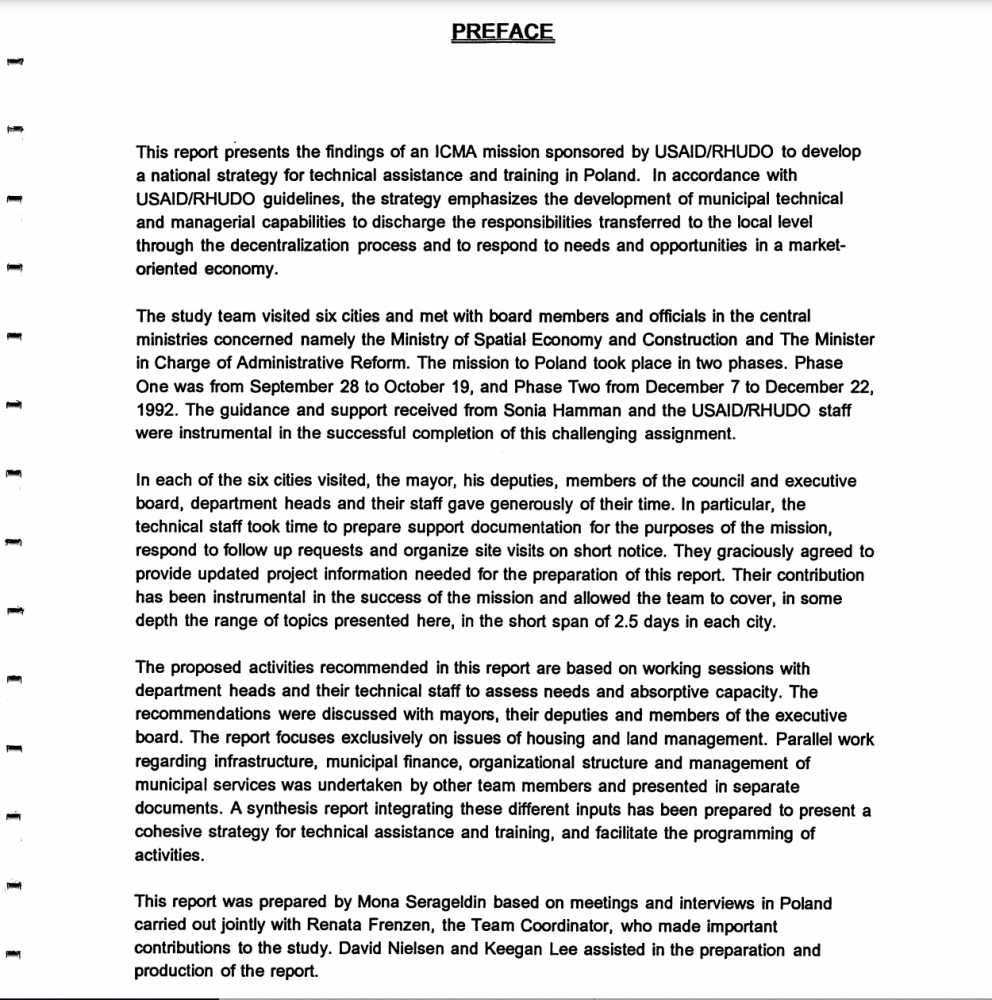
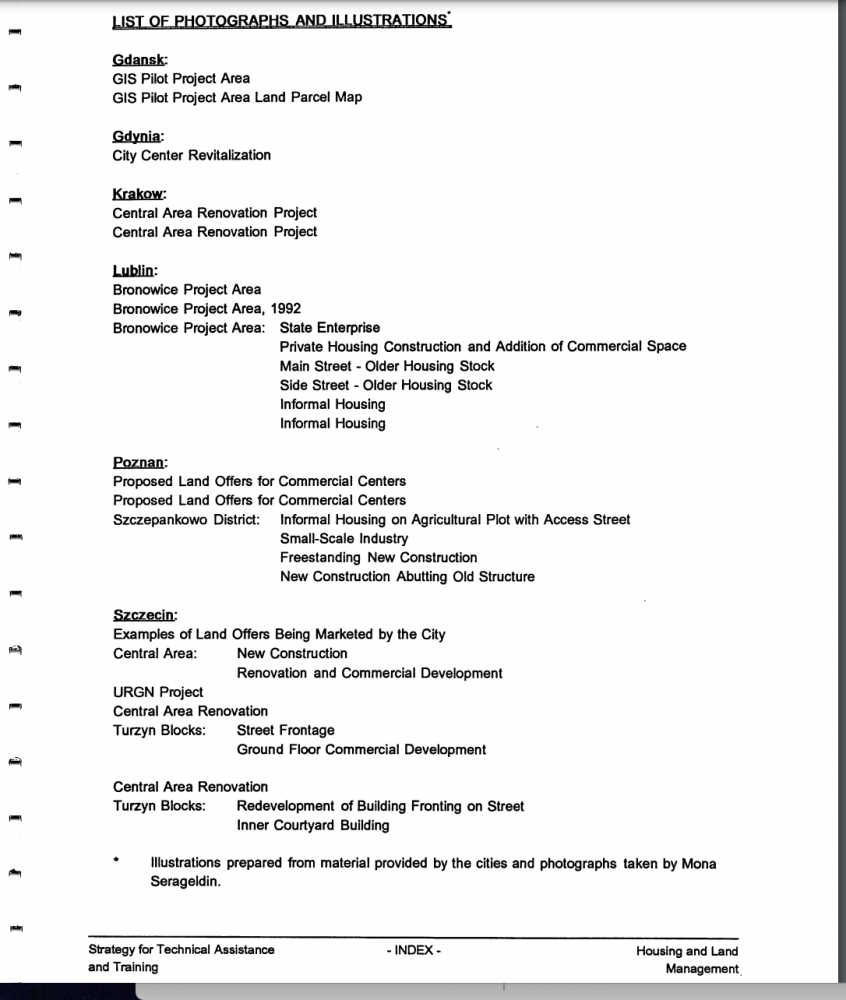
The paper “Strategy for Technical Assistance and Training: Housing and Land Management, Poland” was prepared in 1993 by Mona Serageldin, in her capacity as consultant to the International City Management Association (ICMA). Serageldin’s report was based on interviews and meetings with urban infrastructure officials in 6 Polish cities from 1992 (Gdańsk, Gdynia, Kraków, Lublin, Poznań, and Szczecin). The report covers issues relating to housing and land management, strategic planning, infrastructure finance, real estate development, privatization, and the promotion of private sector participation in urban development in Poland. The analysis concluded with a framework for structuring effective local relations to address major municipal finance concerns.

[Excerpt: Preface, page 6; List of Photographs and Illustrations]

See related I2UD projects below

Project Year:1992
Project Type:Technical Assistance Report
Geographic Regions:Poland (Gdańsk, Gdynia, Kraków, Lublin, Poznań, and Szczecin)
Reports:
Strategy for Technical Assistance and Training: Housing and Land Management, Poland (Mona Serageldin, January 1993)
Authors:Mona Serageldin
Sponsors:USAID Regional Housing and Urban Development Office; International City/County Management Association (ICMA)
Categories:Urban Planning
  
ID:1992_00_001

Related I2UD Projects