
“Urban Resiliency & the Challenge of Coordinating Climate Adaptation Strategies at Different Scales,” Assessment and Presentation, Zofnass Program for Sustainable Infrastructure Workshop on Infrastructure Resilience II, April 2016

Abstract

In 2016, Mona Serageldin and I2UD developed the workshop presentation “Urban Resiliency & the Challenge of Coordinating Climate Adaptation Strategies at Different Scales.” The workshop on Infrastructure Resilience II: Advancing Planning and Design Tools was organized by the Zofnass Program for Sustainable Infrastructure under the Harvard University Graduate School of Design. Documents include the presentation and presentation text.

Learn more about current research on climate resiliency improvement strategies at I2UD’s main site: “AI Climate: A Decision Making Tool for Climate Resilience: Using AI to Identify Climate Change Hazards in the Cities of the Global South.”


[Excerpt: Presentation Text, by Mona Serageldin, for “Urban Resiliency & the Challenge of Coordinating Climate Adaptation Strategies at Different Scales”]

“Urban Resilience is a cornerstone of the UN 2030 Sustainable Development Goals and will be at the center of the discussions at the Habitat III conference. Climate experts and environmentalists are developing tools to assess the regional manifestations of climate change, but reliable prediction tools at the local level are still lacking. Professor Charles Kennel and his colleagues have demonstrated that multiple environmental stress factors interact with local micro-climate and ecological systems to produce different effects at different locations and hence different levels of exposure. They advocate regional assessments as a basis for local action.”

“Settlements in risk areas will differ in location, urban patterns, social characteristics, sources of livelihood and cultural particularities which in combination will shape vulnerabilities to climate change related effects. The focus on informal settlements will highlight the social dimension of exposure to the risks associated with climate change, which are often aggravated by human action. We will present two cases, Arusha, Tanzania and Cartagena, Colombia to illustrate the challenge of resilience building.”

“City and community responses to past weather events provide a good indication of the technical and managerial capacity of local authorities and the ability of vulnerable groups to protect themselves and their assets. Local resilience requires dynamic urban planning and management and an observatory capable of monitoring change in selected environmental indicators and mapping the spatial configuration of affected areas and systems. This task is facilitated by access to aerial photography and GIS. Land issues are critical to the effectiveness of local adaptation strategies, but their impacts tend to be underestimated.”

Project Year:2016
Project Type:Workshop; Presentation
Geographic Regions:Arusha, Tanzania / Cartagena, Colombia
Reports:
Authors:Mona Serageldin; Alejandra Mortarini; Barbara Summers
Sponsors:Zofnass Program for Sustainable Infrastructure, Harvard University Graduate School of Design
Categories:Climate Change and Resilience Building
  
ID:2016_04_001

“Integrated Development Plan in Support of the Socio-Economic Integration of Former Burundian Refugees in Tanzania,” Technical Assistance, 2015

Abstract

This World Bank-funded initiative assessed socio-economic investments, land regularization, and community engagement activities to facilitate the local integration of Burundian refugees in Tanzania. In 2014, the President announced that long-term refugees would be granted Tanzanian citizenship, becoming “New Tanzanians.” Many have lived in different settlements in two regions since 1972. As newly naturalized citizens, they gained rights such as land ownership and political participation, and local authorities needed to integrate these settlements into the governance framework.

The process and product of this assessment are based on the active engagement of the villages, districts, regions, and civil society, with the consultants acting as facilitators. The report: (1) provides a methodology to undertake a participatory and rapid spatial and technical planning assessment to identify priority socioeconomic investments; (2) determines how these priorities should be sequenced and integrated into existing development planning structures and processes.

See related I2UD projects below

Project Year:2015
Project Type:Technical Assistance
Geographic Regions:Tanzania
Reports:Integrated Development Plan in Support of the Socio-Economic Integration of Former Burundian Refugees in Tanzania (November 2015)
Authors:Maureen Moriarty-Lempke; John Driscoll
Sponsors:World Bank
Categories:Urban Finance
  
ID:2015_11_001

Habitat III Regional Report for the Arab Region: Papers on “Inclusive cities,” “Migration and Refugees in Urban Areas,” and “Land Structure, Process, and Outcome,” for UN-Habitat (ROAS) and United Nations (ESCWA), 2015-2016

Abstract

In 2016, the Institute for International Urban Development (I2UD), led by Mona Serageldin and François Vigier, acted as main contributor to a report, “Habitat III Regional Report for the Arab Region,” implemented under the UN-Habitat Regional Office for Arab States (ROAS) and the United Nations Economic and Social Commission for Western Asia (ESCWA).

Topics include “Inclusive cities,” “Migration and Refugees in Urban Areas,” and “Land Structure, Process, and Outcome.” Documents are a range of preliminary draft materials, expert group meeting materials, and full report. Presentations are from Expert Group Meetings in Beirut and Cairo, and for the May 2017 ICNUP Conference. Two draft issue papers from 2015 were presented at the Habitat III conference in Quito, Ecuador in October 2016.

Project Year:2015
Project Type:Regional Report
Geographic Regions:Beirut, Lebanon and Cairo, Egypt (Meeting Locations) / Quito, Ecuador (Conference Location)
Reports:
Authors:Mona Serageldin; FrançoisVigier; Barbara Summers; Maren Larsen; Johann Friedl
Sponsors:UN-Habitat; United Nations Economic and Social Commission for Western Asia (ESCWA); UN-Habitat Regional Office for Arab States (ROAS)
Categories:Climate Change and Resilience Building
  
ID:2015_10_003

Related I2UD Projects

“Arusha City Resilience Index Pilot Program” for the Tanzanian Ministry of Lands, Housing and Human Settlements Development, Arusha, Tanzania, 2015

Abstract

The “Arusha City Resilience Index Pilot Program” established an accessible, evidence-based definition of urban resilience in Arusha, Tanzania, culminating in the publication of the City Resilience Framework in July 2015.

The City Resilience Index (CRI) from 2015 aimed to measure and assess to what extent a city is achieving its resilience goals. The CRI was developed by International Development non-project branch of Ove Arup & Partners International Ltd with support from the Rockefeller Foundation. The Ministry of Lands, Housing and Human Settlements Development in Arusha, Tanzania was one of five municipalities to participate in the CRI pilot program to test the feasibility and utility of the Index in different contexts around the world.

As part of the Program, I2UD staff performed an initial review of the Index to develop a work plan for the pilot program and to contextualize urban planning in Arusha. The team managed a task force of local authorities to collect qualitative and quantitative data related to the four dimensions of resilience: (Health and well-being, Economy and society, Infrastructure and environment, and Leadership and strategy). Finally, I2UD experts analyzed data collection outputs to produce an internal report assessing the indicators and data collection process and provided recommendations for improving the Index. I2UD also interviewed key community stakeholders from a wide range of disciplines, and facilitated a stakeholder workshop to perform a qualitative assessment of urban resilience in Arusha.

Documents include a CRI Introduction, an I2UD Schedule, and a Master Plan Stage II “Socio-Economic Report” and “Preliminary Visioning and Programming Report”. Supporting documents include a Technical Working Group Meeting Agenda.


[Excerpt: CRI Introduction, July 2015]

“Urban populations are facing increasing challenges from numerous natural and manmade pressures such as rapid urbanization, climate change, terrorism and increased risks from natural hazards. Cities must learn to adapt and thrive in the face of these diverse challenges – they must learn how to build resilience in an uncertain world. Armed with this knowledge and understanding, governments, donors, investors, policy makers, and the private sector will be able to develop effective strategies to foster more resilient cities.”

Project Year:2015
Project Type:Workshop
Geographic Regions:Arusha, Tanzania
Reports:
Authors:Andrew Charles (Ove Arup & Partners International Ltd); Alejandra Mortarini; Barbara Summers
Sponsors:Rockefeller Foundation
Categories:Climate Change and Resilience Building
  
ID:2015_08_001

7th Africities Conference, Johannesburg, South Africa, November 29th, 2015: Presentations, Case Studies, Workshop Documents

Abstract

Beginning in July 2015, Mona Serageldin, Daniel Tsai, and Barbara Summers from I2UD prepared presentation materials for the 7th Africities Conference, held on November 29, 2015, in Johannesburg, South Africa.

Conference presentations include an Inception Report, and workshop documents and agendas from July 2015, in French and English. Case studies from July and November 2015 discuss Cairo and Khartoum. A final presentation, “Looking Back, Looking Forward: Johannesburg,” was given by Phillip Harrison (SA Research Chair for Spatial Analysis & City Planning of Johannesburg).


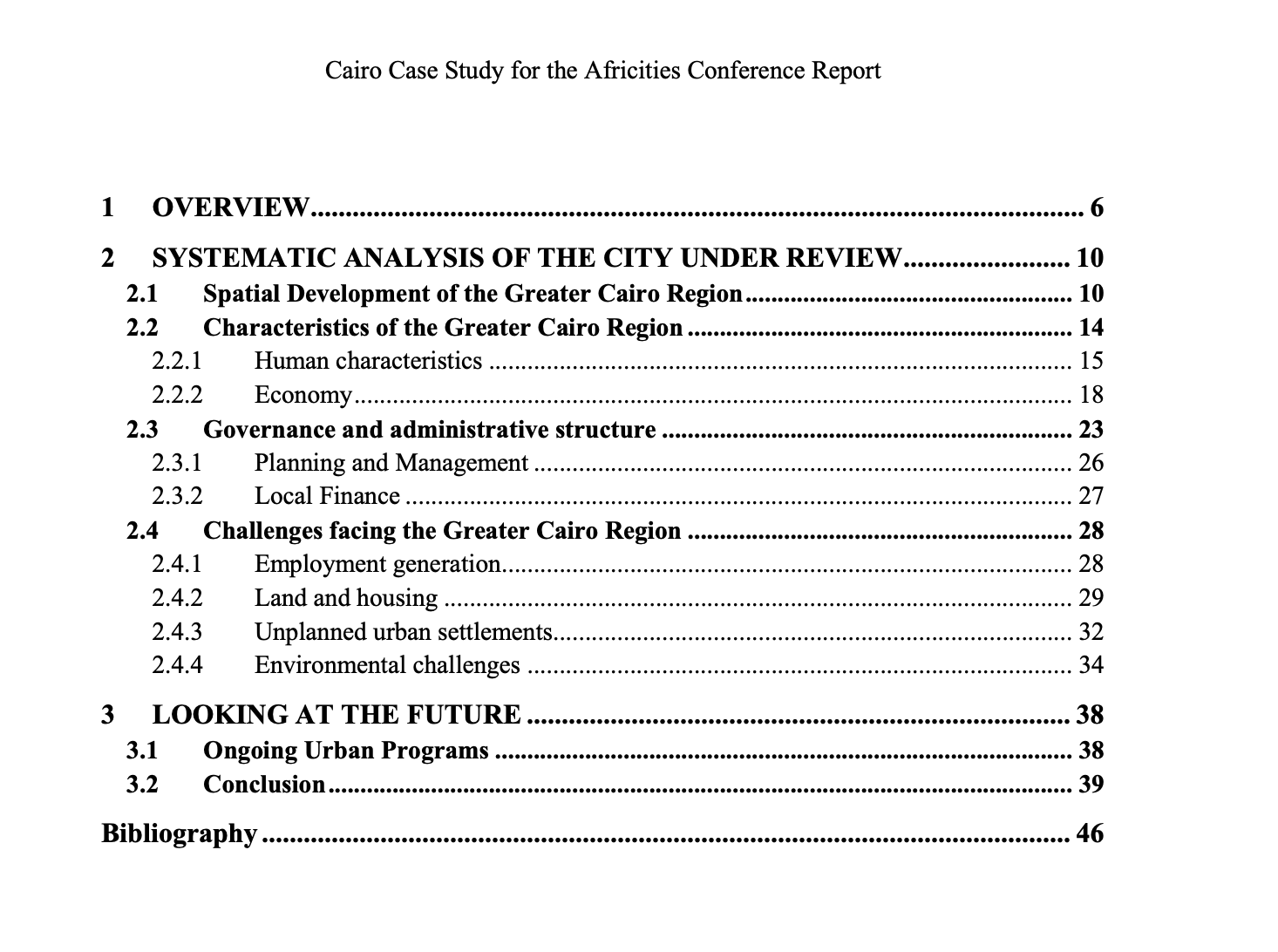
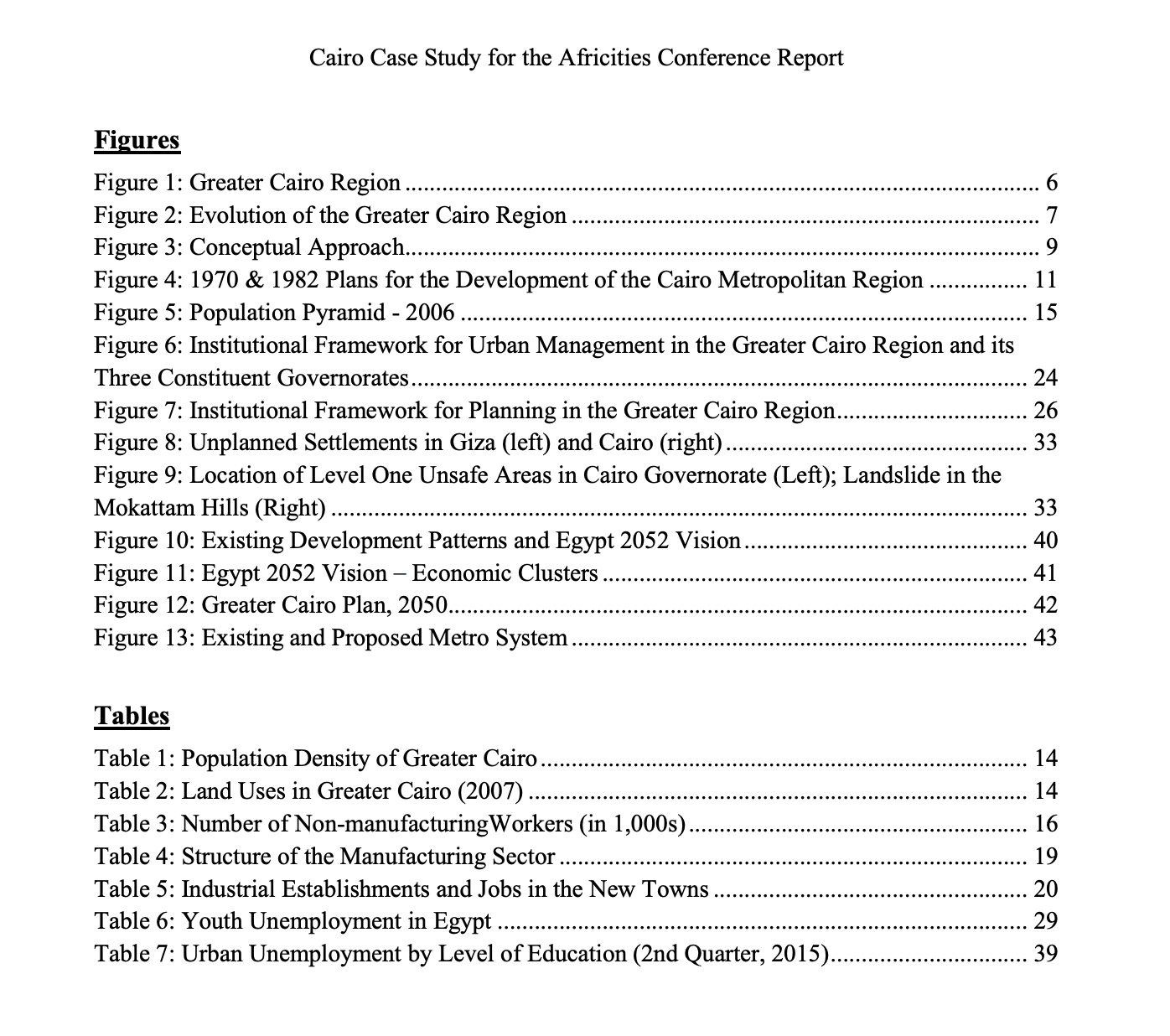
[Excerpt: Index and List of Figures for “Cairo Case Study for the Africities Conference Report,” I2UD, 2015]

Project Year:2015
Project Type:Conference; Workshop
Geographic Regions:Cairo, Egypt / Khartoum, Sudan / Johannesburg, South Africa
Reports:
Presentations:
Authors:Mona Serageldin; François Vigier; Daniel Tsai; Barbara Summers; Tarek Waly; Maren Larsen; Oriol Monfort; Philip Harrison
Sponsors:South African Cities Network (SACN); United Cities and Local Governments of Africa (UCLG-A)
Categories:Urban Planning
  
ID:2015_07_001

Related I2UD Projects

Keynote for City Debates 2015, American University of Beirut: “The Dynamics of Neighborhood Transformation: Long Term Trends and Immediate Responses to Turmoil and Civil Unrest,” Mona Serageldin

Abstract

Mona Serageldin prepared the keynote presentation “The Dynamics of Neighborhood Transformation Long Term Trends and Immediate Responses to Turmoil and Civil Unrest” for the 2015 City Debates program on Other Gentrifications: Urban Change Beyond the Core at the American University of Beirut.

The Keynote speech and presentation by Serageldin examine the impact of spatial segregation and social exclusion on gentrification in the Mashreq countries of Egypt, Syria, Lebanon, Iraq, Palestine, and Jordan. Documents include presentation slides and transcript.


[Excerpt: Key Note text, Dr. Mona Serageldin, Page 1]

“Gentrification, within or outside the urban core, conjures images of forced displacement, eviction and marginalization of poorer segments of society. However, when discussing gentrification it is important to distinguish between spatial segregation and social exclusion and between diversity and social mixity. Each of these concepts involves a different perspective on urban space. Furthermore, except in cases of clearance and redevelopment, changes in the structure and morphology of urban areas, entail longer term processes which start slowly, accelerate and reach a tipping point. Taking into consideration the time frame often alters perspectives and viewpoints.”

“Social and economic change at the neighborhood level is an inherent component of urban growth. Over time, the regional context has shaped the drivers of transformation processes. Historically, ruling elites eager to display their power, wealth, and status built exclusive precincts outside the urbanized area inhabited by the commoners, a diverse population with a wide range of economic means and social standing including different ethnicities and religions. Later, the desire of colonial expatriate communities to replicate their own living environment introduced a trend towards exclusive suburban extensions. The regulatory controls included in the charters and by laws of the companies which developed these suburbs and the boards running the select amenities tended to collapse from the mid-1960s on as the colonial era came to an end and massive capital infusion in urban real estate altered the dynamics of growth.”

“In labor sending countries, remittance-driven urbanization, formal and informal, sustained by high rates of household formation and pervasive housing shortages, sent land values skyrocketing beyond the affordability of many among the middle classes. It accelerated the proliferation and subsequent densification of informal settlements and sharpened class differentiation within them.”

See related I2UD projects below

Project Year:2015
Project Type:Presentation
Geographic Regions:Beirut, Lebanon (Program Location) / Egypt / Syria / Lebanon / Iraq / Palestine / Jordan
Reports:
Authors:Mona Serageldin; Barbara Summers
Sponsors:American University of Beirut
Categories:Informal Settlements and Urban Upgrading
  
ID:2015_03_001

Related I2UD Projects

“World Migration Report,” Background Papers on Displacement, Migration and Resettlement in MENA (Middle East and North Africa), International Organization for Migration, 2014

Abstract

In 2014, an I2UD research team produced a set of background research materials for the International Organization for Migration’s 2015 “World Migration Report,” addressing issues of displacement, migration and resettlement in the Middle East and North African (MENA) geographic region. In the Background Paper, the MENA region is further delineated as the Mashreq, Maghreb, Gulf Cooperation Council, and Southern Tier regions.

I2UD staff prepared of a series of case studies and facilitation of training course for Iraqi officials, discussing durable shelter solutions for internal displaced persons (IDPs) and returnees in Iraq, Syria, Spain, Italy, Sudan, and Yemen. The project aimed to: support local authority’s capacity to deal with migration patterns, review shelter needs for refugees, address reforms and challenges for accommodating migrants, and offer support for returnees.

Documents include a MENA Background Paper and a corresponding outline and work plan from 2014. Supporting materials include a display of “Project Statistics and Refugee Camps” in the region, a “Provincial Action Plan” for Van, Turkey, and an outline of “Durable Housing Solutions and Livelihoods for Georgian IDPs.”

Project Year:2014
Project Type:Research Paper
Geographic Regions:Middle East and North Africa / Van, Turkey / Georgia / France / Spain / Italy / Germany / United Kingdom
Reports:
Authors:Mona Serageldin; François Vigier; Maren Larsen; Barbara Summers; Sheelah Gobar
Sponsors:International Organization for Migration (IOM)
Categories:Reconciliation and Development
  
ID:2014_09_001

Related I2UD Projects

“National Urban Policies in Arab States,” Regional Assessment and Case Studies on NUPs in Egypt, Jordan, Morocco, Saudi Arabia, and Sudan, 2014

Abstract

I2UD produced a regional assessment report of National Urban Policies (NUPs) in Arab States in 2014, to describe and analyze contextual factors and the evolution of policies in major Arab states. The assessment included five in-depth case studies of NUPs in Egypt, Jordan, Morocco, Saudi Arabia, and Sudan, which reflect the geographical diversity in the area, as well as current policy objectives, opportunities and challenges in implementation for the region.

In a related report from April 2016, Mona Serageldin and François Vigier addressed a broader scope of NUPs, including European and global factors, in a paper titled “National Urban Policies and the Role of Sub-National Governments.”

Case study analysis focused on cross-cutting themes of compact and connected cities, inclusive cities, and climate-resilient cities. The final outputs included these case studies, a regional synthesis report, and a table of country profiles in relation to national urban policies.

Documents include an initial expression of interest, inception report, case studies for each country, final assessments, an executive summary, annexes and methodological notes, and an additional memo on informal settlements in Egypt.

See related I2UD projects below

Project Year:2014
Project Type:Regional Report
Geographic Regions:Egypt / Jordan / Morocco / Saudi Arabia / Sudan
Reports:

Case Studies:
Authors:Mona Serageldin; François Vigier; Maren Larsen; Lucie Charles
Sponsors:United Nations Centre for Human Settlements (UN-Habitat)
Categories:Urban Planning
  
ID:2014_08_001

Related I2UD Projects

“Economy of Historic Preservation” in Erbil, Kurdistan, Report for Strengthening Urban & Regional Planning (SURP), UN-Habitat, 2014

Abstract

Mona Serageldin directed a report series titled “Economy of Historic Preservation” in 2014, in collaboration with the Ministry of Municipalities and Tourism (MOMT) and the Iraqi-Kurdistan Erbil Governorate. The project fulfilled a UN-Habitat program “Strengthening Urban and Regional Planning” (SURP), with support from François Vigier and Barbara Summers.

The report examines the interrelationship of cultural heritage preservation and urban development, in light of globalization, urbanization shifts, and technological innovation. The analysis aligned with the SURP program goals, which support the capacity of officials in Erbil, the capital city of the Kurdistan Region of Iraq, to stimulate financing for local infrastructure, and promote land value capture and community participatory processes.

Documents include the main report in two sections, an outline, slides for the full presentation, and supporting presentations with photographs. Case studies cover cultural heritage sites in the Medina of Tunis, Tunisia; Icheri Sheher in Baku, Azerbaijan; and in Quito, Ecuador.

See also: “National Urban Strategy for Governorates in Iraq,” Development Strategy for Phase II of the United Nations Development Programme (UNDP) and Iraq Ministry of Planning Local Area Development Programme (LADP II), 2014-2018 (Project ID: 2014_11_001)

See related I2UD projects below

Project Year:2014
Project Type:Capacity Building Project
Geographic Regions:Erbil, Southern Kurdistan, Iraq (also Medina of Tunis, Tunisia; Icherisheher, Baku, Azerbaijan; and Quito, Ecuador)
Reports:

Authors:Mona Serageldin; François Vigier; Barbara Summers; David C. Jones
Sponsors:United Nations Centre for Human Settlements (UN-Habitat)
Categories:Historic Districts
  
ID:2014_06_002

Related I2UD Projects

“Inclusive Cities and Access to Land, Housing, and Services in Developing Countries,” Urban Development Series: Knowledge Papers, World Bank’s Social, Urban, Rural & Resilience Global Practice, 2016

Abstract

I2UD produced a research paper titled “Inclusive Cities and Access to Land: Housing and Services in Developing Countries.” The World Bank-supported project addressed how global disparities in income, wealth, and opportunity, experienced worldwide, have contributed to social exclusion and spatial segregation in cities in the Middle East, North Africa, Latin America, Central America, and Western Asia.

The final report—authored by Mona Serageldin and I2UD staff, and published in 2016 by the World Bank—documented examples of successful inclusionary policies, programs, and initiatives by public agencies and NGOs with a special focus on cities in Latin America and the Middle East. The report discussed the difficulty in organizing integrative projects. It underscored the shortcomings arising from acting on one dimension of inclusion while ignoring others.

Documents include a workshop presentation from January 2014, with a final draft from April 2014, along with the final report from February 2016.


[Excerpt: Index for the Final Report: “Inclusive Cities and Access to Land, Housing, and Services in Developing Countries.”]

The Growing Importance of Inclusion in Urban Areas
1.1 Defining Inclusion
1.2 Measuring the Dimensions of Exclusion: São Paulo’s Exclusion/Inclusion Indicator Mapping

2. Trends Affecting Social Inclusion in Urban Areas
2.1 Demographics
2.2 Mobility and Migration

3. Infrastructure and Public Services: A Powerful Tool to Promote Social Inclusion
3.1 Rethinking the Approach to Slum Upgrading and Regularization of Informal Settlements
3.2 South Africa’s Municipal Infrastructure Grant Program (MIG)
3.3 Access to Public Services: Social Missions in the the República Bolivariana de Venezuela

4. Restoring the Social Function of Public Space
4.1 Rio de Janeiro’s Favela Bairro Program

5. Access to Land: A Critical Factor at the Core of Inclusion and Exclusion
5.1 Regularizing Tenure in Informal Settlements: Impacts on Social Inclusion
5.2 Impacts of Property Registration on the Inclusion of Informal Settlers
5.3 Integrated Projects to improve the Living Environment: The Role of State Agencies 16
5.4 Egypt’s Informal Settlements Development Facility (ISDF)

6. The Erosion of Inclusive Options for Affordable Housing
6.1 Affordable Housing and Spatial Segregation in Chile
6.2 Looking to Rental Markets as Instruments of Inclusion

7. Generating Revenues to Finance Urban Improvements: Land-Based Financing
7.1 Cuenca’s Improve Your Neighborhood Program

8. The Right to the City
8.1 Implementing the Right to the City in Brazil
8.2 National Legislation and Local Implementation: Colombia’s Policies of Decentralizing the Improvement of Lower Income Settlements
8.3 An Emerging Urban Agenda in the Middle East
8.4 Recife, Brazil (ZEIS)

9. NGOs and CBOs as Strategic Partners in Driving the Implementation of Inclusionary Programs
9.1 Grassroots Initiatives: A Rights-Based Approach
9.2 SEWA
9.3 CODI, Thailand

Concluding Remarks
References
Appendix 1: Indicators of Urban Exclusion and Inclusion in São Paulo, Brazil
Appendix 2: Property Tax and Registration in Middle Eastern Countries
Appendix 3: Statistical Appendix
Appendix 4: Resources

See related I2UD projects below

Project Year:2014-2016
Project Type:Research Paper
Geographic Regions:Latin America and Middle East / Venezuela / Recife and São Paulo, Brazil / Chile / Colombia / Mexico / Syria / Egypt / Morocco / Tunisia / South Africa / Thailand
Reports:

Authors:Mona Serageldin; Sheelah Gobar; Warren Hagist; Maren Larsen
Sponsors:World Bank
Categories:Informal Settlements and Urban Upgrading
  
ID:2014_04_001

Related I2UD Projects

“Basic Services for an Urbanizing World,” Third Global Report on Local Democracy and Decentralization (GOLD III, UCLG). Chapter on “Middle East and West Asia” by Mona Serageldin, I2UD, 2013

Abstract

In 2013, I2UD prepared a chapter on the Middle East and West Asia (MEWA) region, for the Third Global Report on Democracy and Decentralization (Gold III): “Basic Services for an Urbanizing World.”

I2UD’s Chapter on “Middle East and West Asia,” (p. 59-64) (see below) addressed four components:

  1. Assessing the role of local and regional authorities in the provision of basic local public services;
  2. Determining obstacles to local authority and services;
  3. Exploring best practices underway or in development in the region; and
  4. Proposing recommendations to improve service delivery through the greater involvement of local and regional authorities.

Documents include a complete Gold III Report “Executive Summary,” with the I2UD Chapter on “Middle East and West Asia.” Presentations relate to case studies presented by I2UD on Barcelona and Marseille. The I2UD research team was led by Mona Serageldin, with Sheelah Gobar, Warren Hagist, Carolina Morgan, and François Vigier, also from I2UD, and Ozdemir Somnez from the Istanbul Metropolitan Planning and Urban Design Centre of Turkey.

See related I2UD projects below

Project Year:2013
Project Type:Research Presentations
Geographic Regions:Middle East / Western Asia
Reports:

Supporting Documents and Presentations:
Authors:Mona Serageldin; François Vigier; Sheelah Gobar; Warren Hagist; Carolina Morgan; Ozdemir Somnez
Sponsors:United Cities and Local Governments (UCLG)
Categories:Urban Planning
  
ID:2013_02_001

Related I2UD Projects

World Bank MNA Urban Action Plan – Policy and Strategy Papers: “The Evolving Regional Urban Agenda: Key Challenges and Opportunities” and “From Spring to Renaissance: Repositioning the Arab Cities,” 2013

Abstract

In 2013, I2UD researchers co-wrote material for the 2013 “World Bank MNA Urban Action Plan,” an urban development policy and strategy plan for the Middle East and North Africa (MNA/MENA) region.

I2UD gave a preliminary presentation in October 2012 at a special meeting of the urban sector team at the World Bank. Team members presented priority issues at the in-person session, and from the field via video conferencing. Inputs and comments were solicited from all MNA colleagues, to enrich urban challenge assessments, and proposals presented in the Urban Action Plan.

Documents include an Executive Summary by Mona Serageldin, a March 2013 presentation titled “The Evolving Regional Urban Agenda: Key Challenges and Opportunities,” and a January 2013 working paper, “From Spring to Renaissance: Repositioning the Arab Cities.” Supporting materials include a statistical annex, country spatial profiles, and a slideshow compendium. The draft paper and PowerPoint slides were forwarded to the whole MNA urban group, for review and commentary.


[Excerpt: October 1st, 2012 MNA Urban Action Plan, Executive Summary by Mona Serageldin.]

“This inception report expands on the four themes presented in the Key Pillars of the MNA urban strategy and identifies the development priorities that must be addressed to implement MNA’s Action Plan. The objective is to raise issues for discussion and solicit inputs and comments from MNA colleagues in order to expand on the assessment of key urban challenges and enrich the proposals to be presented in the action plan. The region is 62% urbanized and has one of the World’s most rapidly expanding populations. By 2030, the region will have experienced a 45% increase of its urban population with over 106 million additional urban inhabitants. Some countries will see their urban populations double between 2030 and 2050: Egypt, Djibouti, Kuwait, Iraq, OPT, Syria and Yemen.”

“A long history of settlement, along the great rivers, smaller watercourses and the main oases, has led to imbalances in the geographical distribution of urban development, income and wealth. These patterns have been reinforced by the focus of colonial governments on the export of commodities and port cities and, in the post-colonial period, by the migration of rural populations caused by the increasing severity of droughts. The development of oil, gas and petrochemical industries has favored the industrial dominance of coastal cities.”

“The region’s urban dynamics and relatively weak institutions, particularly at the local level, have resulted in unplanned and often chaotic urban growth. Few national spatial development strategies have been elaborated and most regional development plans suffer from a lack of coherence among sectoral investments. The sub-national plans that have been prepared are project-driven with a bias towards primary urban centers and locations where real estate development is lucrative. There is an urgent need for the elaboration of national urban development frameworks and the preparation of integrated regional development strategies to guide and structure growth along development corridors and nodes in order to open up opportunities in the hinterland. Coordinated investments in transport and water supply are critical to start alleviating regional disparities.”

See related I2UD projects below

Project Year:2013
Project Type:Policy Papers; Presentations; Urban Action Plan
Geographic Regions:Middle East / North Africa
Reports:
Supporting Materials:
Authors:Mona Serageldin; Sheelah Gobar; Warren Hagist; Carolina Morgan
Sponsors:World Bank
Categories:Reconciliation and Development
  
ID:2013_01_001

Related I2UD Projects

“The Unplanned Areas Upgrading and Employment Enhancing Programme in Egypt,” Needs Assessment and Activity Design Study for Informal Settlements in the Cairo and Giza Governorates, Egypt, 2011-2016

Abstract

Between 2011 and 2016, I2UD worked with the Egyptian Government, the Agence Française de Développement (AFD), and Social Fund for Development (SFD) to create a risk assessment study for four informal settlement areas in Egypt: ‘Izbit Khayrallah and Al Zawya al-Hamra in the Cairo Governorate and Mīt ‘Uqba and Ard el-Lewa in the Giza Governorate.

In October 2012, I2UD submitted an Expression of Interest for consultancy on a project in Egypt, titled “Redevelopment and Upgrading of Selected Unsafe and Unplanned Areas in Cairo and Giza Governorates.” I2UD posited that Egyptian authorities could evaluate current informal settlements as key components in the Greater Cairo Plan to forestall future development of unregulated settlements.

From 2015-2016, I2UD partnered with the Tarek Waly Center (TWC) and Environmental Quality International (EQI) on the “Needs Assessment and Activity Design Study.” The study reviewed policies and institutions that impact the delivery of services in four informal settlements. I2UD and TWC identified the types of micro-finance services, emphasized community participation via assessment, and conducted outreach training for community members.

Documents include a 2012 Expression of Interest, I2UD’s Deliverables No. 1 through No. 4 in multiple volumes, and a January 2016 presentation for the Cairo Governor, titled “Investment Programme for Izbit Khayrallah and Al Zawya Al-Hamraa, Cairo: The Unplanned Areas Upgrading and Employment Generation Programme in Egypt.”

Project Year:2012-2016
Project Type:Risk Assessment and Local Development Strategy
Geographic Regions:Cairo, Egypt / Giza, Egypt
Reports:


Full Document List:
Deliverable 1:
Deliverable 2:
Deliverable 3, Volumes 1-5:
Deliverable 4:
Authors:Tareq Abdalla; Wafik Arif; Mohamad Ashraf Al-Sayed Afifi; Abd el-Aziz el-Sayed Abd el-Aziz Mosa; Emad El-Din Nabil Al Bayoumi; John Driscoll; Emad Farid; Tarek Hamed; Maren Larsen; Enas El Mudaris; Mounir Neamatalla; Bruce Purdy; Shimaa Shaheen; Elda Solloso; Barbara Summers; Tarek Waly; Tariq Zulficar
Sponsors:French Development Agency (AFD); Social Fund for Development (SFD); European Union
Categories:Urban Finance
  
ID:2012_10_004

Related I2UD Projects

“Arusha Urbanization Strategy and Urban Development Plan,” Development Strategy for Arusha Municipality, Tanzania, 2009-2012

Abstract

The “Arusha Urbanization Strategy and Urban Development Plan” was a comprehensive development strategy completed by I2UD for the East African Community of Arusha, Tanzania in 2012.

I2UD compiled the plan between 2009 and 2012, funded by the Aga Khan University, which has an extensive East African campus. As the designated capital of East Africa, Arusha attracts investments and donor support for development projects, is a prime tourist destination, wildlife region and key node in the African Rift Valley with a wealth of natural and cultural heritage.

Documents include a Planning Proposal draft, a 2009 Inception Report, Second Interim, Summary, and Field reports from 2010, followed by Fourth, Fifth, Sixth, Seventh and Eighth Interim Reports. Finally, a Final Report, Brief, and Community Case Studies from 2012 complete the materials on this project.

Project Year:2009-2012
Project Type:Comprehensive Plan
Geographic Regions:Arusha, Tanzania
Reports:


Authors:Mona Serageldin; Warren Hagist; Caroline Jordi; Richard Kruger; Christa Lee-Chuvala; Kendra Leith; Biorn Maybury-Lewis; Carolina Morgan; Alejandra Mortarini; Natalie Pohlman; Linda Shi; Daniel Tsai
Sponsors:Aga Khan University
Categories:Urban Planning
  
ID:2012_01_001

Related I2UD Projects

“Technical Assistance to Lesedi Local Municipality,” Design Framework for South Africa’s Neighborhood Development Partnership Grant (NDPG), Gauteng Province, South Africa, 2011

Abstract

In 2011, South Africa’s Lesedi Local Municipality contracted I2UD and engineering firm Worley Parsons RSA to provide technical assistance to the municipality, sponsored by South Africa’s Neighborhood Development Partnership Grant (NDPG).

The technical assistance proposal also developed strategic, sustainable plans and an urban design framework for four economically distressed townships within Lesedi Municipality. I2UD formulated development and urban design strategies to revitalize, upgrade, and take advantage of the strategic locations of communities in South Africa’s Gauteng Province.

Documents include an overview presentation, inception report, field report, and stakeholder meeting notes, and a Turn-Around template for Pre-2011 Priority Areas.

See related I2UD projects below

Project Year:2011
Project Type:Comprehensive Plan
Geographic Regions:Lesedi Local Municipality, Gauteng, South Africa (Ratanda, Impumelelo, Kwazenzele, and Jameson Park)
Reports:
Authors:Mona Serageldin; Carolina Morgan; Alejandra Mortarini
Sponsors:Neighbourhood Development Partnership Programme (Republic of South Africa)
Categories:Climate Change and Resilience Building
ID:2011_08_001

Related I2UD Projects

State of Arab Cities, UN-Habitat Report & Conference, “Challenges of Urban Transition: Municipal Management and Urban Development Conference for Sustainability in Arab States,” 2012

Abstract

In 2012, UN-Habitat launched the first State of Arab Cities report and conference to address urbanization trends and challenges in the four major Arab and Middle Eastern regions: Mashreq, Maghreb, Gulf Cooperation Council, and the Southern Tier Countries (defined below). With Mona Serageldin as team leader, I2UD contributed a significant body of research for the conference, “Challenges of Urban Transition: Municipal Management and Urban Development Conference for Sustainability in Arab States.” The conference was hosted by the UN-Habitat Regional Office for Arab States (ROAS) and the Kuwait Knowledge Development Regional Centre.

The I2UD team compiled urban housing and demographic data for nations in Maghreb and Mashreq. The I2UD team reviewed 180 documents for each region, covering topics such as the following:

  • “Population and Urbanization;”
  • “Growing Role of Economic Cities;”
  • “Urban Development and Housing Conditions;”
  • “Transportation and Mobility;”
  • “Urban Environmental Challenges;”
  • “Urban Governance Systems;”
  • “Transnational Migration;” and
  • “Emerging Urban Issues and Innovations.”

Documents include I2UD’s inception report, progress report, a I2UD board meeting presentation on the project, and a conference presentation (from the “Municipal Management and Urban Development Conference for Sustainability in Arab States,” from Kuwait, May 2012). The final report for the 2012 UN-Habitat State of Arab Cities lays out urban development and migration issues in the Middle East and North Africa, including I2UD’s contributions. Additional materials include data on regional food and water security, energy security, and air pollution.

Maghreb includes Algeria, Libya, Morocco and Tunisia; Mashreq includes Egypt, Jordan, Lebanon, Palestine, Syria; the Gulf Cooperation Council includes Bahrain, Kuwait, Oman, Qatar, Saudi Arabia, and the United Arab Emirates; the Southern Tier includes Comoros, Djibouti, Mauritania, Somalia, Sudan, and Yemen.

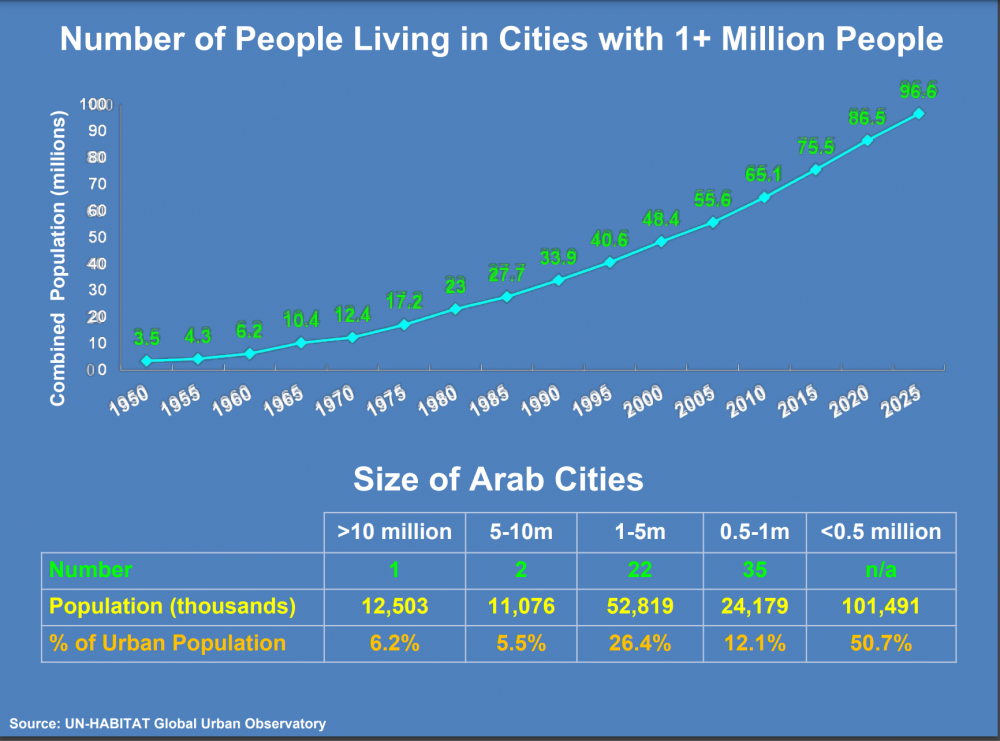
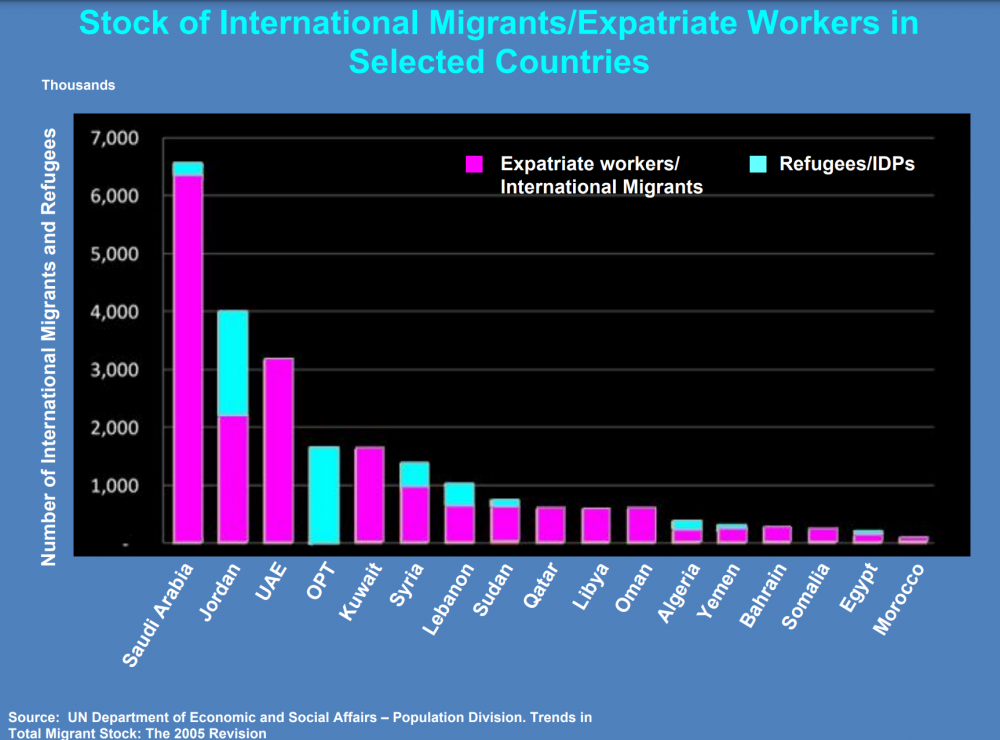
Excerpts, Final Report, “State of Arab Cities,” December 2012
Project Year:2010-2012
Project Type:Regional Report
Geographic Regions:Middle East / North Africa
Reports:
Authors:François Vigier; Mona Serageldin; María-Luisa Fernández; Kendra Leith; Linda Shi
Sponsors:UN-Habitat Regional Office for Arab States (ROAS)
Categories:Urban Planning
  
ID:2010_07_001

Related I2UD Projects

“Technical Assistance to Ezakheni, Ladysmith/Emnambithi Local Municipality,” Urban Development Strategy, South African Government Neighborhood Development Partnership Grant, 2010

Abstract

In 2010, I2UD developed a regeneration plan for Ezakheni, an economically distressed township in LadysmithEmnambithi Local Municipality located southeast of Johannesburg, South Africa. The Institute partnered with KV3 Engineers, with funding from the South African Government’s Neighborhood Development Partnership Grant (NDPG). I2UD’s urban development framework focused on renewal, connectivity, and socio-economic integration in the region. Note: In 2016, the Emnambithi Local Municipality and Indaka Local Municipality were regrouped into the new Alfred Duma Local Municipality.

The development strategies presented by I2UD included:

  • Developing an East-West corridor and a North-South spine;
  • Creating a hierarchy of road networks;
  • Improving the two main entrances;
  • Developing unused space in the urbanized areas for parks, housing, commercial and institutional uses;
  • Identifying existing and future nodes where new infrastructure will attract and support private investment; and
  • Providing appropriate setting for the generation of local job opportunities.

See related I2UD projects below

Project Year:2010
Project Type:Technical Assistance
Geographic Regions:Ezakheni, Ladysmith/Emnambithi Municipality (now Alfred Duma Local Municipality), KwaZulu-Natal, South Africa
Reports:
Authors:KV3 Engineers; Mona Serageldin; Alejandra Mortarini; Natalie Pohlman; Kendra Leith
Sponsors:Neighbourhood Development Partnership Programme (Republic of South Africa)
Categories:Urban Planning
  
ID:2010_02_001

Related I2UD Projects

“Township Development Strategy for Emfuleni Municipality,” Technical Assistance to Sedibeng, Gauteng, South Africa, 2009

Abstract

In 2009, I2UD prepared a township development strategy for the Emfuleni Local Municipality in Sedibeng, South Africa, in partnership with Kwezi V3 Engineers, sponsored by South Africa’s Neighborhood Development Partnership Grant (NDPG).

The development strategy focused on reconnecting the four townships, originally isolated by apartheid spatial planning. The proposed plan linked them to the primary economic centers of Vanderbijlpark and Vereeniging. The strategy emphasized three local development corridors linking townships to larger regional routes, and identified five key economic nodes for concentrated investment. It also delineated a tourism route featuring points of interest and historic sites within the four townships.

See related I2UD projects below

Project Year:2009
Project Type:Local Development Strategy
Geographic Regions:Emfuleni Local Municipality, Gauteng, South Africa
Reports:Township Development Strategy for Emfuleni Local Municipality, South Africa: (August 2009)
Authors:Alejandra Mortarini; Mona Serageldin; Kwezi V3 Engineers
Sponsors:Neighbourhood Development Partnership Programme (Republic of South Africa)
Categories:Urban Planning
  
ID:2009_03_001

Related I2UD Projects

“Climate Change in the Local Development Agenda: Promoting Resilience Through Enhanced Understanding of Early Threats,” I2UD Report on Alexandria, Egypt and Cotonou, Benin for the 5th World Bank Urban Research Symposium, June 2009

Abstract

In 2009, I2UD wrote a report for the Fifth World Bank Urban Research Symposium analyzing the threats posed by climate change—flooding, extreme weather events, pollution, and coastal erosion—using example studies from Alexandria, Egypt and Cotonou, Benin.

I2UD’s team, led by Mona Serageldin, addressed how climate change strategies must simultaneously address immediate threats, long-term economic health, and important political issues. The report highlighted how resilience strategies were essential in order to build urban preparedness, especially for municipalities with limited resources to protect their economies, housing infrastructure, and service delivery provision. I2UD defined a need for direct urban expansion away from vulnerable areas, and offered to craft development strategies with action plans to address the local challenges of climate change.


[Excerpt: Introduction, p. 1]

“This paper discusses the responses of city authorities to the current and future threats posed by climate change in Alexandria, Egypt and Cotonou, Benin, two port cities facing increasing shoreline erosion, saltwater intrusion and flooding of low-lying areas. Each city has taken some actions to address these challenges but neither has yet developed an overall strategy to build resilience to climate change.”

[Excerpt: Summary]

“Experts have named Alexandria, Egypt and Cotonou, Benin as two cities facing high risks due to the impacts of climate change. City authorities are taking actions to build resilience to the most pressing threats, but they must also employ their limited resources to address economic development, employment generation and service provision. Strategies to address climate change must therefore be linked to immediate threats and politically and economically important issues. In both cities, land management policies and plans must focus on directing further urban expansion away from the most vulnerable, low-lying areas. Moreover, regional development strategies and action plans are needed to address impacts that spill over jurisdictional boundaries and promote coordination.

Key Words: Climate change, resilience, Alexandria, Cotonou, land management.


[Excerpt: Conclusion, p. 15]

“The dynamics of urban growth and land markets make appropriate responses difficult and expensive. As Alexandria and Cotonou grow, vulnerable populations continue to settle in risk-prone areas and future resettlement is even more difficult to contemplate due to the lack of suitable and affordable land, lagging infrastructure and inadequate public transportation. Decision-makers need to adopt land management strategies that will guide growth away from the most flood-prone and hazardous areas. This will require partnership with private developers and NGOs to increase the supply of affordable land for urban expansion and in the case of Cotonou organizing links between formal and informal service providers to extend services to newly urbanized areas yet to be reached by infrastructure networks. It will also require sustained action to control pervasive corruption in the administration of permits issued by subdistrict offices and in the inspectional services that allow violations to continue unabated.”

Project Year:2009
Project Type:Research Paper
Geographic Regions:Alexandria, Egypt / Cotonou, Benin
Reports:Fifth Urban Research Symposium 2009: “Climate Change in the Local Development Agenda: Promoting Resilience Through Enhanced Understanding of Early Threats” (Final Report)
Authors:Mona Serageldin; Erick Guerra; Christa Lee-Chuvala
Sponsors:World Bank
Categories:Climate Change and Resilience Building
  
ID:2009_00_002

“State of African Cities,” Research for Regional Chapter on North African Cities for UN-Habitat Reports, 2008 and 2010

Abstract

In 2008, a team from I2UD prepared research for regional chapters on Northern Africa for the first UN-Habitat “State of African Cities” report. Topics covered demographics and urban growth, cities as engines of economic growth, urban poverty and housing conditions, environmental challenges in urban areas, and urban governance. Countries addressed in the North Africa regional chapter included Algeria, Egypt, Libya, Mauritania, Morocco, Tunisia, and Sudan.

Documents include I2UD’s North Africa regional report for the 2008 State of African Cities report, as well as two full State of African Cities documents from 2008 and 2010.

Project Year:2008-2010
Project Type:Research Paper
Geographic Regions:North Africa
Reports:

Authors:Mona Serageldin; François Vigier; Christa Lee-Chuvala; Erick Guerra
Sponsors:United Nations Centre for Human Settlements (UN-Habitat)
Categories:Urban Planning
  
ID:2008_03_001

Related I2UD Projects

Executive Education Program 2007: “Strategic Planning for Sustainable Human Settlements,” Pretoria, South Africa

Abstract

In 2007, the Institute for International Urban Development (I2UD) organized a 4-day Executive Training Program workshop, “Strategic Planning for Sustainable Human Settlements,” held in Pretoria, South Africa.

Topics included:

  1. Globalization and local development;
  2. Meeting the challenge of development in Africa;
  3. Promoting sustainability in human settlements;
  4. Building sustainability in housing projects;
  5. Local revenue generation;
  6. Financing local capital improvements;
  7. Partnerships for local development; and
  8. Indicators of local development.

Documents feature a workshop schedule, followed by detailed case studies on development projects around the globe.

See related I2UD projects below

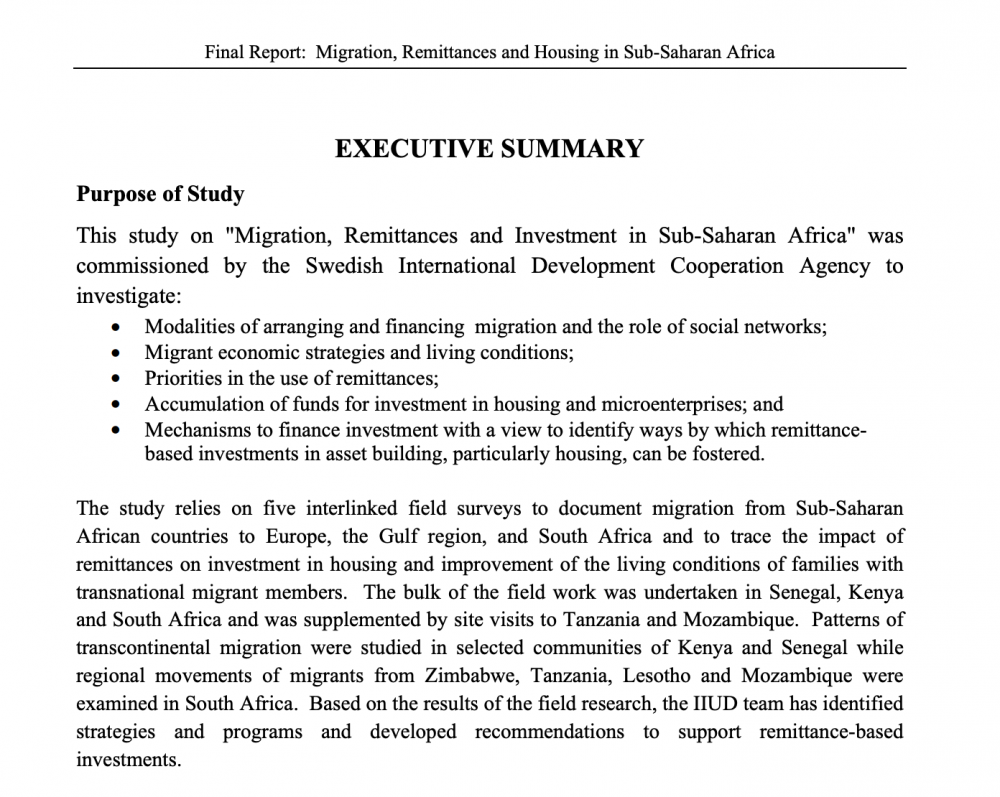
“Migration, Remittances and Housing in Sub-Saharan Africa,” Study on Senegal, Kenya, and South Africa, with the Swedish International Development Cooperation Agency (Sida), 2007-2008

Abstract

In 2007 and 2008, I2UD conducted a study on “Migration, Remittances and Housing in Sub-Saharan Africa” as part of a successful partnership with the Swedish International Development Cooperation Agency (Sida). The report defines recommendations for target funding for migrant populations in Senegal, Kenya, Tanzania, Mozambique, and South Africa.

The study sought to foster the ability of migrants to improve their incomes and their living environments through access to housing, infrastructure, and financial services. Documents include an interim report from 2007 and final report from 2008.

[Excerpt: Executive Summary p. 1. Final Report: Migration, Remittances and Housing in Sub-Saharan Africa, “Purpose of Study,”August 2008, Page 1]

See related I2UD projects below

Project Year:2007-2008
Project Type:Research Paper
Geographic Regions:Sub-Saharan Africa (Kenya; Senegal; Tanzania; Mozambique; South Africa)
Reports:
Authors:Erick Guerra; Mona Serageldin; Ian Chodikoff (Architect and Urban Planner, Toronto, Canada); Prof. Ababacar Dieng (University of Dakar, Senegal); Richard Kruger (Management Consultant, Pretoria South Africa); Prof. Winnie Mituallah (University of Nairobi, Kenya); Chelina Odbert (Urban Planner, Boston); Johann Watermeyer (Principal, Dynex Consulting, Pretoria, South Africa)

Research Assistants:
Oumar Ngalla Ndiour (Senegal); Mamadou Yaya Sabaly (Senegal); Gonde Fall (Senegal); Florence Mitullah (Kenya); Peter Oty (Kenya); Serame Phakedi (South Africa); George Lubidla (South Africa); Elizabeth Mpako (South Africa)
Sponsors:Swedish International Development Cooperation Agency (Sida)
Categories:Reconciliation and Development
  
ID:2007_07_001

Related I2UD Projects

Executive Training Course 2006: “Strategic Planning for Sustainable Infrastructure Development,” Workshop Curriculum with Case Studies, Pretoria, South Africa, 2006

Abstract

In November 2006, the Institute for International Urban Development (I2UD) organized a week-long Executive Training Program on “Strategic Planning for Sustainable Infrastructure Development” for local leaders and municipal officials in Pretoria, South Africa. The workshop covered four main topics:

  1. Sustainability of infrastructure projects;
  2. Impact of migration on housing and service delivery;
  3. Infrastructure and municipal finance; and
  4. Infrastructure and the millennium development goals (MDGs).

Case studies from past I2UD projects used as background reference in the workshop profile the cities of Southwark, London, UK; Szczecin, Poland; Santo André, São Paulo, Brazil; Saint-Denis, France; Ahmedabad, India; Middledrift, South Africa; Cuenca, Ecuador; Cotonou, Benin; Belo Horizonte, Brazil; Bogotá, Colombia; and Barcelona, Spain. Documents include presentation slides, with a workshop overview, schedule, and bibliography – followed by case studies.

[Excerpt: Sustainability Presentation:
Discussion Topics]


INTEGRATED DEVELOPMENT PLAN

REVITALIZATION OF SMALL TOWN CENTERS

SUSTAINABLE DEVELOPMENT

HOUSING AND INFRASTRUCTURE

SUSTAINING MUNICIPAL FINANCE


Workshops defined inter-linkages between topics:

– Finance

– Local economic development

– Social inclusion

– Partnerships

– Sustainability

– Institutional framework

– Management for performance indicators

See related I2UD projects below

Project Year:2006
Project Type:IEP; Education
Geographic Regions:Pretoria, South Africa (Workshop Location)
Reports:

Case Studies:
Authors:Barry Shaw; Clare Wright; Mona Serageldin; Raj Rewal; Suzanne Kim; Sameh Wahba
Sponsors:Institute for International Urban Development (I2UD)
Categories:International Education Program; Executive Training Program; Education
  
ID:2006_11_001

Related I2UD Projects

Beginning in 1982, the Unit for Housing and Urbanization at Harvard University’s Graduate School of Design hosted International Training Programs (ITP), an annual series of 2- to 4-week summer seminars designed to strengthen the decision-making skills of senior professionals in public and private agencies responsible for urban development.

The I2UD Digital Library holds curriculum materials for ITPs from 19881991199419951997, and 1998:

The tradition of ITPs continued after 2000, when the Center for Urban Development Studies (CUDS) (a re-organization of the Unit) continued training seminars as International Education Programs (IEP) from 2000-2004:

Programs included inter-linked modules, lectures, case studies, interactive computer simulation models, site visits to urban projects, discussion groups and networking with professional counterparts from international metropolitan regions. Sessions had a modular format and structured team teaching, taught by a team of senior faculty and guest lecturers. Programs ended with a synthesis presented through a project evaluation exercise. Participants used case projects to examine strategies from the viewpoint of both public and private partners — to assess the feasibility and potential impacts of policies and projects on the community and the city. Presentations by guest speakers, representing U.S. and international agencies, NGOs, and community groups, were also integrated within the pedagogic framework of each module.

“Continuity and Change” by Dr. Mona Serageldin, Topic Paper for 48th World Congress, International Federation for Housing and Planning (IFHP), 2004

Abstract

In 2004, Mona Serageldin prepared remarks in a report titled “Continuity and Change” for a topic panel on “Governance for Urban Change” at the 48th International Federation for Housing and Planning (IFHP) World Congress in Oslo, Norway. Serageldin’s paper addressed change in urban zones and the value of consistency to preserve cultural heritage, in relation to urban dynamics and large migratory flows.

Documents include the report, as well as another IFHP panel presentation by Serageldin, titled “Managing Dynamics on Development and Change.”


[Excerpt: Introduction, “Continuity and Change,” Dr. Mona Serageldin, 2004]

“Culture is now recognized as an important dimension of development. Professor Amartya Sen has convincingly demonstrated this link from the standpoint of an economist and a philosopher. Culture and Development both embody concepts of continuity and change but attitudes vary regarding the value placed on the legacy of the past and the role this legacy should play in shaping the future. Cultural continuity provides a coherent framework which can integrate change while providing anchors that shape identity and references that affect social behavior.”

“The inability to manage change creates disruptions that tend to aggravate cleavages along ethnic, religious and class lines. It also affects governance in that it tends to encourage the transfer of imported models and the establishment of technocratic structures as an expedient solution. Yet devoid of cultural significance, these structures can neither motivate participation nor provide modes of empowerment and end up undermining the development of local institutions.”

“Dr. Ismail Serageldin has argued that the management of change in developing countries which have experienced sudden culturally disruptive transformations requires restoring the coherence of the socio-cultural framework so that it can evolve by incorporating new elements, adapting and responding to new challenges and generating new opportunities. This implies restoring some degree of continuity.”

“This presentation focuses on two major challenges to continuity confronting local authorities in both developing and developed countries: (1) Dealing with increasingly complex urban dynamics and (2) Coping with unprecedented mobility and large migratory flows.”
____

See related I2UD projects below

Project Year:2004
Project Type:Research Paper
Geographic Regions:Oslo, Norway (Conference Location)
Reports:
Authors:Mona Serageldin
Sponsors:Center for Urban Development Studies, Harvard University Graduate School of Design
Categories:Climate Change and Resilience Building
  
ID:2004_09_002

Related I2UD Projects

“Municipal Finance of Urban Development,” Background Report for UN-Habitat Global Report on Human Settlements, 2005

Abstract

In 2005, staff at the Center for Urban Development Studies (CUDS) at Harvard University’s Graduate School of Design prepared a research background paper, titled “Global Report on Human Settlements: Financing Shelter and Urban Development,” for the UN-Habitat Global Report on Human Settlements for 2005, Financing Urban Shelter.

The report emphasized new approaches developed by emerging economies and poorer countries, where challenges are the greatest and resource constraints are most acute. The chapter discussed the wide range of problems that faced municipal authorities in financing urban development—based on extensive research and a review of more than 40 case studies—as community leaders responded to the challenges of major shifts in their economic base resulting from falling trade barriers and a globalizing economy. Case studies document sources of municipal revenues, the evolution of spending patterns as result of decentralization, and the impact of privatization of public services.


[Excerpt]: INTRODUCTION: This report was prepared as a background paper for the UN-Habitat Global Report 2005: Financing Urban Shelter and a summary was included as Chapter 3 of the Global Report under the title: “Municipal Finance: Conditions and Trends.

“It addresses the wide range of problems that face municipal authorities in financing urban development as they respond to the challenges of major shifts in their economic base resulting from falling trade barriers and a globalizing economy. Concurrently in, the devolution of administrative and financial responsibility from central governments has forced them to finance a growing proportion of their recurring and capital expenditures at a time when, in most countries, migrants constitute a growing proportion of their population. Local authorities have had to: (1) enhance their economic competitiveness; (2) meet the demands for public services; (3) expand and diversify the local tax base; and (4) generate funding for capital investments.

“Municipalities are but one actor in the financing of urban development, but in many ways they are the pivotal one because of their statutory powers and their ability to act on all sectors in a defined geographic space. Households and private enterprises are the developers and builders of urban communities and the owners and operators of economic activities. But unless the municipality can deliver to them the support infrastructure and services they need, orderly development will be impaired.

“In emerging economies, the rapid pace of urbanization and large migratory flows have increased the pressure on local government spending for urban development. In most of these countries decentralization laws were enacted in the decade of the 80’s and 90’s amid fiscal deficits, financial crisis and political unrest, eroding local revenue and disrupting access to funds for capital investment. In this report, the emphasis is placed on emerging economies and poor countries where the challenges are the greatest and the resource constraints the most acute. They are the areas targeted by the Millennium Development Goals (MDGs), and associated 2015 targets adopted in 2001 (The Millennium Project, 2003). Reaffirming the world commitment to address the growing disparities in income and wealth among countries and within countries, multilateral and bilateral development organizations are placing a priority on poverty reduction.

The success of these efforts hinges on democratic local governance, partnerships involving communities and stakeholders in urban development initiatives, and strengthening the capabilities and resources of local governments as the pivotal partners in the development process.” [End Excerpt]

Project Year:2004
Project Type:Research Paper
Geographic Regions:Global / None Specified
Reports:
Authors:David C. Jones; Mona Serageldin; Elda Solloso; François Vigier
Sponsors:UN-Habitat
Categories:Urban Finance
  
ID:2004_07_001

IEP 2003: “Infrastructure and Partnerships for Local Economic Development” in Pretoria and Bloemfontein, South Africa, International Education Programs, 2003

Abstract

Curriculum components from the 2003 IEP (International Education Program) “Infrastructure and Partnerships for Local Economic Development,” which was held in Pretoria and Bloemfontein, South Africa in August and September 2003.

Documents include agendas, case studies, project summaries, and reference materials. Noted work by Mona Serageldin includes “Decentralization and Urban Infrastructure Management Capacity,” a background paper for the 2001 Third Global Report on Human Settlements.

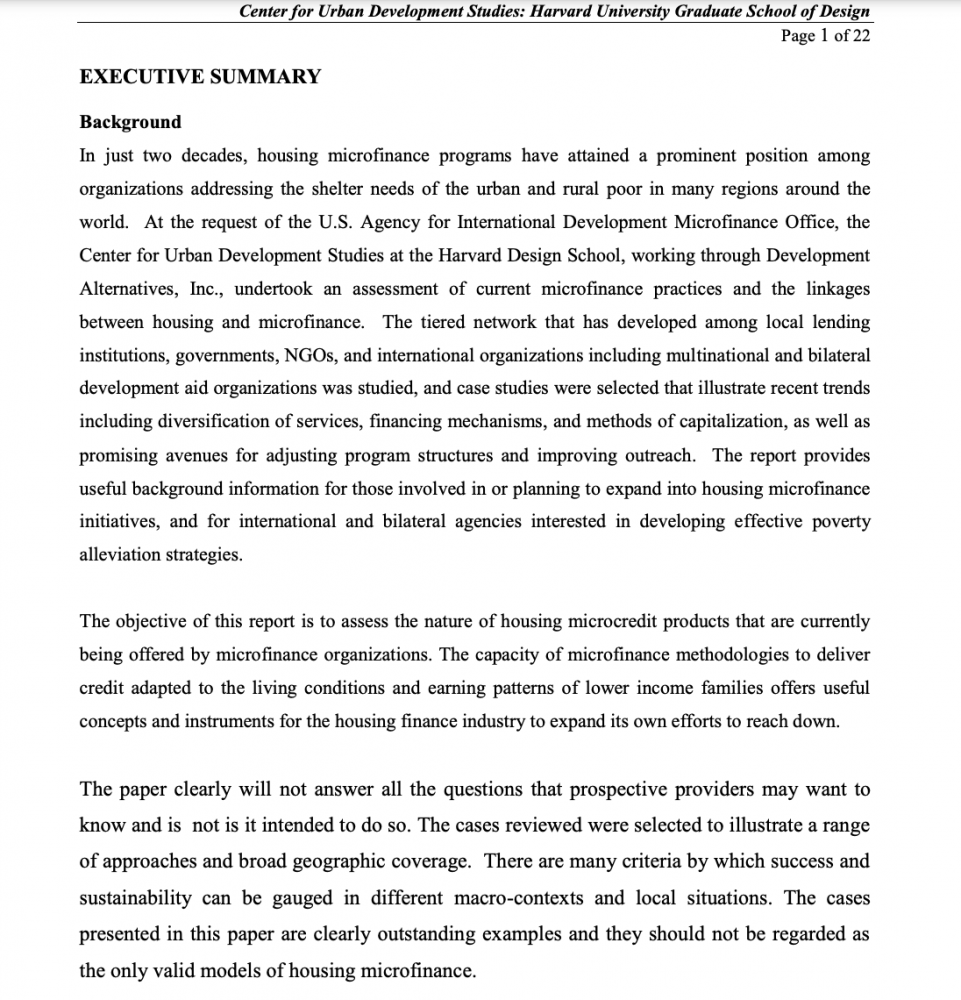
Additional contextual documents include: The “Best Practices 2001” submission for Middledrift, Eastern Cape, South Africa; an executive summary from May 2000 for the “Housing Microfinance Initiative”; a presentation of indicator reports by CUDS “Neighborhood Improvement Program, Neiva, Colombia”; and “Participant Evaluation and Comments” forms for the 2003 seminar participants.

See related I2UD projects below

Project Year:2003
Project Type:IEP; Education
Geographic Regions:Pretoria and Bloemfontein, South Africa (Program Locations) / Brazil / Boston, Massachusetts, US / South Africa / Bogotá, Colombia / Southwark, London, UK / Saint-Denis and Aubervilliers, France / Ahmedabad, India / Adjamé, Abidjan, Côte d’Ivoire / Szczecin, Poland
Reports:
Authors:CUDS Team
Sponsors:Center for Urban Development Studies, Harvard University Graduate School of Design
Categories:International Education Program; Education
  
ID:2003_08_001

Related I2UD Projects

Beginning in 1982, the Unit for Housing and Urbanization at Harvard University’s Graduate School of Design hosted International Training Programs (ITP), an annual series of 2- to 4-week summer seminars designed to strengthen the decision-making skills of senior professionals in public and private agencies responsible for urban development.

The I2UD Digital Library holds curriculum materials for ITPs from 19881991199419951997, and 1998:

The tradition of ITPs continued after 2000, when the Center for Urban Development Studies (CUDS) (a re-organization of the Unit) continued training seminars as International Education Programs (IEP) from 2000-2004:

Programs included inter-linked modules, lectures, case studies, interactive computer simulation models, site visits to urban projects, discussion groups and networking with professional counterparts from international metropolitan regions. Sessions had a modular format and structured team teaching, taught by a team of senior faculty and guest lecturers. Programs ended with a synthesis presented through a project evaluation exercise. Participants used case projects to examine strategies from the viewpoint of both public and private partners — to assess the feasibility and potential impacts of policies and projects on the community and the city. Presentations by guest speakers, representing U.S. and international agencies, NGOs, and community groups, were also integrated within the pedagogic framework of each module.

“Monitoring Processes of Change in Historic Centers: A Case Study of Fes, Morocco,” Case Study Paper for UNESCO World Heritage Center and the International Centre for the Study of Preservation and Restoration of Cultural Property (ICCROM), 2002

Abstract

Mona Serageldin presented the report “Monitoring Processes of Change in Historic Centers: A Case Study of Fes, Morocco” at a workshop on Monitoring World Heritage in November 2002, held in Vicenza, Italy and sponsored by the UNESCO World Heritage Centre and the International Centre for the Study of Preservation and Restoration of Cultural Property (ICCROM). Serageldin’s report assesses the rehabilitation strategy for the Medina of Fez based on a spatial analysis and social and economic indicators, and outlines the considerations involved in implementing the strategy and a geographic monitoring system.


[Excerpt: Abstract, p. 3]

ABSTRACT
“Historic centers encompass monumental buildings and landmarks embedded within a rich urban fabric of utilitarian buildings. Property owners and residents are constantly altering these buildings to adapt them to new needs and lifestyles. Their interventions trigger interlinked processes of transformation that lead either to preservation or to deterioration. Rehabilitation strategies must reconcile the plurality of views, interests, mandates and missions adds layers of complexity to the already challenging task of coping with the impact of disinvestments, misuse, abuse and neglect eroding the quality of life in historic centers.”

“The strategy developed for the first phase of the rehabilitation of the Medina of Fez required a thorough understanding of the dynamics at work in the Medina and of the institutional and financial blockages that prevented reinvestment and fostered the continued deterioration of residential buildings. This assessment was based on a spatial analysis of the key physical, social and economic indicators for the area, including property transactions and building permits for new construction and improvements.”

“The institutionalization and periodic updating of a monitoring system recording the key indicators used in the preparation of the project and linking these databases to the ADER-FEZ GIS has been recommended, but not yet implemented. With a good monitoring system in place and closer collaboration between the tax Department and the Municipality the tax yield from the Medina would be enhanced and the interest of the authorities in the historic core as a viable economic entity [would be] rekindled.”


“At the Center for Urban Development Studies, we have developed an approach to revitalization and rehabilitation that recognizes the plurality of stakeholders in historic centers. We accept the evaluation of cultural significance given to different components of the historic urban fabric by specialized agencies. Our role is to assist local government in devising strategies ensuring coherence, inclusion and impact. Our approach to action plans focuses on valorization of the urban fabric based on the dynamics of change in the site as a living component of a larger urban agglomeration.”

Project Year:2002
Project Type:Workshop
Geographic Regions:Fes, Morocco
Reports:Monitoring Processes of Change in Historic Centers: Fes, Morocco (November 2002)
Authors:Mona Serageldin
Sponsors:UNESCO World Heritage Centre; International Centre for the Study of Preservation and Restoration of Cultural Property (ICCROM)
Categories:Education
  
ID:2002_11_001

Related I2UD Projects

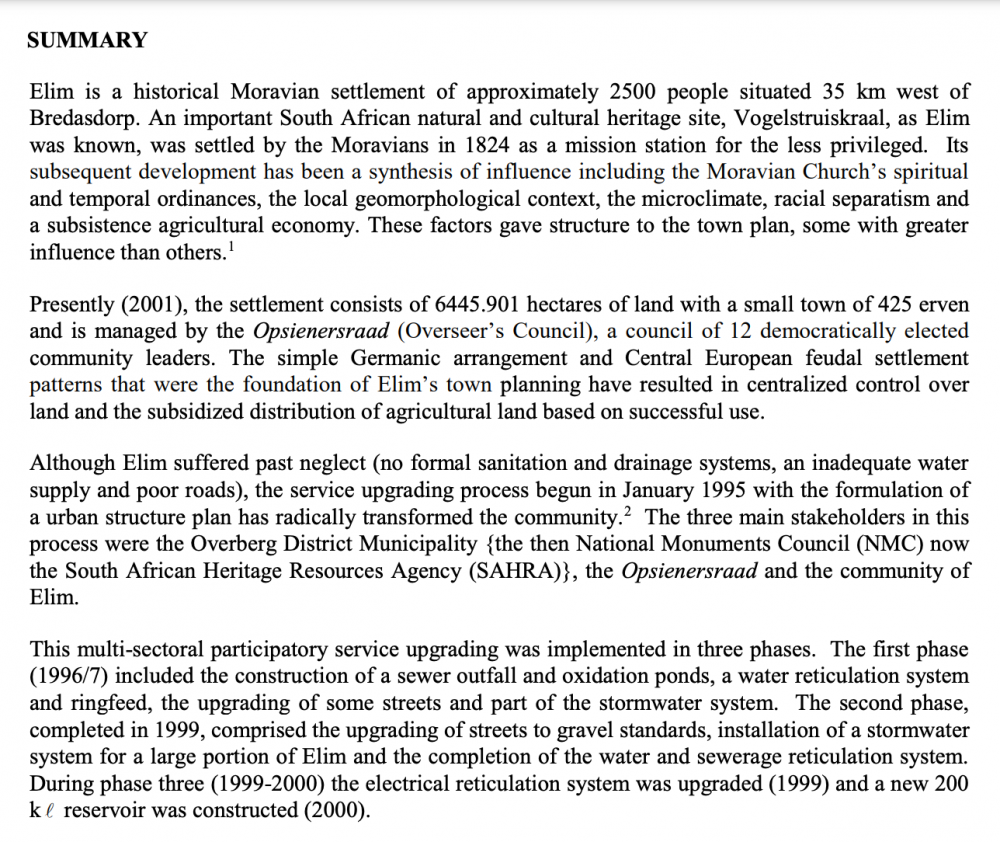
“Development of Infrastructure and Initiating of Sustainable Projects in Elim, South Africa,” Report for the 2001 UN-Habitat Best Practices Leadership Programme for Elim Historic Settlement, Western Cape, South Africa

Abstract

The Center for Urban Development Studies (CUDS) at the Harvard University Graduate School of Design prepared a report “Development of Infrastructure and Initiating of Sustainable Projects in Elim” for submission to the UN-Habitat 2001 Best Practices Local Leadership Programme, based on the upgrading initiative that began in 1995 on the historic settlement of Elim in Western Cape, South Africa.

Primary initiative goals included:

  1. Upgrade the basic town infrastructure and services;
  2. Improve the living standards of the residents;
  3. Improve economic growth within the community;
  4. Preserve the historical character of the village; and
  5. Create employment opportunities, agriculture development, social health and sustainable community development in Elim.

The project assisted in upgrading sewage systems, streets and stormwater systems and the electrical reticulation system. Prior to these upgrades, sewage would flow through the streets and the town reservoir would often dry up in the summer months, causing a shortage of water.

[Excerpt: Summary, page 3]:

See related I2UD projects below

Project Year:2001
Project Type:Development Strategy
Geographic Regions:Elim, Western Cape, South Africa
Reports:Development of Infrastructure and Initiating of Sustainable Projects, Elim, South Africa: (Report, August 2001)
Authors:CUDS Team
Sponsors:United Nations Centre for Human Settlements (UN-Habitat)
Categories:Informal Settlements and Urban Upgrading
  
ID:2001_08_001

Related I2UD Projects

IEP August 2001: “Infrastructure Planning and Partnerships for Local Economic Development,” Pretoria, South Africa, International Education Programs, 2001

Abstract

The Center for Urban Development Studies (CUDS) at Harvard University’s Graduate School of Design developed curriculum on “Infrastructure Planning and Partnerships for Local Economic Development” for its August 2001 International Education Program (IEP) held in Pretoria, South Africa. Materials for the seminar included a workshop discussion guide and case studies and excerpts of past CUDS research. Some materials were repeated or reworked from previous IEP and ITP sessions.

See related I2UD projects below

Project Year:2001
Project Type:IEP; Education
Geographic Regions:Pretoria, South Africa (Workshop Location)
Reports:
Authors:Mona Serageldin; Sameh Wahba
Sponsors:Center for Urban Development Studies, Harvard University Graduate School of Design
Categories:International Education Program; Education
  
ID:2001_08_003

Related I2UD Projects

Beginning in 1982, the Unit for Housing and Urbanization at Harvard University’s Graduate School of Design hosted International Training Programs (ITP), an annual series of 2- to 4-week summer seminars designed to strengthen the decision-making skills of senior professionals in public and private agencies responsible for urban development.

The I2UD Digital Library holds curriculum materials for ITPs from 19881991199419951997, and 1998:

The tradition of ITPs continued after 2000, when the Center for Urban Development Studies (CUDS) (a re-organization of the Unit) continued training seminars as International Education Programs (IEP) from 2000-2004:

Programs included inter-linked modules, lectures, case studies, interactive computer simulation models, site visits to urban projects, discussion groups and networking with professional counterparts from international metropolitan regions. Sessions had a modular format and structured team teaching, taught by a team of senior faculty and guest lecturers. Programs ended with a synthesis presented through a project evaluation exercise. Participants used case projects to examine strategies from the viewpoint of both public and private partners — to assess the feasibility and potential impacts of policies and projects on the community and the city. Presentations by guest speakers, representing U.S. and international agencies, NGOs, and community groups, were also integrated within the pedagogic framework of each module.

IEP May 2001: “Infrastructure Planning and Partnerships for Local Economic Development,” Eastern Cape, South Africa, International Education Programs, 2001

Abstract

The Center for Urban Development Studies (CUDS) at Harvard University’s Graduate School of Design produced a curriculum in 2001 for their International Education Program (IEP) held in Eastern Cape, South Africa in May of that year. The seminar was titled “Infrastructure Planning and Partnerships for Local Economic Development” and included relevant case studies and excerpts pulled from previous CUDS work.

[Excerpt: Executive Summary, May 2001, p. 1]

See related I2UD projects below

Project Year:2001
Project Type:IEP; Education
Geographic Regions:Eastern Cape, South Africa
Reports:
Authors:John Driscoll; Emly Costa; Mona Serageldin; Sameh Wahba; Patrick Bodart; Yves Cabannes; Boguslaw Trondowski
Sponsors:Center for Urban Development Studies, Harvard University Graduate School of Design
Categories:International Education Program; Education
  
ID:2001_05_001

Related I2UD projects

Beginning in 1982, the Unit for Housing and Urbanization at Harvard University’s Graduate School of Design hosted International Training Programs (ITP), an annual series of 2- to 4-week summer seminars designed to strengthen the decision-making skills of senior professionals in public and private agencies responsible for urban development.

The I2UD Digital Library holds curriculum materials for ITPs from 19881991199419951997, and 1998:

The tradition of ITPs continued after 2000, when the Center for Urban Development Studies (CUDS) (a re-organization of the Unit) continued training seminars as International Education Programs (IEP) from 2000-2004:

Programs included inter-linked modules, lectures, case studies, interactive computer simulation models, site visits to urban projects, discussion groups and networking with professional counterparts from international metropolitan regions. Sessions had a modular format and structured team teaching, taught by a team of senior faculty and guest lecturers. Programs ended with a synthesis presented through a project evaluation exercise. Participants used case projects to examine strategies from the viewpoint of both public and private partners — to assess the feasibility and potential impacts of policies and projects on the community and the city. Presentations by guest speakers, representing U.S. and international agencies, NGOs, and community groups, were also integrated within the pedagogic framework of each module.

IEP October 2000: “Seminar on Strategic Planning for Urban Revitalization and Local Development” in Pretoria, South Africa, International Education Programs, 2000

Abstract

Seminar materials represent curriculum components from the 2000 International Education Program (IEP), “Seminar on Strategic Planning for Urban Revitalization and Local Development” held October 30 through November 3, 2000 in Pretoria, South Africa. Documents include project excerpts and case studies used in the seminar, including a presentation by Mona Serageldin presented at the HABITAT II Urban Finance Conference in 1995, “Empowerment and Accountability in Local Governance: Adjame’s Community Development Experience.”

See related I2UD projects below

Project Year:2000
Project Type:IEP; Education
Geographic Regions:Pretoria, South Africa (Seminar Location)
Reports:
Authors:Mona Serageldin; John Driscoll; Sameh Wahba; Boguslaw Trondowski; Patrick Bodart; Yves Cabannes; Emily Costa
Sponsors:Center for Urban Development Studies, Harvard University Graduate School of Design
Categories:International Education Program; Education; Informal Settlements and Urban Upgrading
  
ID:2000_10_001

Related I2UD Projects

Beginning in 1982, the Unit for Housing and Urbanization at Harvard University’s Graduate School of Design hosted International Training Programs (ITP), an annual series of 2- to 4-week summer seminars designed to strengthen the decision-making skills of senior professionals in public and private agencies responsible for urban development.

The I2UD Digital Library holds curriculum materials for ITPs from 19881991199419951997, and 1998:

The tradition of ITPs continued after 2000, when the Center for Urban Development Studies (CUDS) (a re-organization of the Unit) continued training seminars as International Education Programs (IEP) from 2000-2004:

Programs included inter-linked modules, lectures, case studies, interactive computer simulation models, site visits to urban projects, discussion groups and networking with professional counterparts from international metropolitan regions. Sessions had a modular format and structured team teaching, taught by a team of senior faculty and guest lecturers. Programs ended with a synthesis presented through a project evaluation exercise. Participants used case projects to examine strategies from the viewpoint of both public and private partners — to assess the feasibility and potential impacts of policies and projects on the community and the city. Presentations by guest speakers, representing U.S. and international agencies, NGOs, and community groups, were also integrated within the pedagogic framework of each module.

“Mauritanian National Urban Development Strategy,” Policy Action Plan for Nouakchott, Nouadhibou, and Kaédi, Mauritania, 2000 (French)

Abstract

In 2000, the Center for Urban Development Studies (CUDS) at Harvard University’s Graduate School of Design provided assistance in formulating the “Mauritanian National Urban Development Strategy” and policy action plan for Mauritania. This project originated from the Mauritanian “Seminar on Urban Planning and Management,” led by CUDS in 1999.

The CUDS team included Mauritanian urban and legal experts and worked closely with local officials on an economic development strategy for the country’s three largest cities (Nouakchott, Nouadhibou, and Kaédi) and on an update to the legislative framework for land tenure and real estate development.

Documents include multiple provisional and progressive reports from May, June, July, August, and October 2000, as well as preliminary documents, all in French.

Project Year:2000
Project Type:Policy Action Plan; Education
Geographic Regions:Nouakchott, Nouadhibou, and Kaédi, Mauritania
Reports:
Authors:François Vigier; Mona Serageldin; Sameh Wahba; Alain Durand-Lasserve; Jacques Carol; Ahmed Salem Ould Bouboutt; Issakha Diagana; Samir Abdulac
Sponsors:World Bank; AMEXTIPE
Categories:International Education Program; Executive Training Program; Education
  
ID:2000_05_001

“Master Plan for the Revitalization of the Older Urban Fabric,” Preservation in the Old City of Al Qusair, Egypt, 2000

Abstract

In 2000, the Center for Urban Development Studies (CUDS) at Harvard University’s Graduate School of Design produced a planning program that encouraged both economic urban development and historic district revitalization for the preservation of the Old City of Al Qusair, Egypt.

The revitalization program focused on the recently restored major Ottoman fort, archeological excavations of Pharaonic settlements, and tourism development along the Red Sea coast. The CUDS survey emphasized the benefits of a revitalization plan to enact an “operational strategy for the revitalization of Qusair’s old urban fabric” and to “ensure its integration within the official master plan for Qusair commissioned by the Governor.”

Documents include a Full Report, Questionnaire, Suggested Urban Regulations and Building Code, Intervention List, Action Plan Write Up, and a Statistical analysis.


[Excerpt: The Full Report, The Old City of Qusair]

“The Old City of Qusair is an integral component of the whole city…Between the planned extension and the existing city, uncontrolled expansion is occurring primarily along the main roads. This informal and rather chaotic urbanization is bound to have a negative impact on the environment of both the Old and New Qusair. These settlements house families who lived previously in the older neighborhoods and should be included in future development and upgrading plans at the city scale.”

The documentation and analysis involved “three fundamental determinants of change and transformation of the historic urban fabric”:

1. A thorough understanding of tenure patterns and development dynamics in the city as they affect the historic center.

2. The documentation of economic and socio-cultural changes and their impact on lifestyles, on housing, and commercial activity in the different zones of the study area.

3. The identification of factors prompting property owners, shopkeepers, and households to invest in the improvement of their buildings, shops and dwellings.

See related I2UD projects below

Project Year:2000
Project Type:Master Plan
Geographic Regions:Al Qusair, Egypt
Reports:
Authors:Mona Serageldin; François Vigier; Tarek Waly
Sponsors:Wallenberg Foundations
Categories:Historic Districts
  
ID:2000_00_002

Related I2UD Projects

Executive Training Program 1999: Seminar on “Urban Planning and Management” for Executive Officials from Nouadhibou & Nouakchott, Mauritania, 1999

Abstract

The Center for Urban Development Studies (CUDS) at Harvard University’s Graduate School of Design hosted a seminar on “Urban Planning and Management” for a delegation of senior officials from Mauritania, held in Cambridge, Massachusetts in October 1999. The seminar was organized in response to a request from the Agence Mauritanienne d’Exécution des Travaux d’Intérêt Public pour l’Emploi (AMEXTIPE), and led to a formal consultation project by CUDS on recommendations for urban development in October 2000.

In the late 1990s, decentralization initiatives in Mauritania shifted central and local relationships and created new responsibilities for municipalities. Impacted cities under survey included Nouadhibou and Nouakchott. Nouadhibou is the second largest city in Mauritania and serves as a major commercial center, while Nouakchott is the capital and largest city of Mauritania, and serves as the administrative and economic center of Mauritania. Urban issues facing local authorities included increasing urban poverty, demand for urban land, uncontrolled urban development, and underserved communities.

Documents are primarily in French, and include two preliminary reports on Nouadhibou and Nouakchott from 1995 and 1996. A seminar program outline from October 1999 is in English. Also included are copies of the eventual CUDS reports from October 2000. See “Mauritanian National Urban Development Strategy” (Project ID: 2000_05_001) from 2000 for full project documentation.

See related I2UD projects below

Project Year:1999
Project Type:ITP; Education
Geographic Regions:Nouadhibou and Nouakchott, Mauritania
Reports:
Authors:François Vigier (Team Leader); Mona Serageldin; Samir Abdulac; James Kostaras; Sameh Wahba; Jacques Carol; Ahmed Salem Ould Bouboutt; Isakha Diagana
Sponsors:World Bank; AMEXTIPE
Categories:International Education Program; Executive Training Program; Education
  
ID:1999_10_001

Related I2UD Projects

Beginning in 1982, the Unit for Housing and Urbanization at Harvard University’s Graduate School of Design hosted International Training Programs (ITP), an annual series of 2- to 4-week summer seminars designed to strengthen the decision-making skills of senior professionals in public and private agencies responsible for urban development.

The I2UD Digital Library holds curriculum materials for ITPs from 19881991199419951997, and 1998:

The tradition of ITPs continued after 2000, when the Center for Urban Development Studies (CUDS) (a re-organization of the Unit) continued training seminars as International Education Programs (IEP) from 2000-2004:

Programs included inter-linked modules, lectures, case studies, interactive computer simulation models, site visits to urban projects, discussion groups and networking with professional counterparts from international metropolitan regions. Sessions had a modular format and structured team teaching, taught by a team of senior faculty and guest lecturers. Programs ended with a synthesis presented through a project evaluation exercise. Participants used case projects to examine strategies from the viewpoint of both public and private partners — to assess the feasibility and potential impacts of policies and projects on the community and the city. Presentations by guest speakers, representing U.S. and international agencies, NGOs, and community groups, were also integrated within the pedagogic framework of each module.

Workshops on “Strategic Planning and Management of Municipal Infrastructure Programs,” from Review of Grant-Funded MIPs in South Africa, May-June 1999

Abstract

The Unit for Housing and Urbanization at Harvard University’s Graduate School of Design developed two workshops in 1999 on “Strategic Planning and Management of Municipal Infrastructure Programs.” Workshop materials built off original in-depth research and a previous report by the Unit, “Review of South African Governments Grant Funded Municipal Infrastructure Programs” (Project ID: 1998_08_001) from 1998-1999. Workshop One was held on May 19-21, 1999, and Workshop Two was held on July 28-30, 1999.

Documents include a copy of the full report on Municipal Infrastructure Programs (MIPs) in South Africa, an outline on Performance Indicators, a presentation on MIPs, program overviews, and detailed schedules for the two workshops.

See related I2UD projects below

Project Year:1999
Project Type:ITP; Education
Geographic Regions:South Africa
Reports:
Authors:Mona Serageldin (Team Leader); David Cook; David C. Jones; John Driscoll; Christine Williams; Sameh Wahba; Suzanne Kim; Christopher Rogers; Wesley Wirth; Vicky Milne; Alejandra Mortarini
Sponsors:World Bank; Development Bank of Southern Africa
Categories:International Education Program; Executive Training Program; Education
  
ID:1999_05_002

Related I2UD Projects

Beginning in 1982, the Unit for Housing and Urbanization at Harvard University’s Graduate School of Design hosted International Training Programs (ITP), an annual series of 2- to 4-week summer seminars designed to strengthen the decision-making skills of senior professionals in public and private agencies responsible for urban development.

The I2UD Digital Library holds curriculum materials for ITPs from 19881991199419951997, and 1998:

The tradition of ITPs continued after 2000, when the Center for Urban Development Studies (CUDS) (a re-organization of the Unit) continued training seminars as International Education Programs (IEP) from 2000-2004:

Programs included inter-linked modules, lectures, case studies, interactive computer simulation models, site visits to urban projects, discussion groups and networking with professional counterparts from international metropolitan regions. Sessions had a modular format and structured team teaching, taught by a team of senior faculty and guest lecturers. Programs ended with a synthesis presented through a project evaluation exercise. Participants used case projects to examine strategies from the viewpoint of both public and private partners — to assess the feasibility and potential impacts of policies and projects on the community and the city. Presentations by guest speakers, representing U.S. and international agencies, NGOs, and community groups, were also integrated within the pedagogic framework of each module.

“Housing Microfinance Initiatives,” Case Study for USAID Microenterprise Best Practices Initiative, 1999-2000

Abstract

Team members at the Unit for Housing and Urbanization (later the Center for Urban Development Studies) at Harvard University’s Graduate School of Design worked on the “Housing Microfinance Initiative” case study from 1999 to 2000, accompanying USAID’s Microenterprise Best Practices effort. The Unit produced reports to highlight the achievements of housing micro-finance initiatives around the world. Findings noted the challenges facing the extension of microcredit to poor households for funding shelter construction and improvements, land acquisition, and infrastructure provisions. Geographic regions covered include South Asia, Southeast Asia, Latin America, and Sub-Saharan Africa.

Documents include a final report, a 1998 draft background report on Guatemala, an inception brief, multiple summary and synthesis reports, supporting overviews, and case studies with photos. Regional overviews address the broad geographic areas noted above.

See related I2UD projects below

Project Year:1999-2000
Project Type:Case Study
Geographic Regions:South Asia (India and Bangladesh) / Southeast Asia (Philippines) / Latin America (Guatemala) / Sub-Saharan Africa (South Africa)
Reports:
Authors:John Driscoll; Graciela Fortin-Magana; Christopher Rogers; Mona Serageldin; Sameh Wahba; Christine Williams; Kimberly Wilson
Sponsors:USAID Microfinance Office; Development Alternatives, Inc. (Bethesda, Maryland)
Categories:Urban Planning
  
ID:1999_00_001

Related I2UD Projects

Beginning in 1982, the Unit for Housing and Urbanization at Harvard University’s Graduate School of Design hosted International Training Programs (ITP), an annual series of 2- to 4-week summer seminars designed to strengthen the decision-making skills of senior professionals in public and private agencies responsible for urban development.

The I2UD Digital Library holds curriculum materials for ITPs from 19881991199419951997, and 1998:

The tradition of ITPs continued after 2000, when the Center for Urban Development Studies (CUDS) (a re-organization of the Unit) continued training seminars as International Education Programs (IEP) from 2000-2004:

Programs included inter-linked modules, lectures, case studies, interactive computer simulation models, site visits to urban projects, discussion groups and networking with professional counterparts from international metropolitan regions. Sessions had a modular format and structured team teaching, taught by a team of senior faculty and guest lecturers. Programs ended with a synthesis presented through a project evaluation exercise. Participants used case projects to examine strategies from the viewpoint of both public and private partners — to assess the feasibility and potential impacts of policies and projects on the community and the city. Presentations by guest speakers, representing U.S. and international agencies, NGOs, and community groups, were also integrated within the pedagogic framework of each module.

“Review of the South African Government’s Grant-Funded Municipal Infrastructure Programs,” Technical Reports on Nine South African Provinces, 1998-1999

Abstract

In 1998, the Unit for Housing and Urbanization reviewed the effectiveness of the South African Government’s grant-funded Municipal Infrastructure Program. The project involved field visits and detailed reports on economic conditions and progress on “Nine Noteworthy Projects” in South Africa’s provinces:

  • Klapmuts, Western Cape
  • Middledrift, Eastern Cape
  • Atteridgeville, Gauteng
  • Mhluzi, Mpumalanga
  • Itsoseng, North West
  • Ndaleni, KwaZulu-Natal
  • Cornelia, Free State
  • Naboomspruit/Mookgophong, Limpopo
  • Ritchie, Northern Cape

Documents include a letter of interest, draft contract, an inception report, multiple intermediate reports, and various supporting reports, data and maps, and presentation notes. The Unit also developed a workshop in 1999 based on this study.

See related I2UD projects below

Project Year:1998-1999
Project Type:Technical Assistance
Geographic Regions:South Africa
Reports:
Authors:Mona Serageldin; David Cook; John Driscoll; David C. Jones
Sponsors:World Bank; Development Bank of Southern Africa
Categories:Evaluations and Assessments
  
ID:1998_08_001

Related I2UD Projects

ITP 1998: “The Role of Public/Private Partnerships in Urban Improvements,” with Case Studies on Kreuzberg, Berlin (Germany), GIS Mapping on Cape Cod (US) and the Maarouf Quarter of Cairo (Egypt), 1998

Abstract

The curriculum components from the 1998 International Training Program (ITP), “The Role of Public/Private Partnerships in Urban Improvements,” include outlines of public and private partnerships for urban improvement initiatives. Case studies include city project overviews of the Kreuzberg District of Berlin; GIS Mapping of Eastham and Wellfleet in Cape Cod, Massachusetts; and the Maarouf Quarter in Cairo, Egypt.

Guest lecturers included: Pat Cusick, Executive Director of South End Neighborhood Action Plan (SNAP); Richard Dimino, Chief Executive Director of Artery Business Committee; Linda Mogelli Haar, Director of Planning and Zoning of Boston Redevelopment Authority; Richard Henderson, Associate Director of Port Planning and Development of Massachusetts Port Authority; James Kostaras, Senior Architect/Planner for Boston Redevelopment Authority.

See related I2UD projects below

Project Year:1998
Project Type:ITP; Education
Geographic Regions:United Kingdom / Cape Cod, Massachusetts, USA / Kreuzberg, Berlin, Germany / Maarouf, Cairo, Egypt
Reports:
Authors:Unit Team
Sponsors:Unit for Housing and Urbanization, Harvard University Graduate School of Design
Categories:International Training Program; Education
  
ID:1998_07_001

Related I2UD Projects

Beginning in 1982, the Unit for Housing and Urbanization at Harvard University’s Graduate School of Design hosted International Training Programs (ITP), an annual series of 2- to 4-week summer seminars designed to strengthen the decision-making skills of senior professionals in public and private agencies responsible for urban development.

The I2UD Digital Library holds curriculum materials for ITPs from 19881991199419951997, and 1998:

The tradition of ITPs continued after 2000, when the Center for Urban Development Studies (CUDS) (a re-organization of the Unit) continued training seminars as International Education Programs (IEP) from 2000-2004:

Programs included inter-linked modules, lectures, case studies, interactive computer simulation models, site visits to urban projects, discussion groups and networking with professional counterparts from international metropolitan regions. Sessions had a modular format and structured team teaching, taught by a team of senior faculty and guest lecturers. Programs ended with a synthesis presented through a project evaluation exercise. Participants used case projects to examine strategies from the viewpoint of both public and private partners — to assess the feasibility and potential impacts of policies and projects on the community and the city. Presentations by guest speakers, representing U.S. and international agencies, NGOs, and community groups, were also integrated within the pedagogic framework of each module.

Design Studio 1997: “Strategic Planning and Local Development,” Seminar Curriculum

Abstract

The Unit for Housing and Urbanization at Harvard University’s Graduate School of Design hosted a Design Studio in Spring 1997, “Strategic Planning and Local Development,” led by Mona Serageldin and John Driscoll. The studio focused on strategies for urban and regional development for less developed nations, within the context of a globalized economy with cities being the engines of growth.

Documents include a workshop overview with objectives and schedule, a reserved materials list, and a bibliography.


[Excerpt: Syllabus Introduction, ‘Strategic Planning and Local Development,’ Spring 1997]

“The seminar will examine strategies for urban and regional development within the context of a globalized economy where cities are the engines of growth. Fierce competition, unavoidable interdependence, fast paced technological change, widening income disparities and environmental degradation are creating new challenges that urban development strategies must address.”

“Concepts and methods of strategic planning as a framework for participation, decision making and resource allocation will be examined focusing on the complementary roles of public and private actors in planning, financing and managing urban development activities in different economic, institutional and cultural settings. Case studies will illustrate proactive strategies to promote urban development, regenerate functionally obsolete areas and revitalized marginalized neighborhoods.

The seminar will examine the expanding scope of public/private partnerships and discuss the changing role of public agencies, private investors, NGOs and community based organizations in the rehabilitation of the built environment and the provision of housing and urban services. Case studies will illustrate sustainable initiatives focusing on the structure of the interface between city, community and the local business sector. The case studies will also highlight critical roles for urban planners and designers in leading and nurturing initiatives relying on empowerment.”

See related I2UD projects below

Project Year:1997
Project Type:Urban Design Studio
Geographic Regions:Cambridge, Massachusetts, United States (Seminar Location) / Cairo Metropolitan Area, Egypt
Reports:
Authors:Mona Serageldin; John Driscoll
Sponsors:Unit for Housing and Urbanization, Harvard University Graduate School of Design
Categories:Design Studios; Education
  
ID:1997_01_001

Related I2UD Projects

“Best Practices and Local Leadership Programme,” Review of International Urban Development Projects, for the United Nations Centre for Human Settlements (UN-Habitat), 1995

Abstract

In 1995, the Unit for Housing and Urbanization (the Unit) at Harvard University’s Graduate School of Design participated in the “Best Practices and Local Leadership Programme” by the the United Nations Centre for Human Settlements (UN-Habitat).

The Programme highlighted international urban development projects as candidates for the UN’s Best Practices database. Documents addressed human settlement case studies in twelve nations: India, Australia, Austria, Kenya, Egypt, Argentina, Norway, Venezuela, Angola, Greece, Scotland, Philippines, Brazil, Germany, Turkey, and South Africa.

The Unit evaluated 28 city programs following UN-Habitat’s Programme goals:

  1. To develop and maintain a knowledge base on best practices in improving the living environment including their corresponding sources of knowledge, experience and expertise;
  2. To promote the dissemination, sharing and exchange of lessons learned from the above-mentioned best practices and others by and amongst all key groups of actors and stakeholders in the human settlement and development process;
  3. To facilitate the transfer of the knowledge, experience and expertise associated with best practices in improving the living environment through new and improved means of cooperation on a north-north, north-south and south-south basis including decentralized forms of cooperation;
  4. To assist scholars and practitioners in their investigation of innovative approaches to urban development.

In addition to 28 national profiles, documents include a ‘Memorandum of Understanding’ between the Unit and Habitat agency, and Best Practices guidelines for pre-screening cases. See an Excerpt from the Memorandum below.


[Excerpt, “Guide to Documenting and Learning from Best Practices,” 1996. Introduction, page 6]

“The Best Practices Initiative began as a world-wide search for human settlements success stories. An official part of the preparatory process for The City Summit – the second United Nations Conference on Human Settlements (Habitat II) – held in Istanbul, Turkey, in June 1996. Best Practices Initiative generated over 600 submissions from 80 countries by the official deadline. These initiatives are testimonials to human ingenuity in the face of the challenges of an urbanizing world.”

“A two-stage, independent selection process produced a list of 104 Best Practices and highlighted 12 initiatives to receive the Tokyo and Dubai Awards for Excellence in Improving the Living Environment. The twelve Award recipients and many other initiatives were also on display at the Best Practices Exhibition, the largest single-theme exposition ever organised by the United Nations. The enthusiasm and interest generated by the Best Practices Initiative has led to its incorporation as an ongoing programme of UNCHS (Habitat): the Best Practices and Local Leadership Programme (BLP). The BLP will operate as a network of leading capacity-building institutions from around the world. Mandated to support the implementation of the Habitat Agenda – the Global Plan of Action adopted at Habitat II – through the continued sharing and transfer of Best Practices knowledge, experience and expertise, the BLP is launching a second call for submissions, culminating in a second round of Awards for Excellence in Improving the Living Environment in October 1998.”

“The purpose of this guide is to provide a framework for identifying, documenting and learning from BEST PRACTICES. In addition, this guide explains how individuals, groups and organizations can participate in a continuous exchange of know-how, experience and expertise in sustainable human settlements development.”

See related I2UD projects below

Project Year:1995
Project Type:UN-Habitat Best Practices and Local Leadership Programme
Geographic Regions:Tamil Nadu and Delhi, India / New South Wales and Queensland, Australia / Vienna, Austria / Jua Kali Sector, Nairobi and Kisumu, Kenya / Helwan and Cairo, Egypt / Tucumán, Argentina / Oslo Old Town, Norway / Caracas, Venezuela / Sambizanga, Angola / Keramitsa and Perama, Greece / Glasgow, Scotland / Naga, Philippines / Santos, São Paulo, Brazil / Potsdam, Mannheim, and Kiel Mettenhof, Germany / Eryaman and Çankaya, Ankara, Turkey / Nkonkobe (Alice), South Africa
Reports:
Authors:François Vigier
Sponsors:Untied Nations Centre for Human Settlements (UN-Habitat)
Categories:Evaluations and Assessments
  
ID:1995_00_007

Related I2UD Projects

Design Studio 1994: “A New Urban Center for Adjamé, Abidjan, Ivory Coast,” Seminar Curriculum

Abstract

Professors François Vigier and Mona Serageldin led the Spring 1994 Design Studio, an annual seminar hosted by the Unit for Housing and Urbanization at Harvard University’s Graduate School of Design. The topic that year focused on urban development in Abidjan, Côte d’Ivoire (Ivory Coast).

The document, “Designing for Urban Growth: Abidjan, Côte d’Ivoire” (January 1994), discussed the housing compound profiles, land allocation, household demographics, and design conditions of Abidjan’s housing regions. The report details designs for dealing with environmental impacts such as organic and industrial effluents, solutions for reducing public subsidies for housing, reforms the housing production, and, in particular, suggestions for readdressing the respective responsibilities of the public and private sectors.

See related I2UD projects below

Project Year:1994
Project Type:Urban Design Studio
Geographic Regions:Abidjan, Côte d’Ivoire
Reports:1994 Design Studio: Abidjan Designing for Urban Growth (Report, Vigier and Serageldin)
Authors:Mona Serageldin; François Vigier; Samir Abdulac; Howard Trett; Randa Tukan; David Neilson
Sponsors:Unit for Housing and Urbanization, Harvard University Graduate School of Design
Categories:Design Studios; Education
  
ID:1994_01_001

Related I2UD Projects

“The Use of Land and Infrastructure in the Self-Improvement Strategies of Urban Lower Income Families,” Paper by Mona Serageldin, UN-Habitat Fourteenth Commission Report, May 1993

Abstract

A landmark paper by Mona Serageldin, “The Use of Land and Infrastructure in the Self-Improvement Strategies of Urban Lower Income Families,” was included in the the Fourteenth Commission UNCHS/Habitat Report and presented to the Commission in Nairobi, Kenya in May 1993.

This work presented the self-improvement strategies of families dealing with challenging living conditions as an “intricate and dynamic” part of urban development, conditions which planners should respect. Serageldin’s report drew on her long history of research on urban development in cities globally, using short narrative examples and photos to illustrate specific households in: Abidjan, Amman, Cairo, Jakarta, Karachi, Kinshasa, Quito, Mexico City, Rabat, Surabaya, Tunis, and Boston. The report was sponsored by USAID’s Family and Development Program and Office of Housing and Urban Programs.

Another essay on the same topic was published as USAID Seminar Brief No. 4, “How Urban Families use Infrastructure and Housing in their own Development,” in June 1992. This document summarized Serageldin’s seminar presentation for the USAID Family and Development Initiative Series in April 1992, relaying her indication of trends toward informal housing developments emerging in reaction to rapid urbanization in city populations and housing shortages increasingly becoming a critical issue for low-income families.


[Excerpt: USAID Seminar No. 4. “How Urban Families use Infrastructure and Housing in their own Development,” June 1992.]

Keeping Families Together: Dr. Serageldin’s longitudinal research in Cairo illustrated the importance of a house as an asset that keeps families together. Vertical expansion of buildings provides space which can be used to house less fortunate family members, such as the elderly, at advantageous terms to all parties. In one case, the rental income saved by a widowed mother living on a relative’s top floor was spent on her children’s school fees while the income generated by this family member from a ground floor shop covered the family’s living expenses.”

Project Year:1993, 1992
Project Type:Research Paper
Geographic Regions:Abidjan, Côte d’Ivoire / Amman, Jordan / Cairo, Egypt / Jakarta and Surabaya, Indonesia / Karachi, Pakistan / Kinshasa, Democratic Republic of the Congo / Quito, Ecuador / Mexico City, Mexico / Rabat, Morocco / Tunis, Tunisia / Boston, Massachusetts, USA
Reports:
Authors:Mona Serageldin; John Driscoll; María-Luisa Fernández
Sponsors:UN-Habitat; USAID
Categories:Informal Settlements and Urban Upgrading
  
ID:1993_05_001

Related I2UD Projects

Design Studio 1993: “Rabat’s Urban Fringe,” Rabat, Morocco, Seminar Curriculum

Abstract

The Design Studio from Spring 1993, “Rabat’s Urban Fringe,” was led by Professors François Vigier and Mona Serageldin. The seminar focused on informal housing and the fringe region around the old city sections of Rabat, Morocco.

The seminar report includes the following five chapters on urban development in Rabat, Morocco, circa 1992:

  1. National Background
  2. The Process of Urbanization
  3. The Housing Sector
  4. Rabat-Salé: The Capital City, and
  5. The Southern Fringe of Rabat

Section 5 on the Southern Fringe contains an expansive study of squatter settlements, historic regions, and upgrading in Rabat, with details on squatter regions and upgrading activity zones, including an analysis of the social and economic impact of housing projects underway. A final section (5.5) details case studies of Doum and informal housing in Takadoum and La Butte.


[Excerpt: Table of Contents fo Rabat’s Urban Fringe, October 1992]

This document presents an overview of the Design Studio, authored by Vigier and Serageldin in October 1992, for use in the Spring 1993 Design Studio curriculum. This topic was reused from the Design Studio from 1989, “Rabat’s Urban Fringe,”  Urbanization Analysis of Rabat, Morocco, Seminar Curriculum (Project ID: 1989_01_001).

See related I2UD projects below

Project Year:1993
Project Type:Urban Design Studio
Geographic Regions:Rabat, Morocco
Reports:1993 Design Studio: Rabat’s Urban Fringe (Report)
Authors:Mona Serageldin; François Vigier
Sponsors:Aga Khan Program for Islamic Architecture
Categories:Design Studios; Education
  
ID:1993_00_001

Related I2UD Projects

Design Studio 1992: “Cairo and the Medieval City” and “Urban Regeneration in Medieval Cairo,” in Cairo, Egypt, Seminar Curriculum

Abstract

The Design Studio from Spring 1992, led by François Vigier and Mona Serageldin, focused on urban regeneration in the Medieval sector of Cairo, Egypt.

Two reports used maps and photos to propose preservation solutions for buildings in the Darb Qirmiz area, the Darb al-Asfar area, and the northern Gamalia region of Medieval Cairo. Teaching scenarios included realistic issues as well as illustrative examples. Students modeled these detailed surveys of Cairo’s historic districts in a collaborative report based on their study. This topic was repeated for Design Studios from 1998, 1999, and 2000, hosted by the Unit for Housing and Urbanization at Harvard University’s Graduate School of Design.

Documents from 1992 include a full Report on “Cairo and the Medieval City” prepared by Vigier and Serageldin, followed by a student paper on “Medieval Cairo” by Eurico Francisco and Georg Schrom. Also included is a contextual overview titled “Urban Context: The Greater Cairo Region.”

See related I2UD projects below

Project Year:1992
Project Type:Urban Design Studio
Geographic Regions:Medieval Cairo, Egypt (Darb Qirmiz, Darb Al-Asfar, and Gamalia Quarters)
Reports:
Authors:Mona Serageldin; François Vigier; Eurico Francisco; Georg Schrom; Jana Pereau; Katherine Dunham; Catherine Miller; Christophe Drumain; Siew-Leng Fun; Christopher Lane; Muhammad Abdus Sabur; Markus Leibenath; Yu-Hua Wang; Darlene van der Breggen; Stefanie Wagstaff; Samy Zaghloul
Sponsors:Aga Khan Program for Islamic Architecture
Categories:Design Studios; Education
  
ID:1992_00_002

Related I2UD Projects

“Review of Ongoing USAID Shelter Sector Activities in Morocco,” Report for USAID/Morocco Office of Housing and Urban Programs, 1992-1998

Abstract

In 1992, the Unit for Housing and Urbanization (the Unit) at Harvard University’s Graduate School of Design contributed to a USAID/Morocco urban planning report, “Review of Ongoing USAID Shelter Sector Activities in Morocco,” to address challenges of rapid urbanization. These materials present a rich regional profile of public housing and land use in Morocco circa 1991-1992.

The Unit’s contributions from June 1992 presented an economic analysis with financial metrics on urban shelter programs, measuring the impact of two Moroccan agencies: the ANHI Low Income Housing Program and the Tetouan Urban Development Program. Research noted the increased demand for basic services in Morocco’s cities, like water supply and shelter, in connection to widespread unemployment and underemployment for the urban poor. Workshop elements outlined problems and objectives for future urban infrastructure programs, noting where public officials must make decisions to compromise the needs of urban communities with government economic priorities.

Documents include the final report (June 1992), with a summary by Mona Serageldin. Also included is a Phase I Report (January 1998) outlining a strategic planning workshop on supporting the long-term operation of ANHI’s programs, as well as an accompanying document containing documentation, references, and appendices.


[Excerpt: 1.1 Background – “Review of Ongoing USAID Shelter Sector Activities in Morocco” (June 1992)]

“The ongoing USAID shelter sector activities in Morocco were conceptualized in 1985 within a context of accelerating urbanization and massive rural urban migration. The urban programs initiated by USAID focused on priority areas:

Rationalizing the land delivery process and regularizing informal land development.
Institutionalizing sound administrative and fiscal practices in infrastructure management and finance and the delivery of urban services.
Widening the scope of private participation in the shelter sector by increasing the production of affordable building plots and expanding the role of private developers of low cost housing.
Reinforcing decentralization by strengthening local managerial capabilities and enhancing local revenues.”


[Excerpt: 1.0 Background – Phase I Report: “Strategic Planning Workshop” (January 1998)]

ANHI is a state enterprise in charge of providing access to safe and sanitary housing for lower income families in Morocco. Its activities include the purchase of land, its subdivision and servicing to resettle squatters and to market affordable housing plots, as well as the upgrading of infrastructure in under-serviced and unserviced informal settlements. ANHI operates under the Ministry of Housing umbrella. It is headquartered in Rabat, Morocco and has nine regional offices throughout the country. Since its creation in 1984, ANHI has produced an average of 10,000 plots per year. ANHI’s land purchases and other investment cost are financed with beneficiary advances, foreign and local borrowing, and auto financing. It has benefited from US AID support through HG loans and grants, including the currently active HG loan of $100 million which allowed ANHI to increase production to 15,000 serviced plots in 1994 and 1995.”

Dersa, Vertical Expansion of Buildings with Ground Floor Micro-Enterprises. See more photo Excerpts, below.

Taza, Low Cost Housing with Commercial Ground Floor
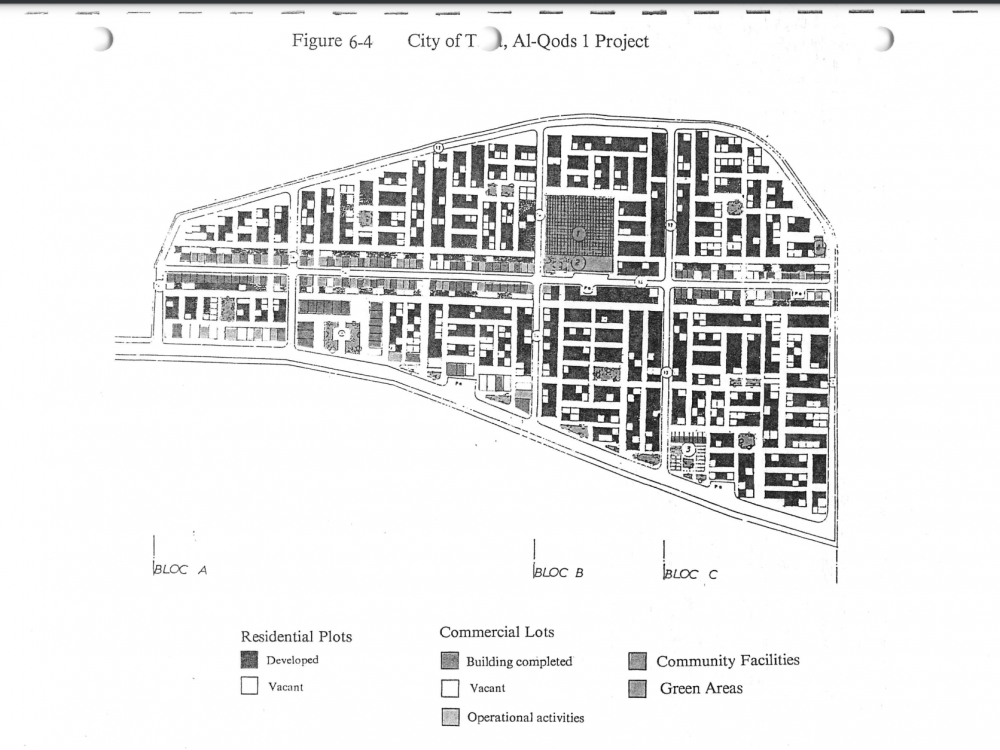
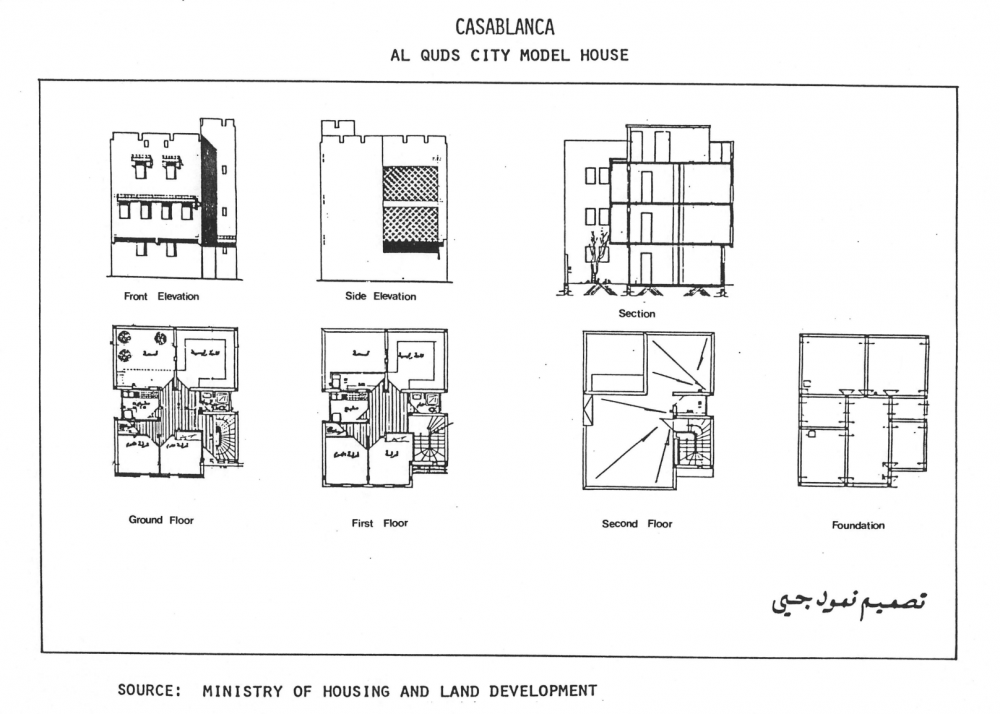
Figure 6-4 City of Taza, Al-Qods 1 Project “Residential Plots, Commercial Lots, Community Facilities, Green Areas”

See related I2UD projects below

Project Year:1992
Project Type:Report
Geographic Regions:Morocco
Reports:
Authors:Samir Kanoun (TSS, Inc.); Mona Serageldin
Sponsors:USAID Office of Housing and Urban Programs; International City/County Management Association (ICMA)
Categories:Informal Settlements and Urban Upgrading
  
ID:1992_00_004

Related I2UD Projects

ITP 1991: “Development Strategies for Urban Regeneration of Old Urban Fabric,” Case Studies and Seminar Curriculum, International Training Programs, 1991

Abstract

The 1991 International Training Program (ITP), hosted by the Unit for Housing and Urbanization (the Unit) at Harvard University’s Graduate School of Design, addressed strategies of re-manipulating old urban fabric, including plans to restructure central zones, recapture the development potential of strategically located parcels, and preserve valued urban and architectural heritage.

Case studies addressed a range of old urban zones needing restructure:

  • Redeveloping obsolete and dilapidated zones (London Docklands);
  • Reshaping deteriorating central zones (Boston’s Waterfront);
  • Halting the degradation of the physical environment (Hafsia district in Tunis, Tunisia); and
  • Preserving the distinctive character of historical areas (Vieux Carré in New Orleans).

Documents represent curriculum components from the 1991 ITP, including case studies, project summaries, newspaper and journal articles, and module overviews. Some materials may be replicated in other years of the ITP programs.

See related I2UD projects below

Project Year:1991
Project Type:ITP; Education
Geographic Regions:Waterfront, Boston, USA / London Docklands, UK / Hafsia, Tunis, Tunisia / Vieux Carré, New Orleans, USA / Kreuzberg, Berlin, Germany / Maarouf, Cairo, Egypt / Walled City of Lahore, Pakistan / Ij Waterfront, Amsterdam, Netherlands
Reports:
Authors:François Vigier; Mr Victor Karen; Barry Shaw
Sponsors:Unit for Housing and Urbanization, Harvard University Graduate School of Design
Categories:International Training Program; Education
  
ID:1991_07_001

Related I2UD Projects

Beginning in 1982, the Unit for Housing and Urbanization at Harvard University’s Graduate School of Design hosted International Training Programs (ITP), an annual series of 2- to 4-week summer seminars designed to strengthen the decision-making skills of senior professionals in public and private agencies responsible for urban development.

The I2UD Digital Library holds curriculum materials for ITPs from 19881991199419951997, and 1998:

The tradition of ITPs continued after 2000, when the Center for Urban Development Studies (CUDS) (a re-organization of the Unit) continued training seminars as International Education Programs (IEP) from 2000-2004:

Programs included inter-linked modules, lectures, case studies, interactive computer simulation models, site visits to urban projects, discussion groups and networking with professional counterparts from international metropolitan regions. Sessions had a modular format and structured team teaching, taught by a team of senior faculty and guest lecturers. Programs ended with a synthesis presented through a project evaluation exercise. Participants used case projects to examine strategies from the viewpoint of both public and private partners — to assess the feasibility and potential impacts of policies and projects on the community and the city. Presentations by guest speakers, representing U.S. and international agencies, NGOs, and community groups, were also integrated within the pedagogic framework of each module.

“Regularizing the Informal Land Development Process,” International Case Studies for the USAID Office of Housing and Urban Programs, Mona Serageldin, 1990

Abstract

In 1990, team members at the Unit for Housing and Urbanization (the Unit) at Harvard University’s Graduate School of Design authored a report on urban development case studies, “Regularizing the Informal Land Development Process,” for the USAID Office of Housing and Urban Programs.

The report focused on organizational disconnects between informal housing and formal planning development for urban communities, considering case studies on land development and legal considerations for nine urban municipalities across Asia, Africa, and the Americas: Navi Mumbai, India; Jakarta, Indonesia; Bangkok, Thailand; Mexico City, Mexico; Caracas, Venezuela; Cairo, Egypt; Amman, Jordan; Abidjan, Côte d’Ivoire; Conakry, Guinea; Kinshasa, Congo; and Lusaka, Zambia.

Case studies discuss three points for each city region:

  1. Informal land development processes;
  2. Regularization of informal land development; and
  3. Legal and institutional frameworks for land regularization.

See related I2UD projects below

Project Year:1990
Project Type:Land Development Case Studies
Geographic Regions:Navi Mumbai, India / Jakarta, Indonesia / Bangkok, Thailand / Mexico City, Mexico / Caracas, Venezuela / Cairo, Egypt / Amman, Jordan / Abidjan, Côte d’Ivoire / Conakry, Guinea / Kinshasa, Congo / Lusaka, Zambia
Reports:Regularizing the Informal Land Development Process: (Mona Serageldin, October 1990)
Authors:Mona Serageldin; John Driscoll; María-Luisa Fernández; Laurent Perrin; Randa Tukan; Phoebe Manzi
Sponsors:USAID Office of Housing and Urban Programs
Categories:Urban Planning
  
ID:1990_10_001

Related I2UD Projects

“The Abidjan Experience”- Four Research Reports on Community-Based Urban Development in Adjamé, Abidjan, Côte d’Ivoire, 1990-1995

Abstract

Between 1990 and 1995, the Unit for Housing and Urbanization (later the Center for Urban Development Studies, or CUDS) at Harvard University’s Graduate School of Design prepared four research reports on the commune district of Adjamé in Abidjan, Côte d’Ivoire (Ivory Coast). As a collection, these materials present a detailed analysis of urban housing trends in Côte d’Ivoire from the 1990s, covering economic, historical, architectural, financial and socio-geographical elements.

First, in September 1990, the Unit produced a major research endeavor, “Urban Infrastructure on Municipal Revenues and the Integration of Informal Sector Activities: The Abidjan Experience.” The report was produced for the USAID Office of Housing and Urban Programs in Washington D.C.

Second, in January 1994, Mona Serageldin and François Vigier wrote “Designing for Urban Growth, Abidjan Ivory Coast,” covering the socio-geography of Abidjan/Côte d’Ivoire in 5 detailed sections on National Context, Landscape, The Urban Landscape, Housing Typologies, and a detailed condition analysis of the Commune of Adjamé.

Third, in September 1994, the Unit presented “Community Based Development Lessons from Experience Across Cities” for a forum on “Enabling Sustainable Community Development” at the 2nd World Bank Conference. The presentation built on the Unit’s previous research on Adjamé among other cities, sponsored by the USAID’s Office of Environment and Urban Programs.

Fourth, in October 1995, Mona Serageldin and CUDS wrote a Working Paper, “Successful Institutionalization of Community Based Development of Adjamé, Abidjan.” The paper built off all previous research on Abidjan, covering six international case studies from Abidjan, Boston, Cairo, Lima, Lublin, and Tunis, selected because of their innovative character.


[Excerpt: “Community Based Development: Lessons from Experience Across Cities,” for the 2nd World Bank Conference, September 1994, Introduction, by Mona Serageldin for the Unit, 09/1994]/

“The ESD Conference, just completed yesterday, saw a remarkable unnamity on two points of relevance, to a discussion of cross-cutting lessons.

First, that community involvement is paramount for any meaningful action to reduce poverty and improve the urban environment; and Second, that there is no single formula to do it. The diversity of cities and their local context entail that concepts be adapted to the particularities of the local context.

Yet, there is a lot to be learned from the sharing of experiences. In spite of the diversity, there are common threads. The issue of empowerment was eloquently discussed this morning. Other issues have been discussed by the previous speakers. My presentation will highlight principles which structure interfaces between communities and municipalities in order to foster community based development approaches.”

Project Year:1990-1995
Project Type:Urban Development Research
Geographic Regions:Abidjan, Côte d’Ivoire (also Boston, United States; Cairo, Egypt; Lima, Perú; Lublin, Poland; and Tunis, Tunisia)
Reports:
Authors:Mona Serageldin; François Vigier; Samir Abdulac; Howard Trett; Wafaa Abdalla; Jeanine Anderson; Nader El Bizri; Janne Corniel; John Driscoll; Denis Lesage; Sherif Lotfi; David Neilson; Tarek Sweilim
Sponsors:Unit for Housing and Urbanization, Harvard University Graduate School of Design; World Bank; USAID
Categories:Urban Planning
  
ID:1990_09_001

Related I2UD Projects

Design Studio 1990: “The Medina of Tunis,” Urban Regeneration for the Historic Hafsia District, Tunis, Tunisia, Seminar Curriculum

Abstract

The Design Studio from Spring 1990, led by Professors François Vigier and Mona Serageldin, focused on urban regeneration in the Medina of Tunis, Tunisia. This studio addressed issues of revitalization of older urban districts of Tunis.

Documents include an overview of urban development, urban housing conditions, institutional frameworks, and government housing policies to outline the urban context of Tunisia. Reports detail the development site of the Hafsia District, and outline phases and plans for the revitalization project, including graphics and maps.


[Excerpt: “Urban and Housing Conditions,” Design Studio 1990]

Urban and Housing Conditions
“Rapid urbanization has generated a large demand for housing and add to intensive unregulated construction activity. As a result, housing stock has increased at an annual average rate of 4 percent, and conditions improved somewhat during the 80’s. However, throughout the decade, the demand for housing and urban services has outpaced the public sector’s ability to keep up with urban growth. Almost half of all dwellings built since 1975 have bypassed urban development regulations and were instead undertaken by the informal sector in areas lacking adequate utilities and relying on low-cost construction methods. To alleviate this problem, the supply of suitably located serviced land at prices affordable to the poorest segments of the population must be expanded.”
….

The Hafsia Revitalization Project
The objective of the project sponsored by the World Bank is to revitalize and renovate the area, and demonstrate the feasibility of upgrading medinas without dividing populations and by involving the private sector in the development process. The specific objectives are:

1. To revitalize the economic base with a look to the future while promoting employment opportunities for its present residents.

2. To upgrade the urban environment with minimum disruption of social cohesion and community life.

3. To structure a replicable self-financing, revitalization process given the lack of public resources. In other words, components of the proposal whose capital cost are not likely to be fully recovered (eg., housing for poorer households, infrastructure improvements, new community facilities) will have to be cross-subsidized by other revenue producing components.

4. To reverse development trends destructive to the character of the medina.”

See related I2UD projects below

Project Year:1990
Project Type:Urban Design Studio
Geographic Regions:Medina of Tunis, Tunisia
Reports:1990 Design Studio: Tunisia Urban Development
Authors:François Vigier; Mona Serageldin
Sponsors:Aga Khan Program for Islamic Architecture
Categories:Design Studios; Education
  
ID:1990_00_002

Related I2UD Projects

“Sustainable Improvement Strategies for Lower Income Urban Communities,” Upgrading Policy Plans for Amman and Aqaba (Jordan), Cairo (Egypt), and Karachi (Pakistan), 1990

Abstract

In 1990, the Unit for Housing and Urbanization undertook a project, “Sustainable Improvement Strategies for Lower Income Urban Communities,” focusing on upgrading strategies for low-income neighborhoods in Amman and Aqaba (Jordan), Cairo (Egypt), and Karachi (Pakistan).

The project was in collaboration with the Housing and Urban Development Corporation (HUDC) in Jordan and the Department of Community Health at the Aga Khan University in Karachi. Co-funded by the Ford Foundation and UNICEF, the study assessed projects in Jordan and Egypt that demonstrated successful approaches to improving environmental quality in urban neighborhoods.

The assessments focused on determining the potential for empowering lower income households to improve their economic conditions and living environments through the provision of appropriate infrastructure services. In Karachi, the Unit funded a survey of low-income communities (see “Issues Checklist”).

Documents include an overall summary of the study components and a working paper on “Sustainability of Public Spaces,” prepared by Howard Trett for the Unit in December 1990, as well as component reports by region. Supporting documents are an outline of the research agenda, a quality of life “Issues Checklist for the Reassessment of Common Spaces,” and a background report on HUDC Municipal and NGO Support Options for urban development assistance to the studied regions.


[Excerpt: “Summary of Overall Study Components,” p. 1-2]

PROBLEM DEFINITION
“The World Health Organization estimates that 5 million deaths and 2 to 3 million cases of permanent disability are caused yearly by contaminated water, poor sanitation, air pollution and overcrowding. The cumulative impact of these conditions is the most severe for children in low income urban neighborhoods. It is estimated that a child born in a squatter settlement is 40—to-50 times more likely to die before the age of five than a child in an industrialized country. According to the UN, efforts to alleviate these conditions through conventional upgrading and sites-and-services projects, has reached only ten percent of the urban poor. This investment has been concentrated in 150 projects which sought to achieve replicability through lower standards and higher levels of cost recovery.”

“These projects, which necessitate central government subsidies in one form or another, are increasingly becoming unaffordable to nations burdened by heavy foreign debts at a time when decentralization policies are shifting the responsibility of providing services to local governments.”

Municipalities in developing countries are attempting to cope with their new obligations by redefining their land development strategies, reorganizing their institutional structures and finding new methods of generating the financial resources necessary to provide and maintain urban services.”

“The ability of local government to respond to needs, and the effectiveness of the responses are linked to the capability to formulate and implement affordable improvement strategies which are also sustainable without a continuous infusion of public resources.”


PROJECT GOAL
“The research project seeks to identify, define and test strategies and methods to enable government authorities with private sector participation, to develop sustainable approaches to upgrading and maintaining urban environments in limited income communities. Special emphasis will be placed on defining strategies which have beneficial impacts on the quality of life for children and youths.”

PROJECT OBJECTIVES
– “Identify and select pragmatic approaches to sustaining environmental quality in low-income urban neighborhoods with particular emphasis on the needs of children and youths.

– Identify, select and define appropriate monitoring and evaluation criteria to appraise prevailing levels of urban environmental quality including health and sanitary conditions.

– Develop guidelines for sustainable improvement programs to be implemented by public authorities and non-government organizations.

– Train public officials and members of community organizations in assessment techniques and implementation of action programs for improving and maintaining environmental quality.”

See related I2UD projects below

Project Year:1990-1992
Project Type:Policy Plan
Geographic Regions:Amman and Aqaba, Jordan / Cairo, Egypt / Karachi, Pakistan
Reports:
Authors:John Driscoll; Mona Serageldin; Howard Trett; François Vigier
Sponsors:Ford Foundation; UNICEF; Unit for Housing and Urbanization, Harvard University Graduate School of Design; Aga Khan Trust for Culture; Housing and Urban Development Corporation (Jordan)
Categories:Informal Settlements and Urban Upgrading
  
ID:1990_01_001

Related I2UD Projects

“Second Urban Project,” Urban Development Study Proposals for Conakry, Guinea, 1990

Abstract

In May 1990, the Unit for Housing and Urbanization (the Unit) at Harvard University’s Graduate School of Design proposed an urban development study, “Strategies for Sustainable Improvements Through Community Participation,” as part of the “Second Urban Project” for Conakry, Guinea. The Unit’s proposal reflected the need in Guinea for an action program designed to better local neighborhood conditions in 1990. Suggested plans aimed to boost community participation and improve urban health through local planning guidelines, developing strategies for progressive improvements at the neighborhood level and providing analytical tools to support long-term development.

Documents include an annotated final report for “Guinea’s Second Urban Project,” study proposals by the Unit, notes by John Driscoll, and population distribution map.


[Excerpt: Report, February 1990, page 16]

The Housing and Land Development Component will include the implementation of a first 200-ha land development operation, in Conakry, following the financing and institutional proposals of the recently completed housing policy study (see para. 1.32). That study identified procedures and mechanisms to implement the Government’s strategy to increase formally recognized housing production through subdivision and development of urban land, to rationalize unregulated urban growth through the creation of a regulatory framework for urban planning and land market operations, and to maximize the number of households with access to security of tenure, housing and urban services.

The implementation of this policy is based on replicable land development operations relying on procedures which will limit public sector involvement to construction of secondary infrastructure, whose costs will be fully recovered, and will encourage a variety of public, semipublic and private developers to undertake subdivision and tertiary works within the blocks delimited by the secondary infrastructure network.”

See related I2UD projects below

Project Year:1990
Project Type:Urban Development Study
Geographic Regions:Conakry, Guinea
Reports:
Authors:John Driscoll
Sponsors:Unit for Housing and Urbanization, Harvard University Graduate School of Design
Categories:Informal Settlements and Urban Upgrading
  
ID:1990_01_002

Design Studio 1989: “Rabat’s Urban Fringe,” Urbanization Analysis of Rabat, Morocco – Seminar Curriculum

Abstract

The Design Studio from 1989, “Rabat’s Urban Fringe,” presented the urban evolution of Rabat, Morocco from 1987 through the early 1990s. Hosted by the Aga Khan Program for Islamic Architecture at Harvard University and the Massachusetts Institute of Technology, the seminar covered Rabat’s urban development experience as a case study for Seminar attendees. Professors Francois Vigier and Mona Serageldin led the sessions, research, and discussions.

Seminar materials focused on analyzing methods to accelerate the release of land for urban development in Rabat, and to discourage imbalanced city growth patterns. The studio covered the application of standards that balance climate requirements, socio-cultural needs, and affordability, the creation of cost-efficient designs to support the economic life of projects, and the use of politically-feasible mechanisms to improve cost recovery and affordability. This topic was repeated in Urban Design Studio curricula from 1989 to 1993.

Documents include a seminar syllabus and overview report; a full report, “Rabat’s Urban Fringe,” with text by Mona Serageldin, supported by the Seminar’s research team; and a final student report on urban planning in Rabat.


[Excerpt: Syllabus, Overview, Spring 1989, Mr. Vigier, Ms. Serageldin, pp. 1-2.]

Urban Housing in Rabat, Morocco,” An Overview:

“Urban areas of Third World countries are growing rapidly as a result of a high rate of natural increase of the population and of migration from rural areas. In older areas, usually highly accessible to a broad range of job opportunities, continued population pressures is causing a densification of the housing stock which is deteriorating rapidly from lack of maintenance and subdivision into smaller units. Their infrastructure systems are utilized well beyond their design capacity, creating an increasingly unsanitary environment and threatening the structural soundness of buildings. More recently, governments have had to cope with a dynamic private sector whose activities have proved difficult to control.”

“At present [ca. 1989], the urban fringe is developing rapidly as squatter and informal settlements, ranging in quality from little more than shacks to sound housing for moderate income households striving to improve their standard of living, are built illegally. Currently accounting for sixty to eighty percent of housing starts, these fringe developments present an unprecedented challenge to planners and public officials concerned with preventing urban sprawl and maintaining control over the dynamics of growth in order to provide efficiently the necessary infrastructure and services.”

Planning and Design Issues. High rates of urban growth necessitate forceful public interventions to direct the development of the urban fringe and improve the functional efficiency of older districts. Located in both older areas and on the urban fringe, large-scale projects are being undertaken to upgrade the infrastructure, extend the capacity of transportation systems, provide public amenities, and build mixed-use developments.”

“Yet, the prevalence of poverty has overtaxed the ability of governments to provide adequate public services or enforce even minimum sanitary standards of housing for the majority of urban households. Government housing policies have sought to reconcile three potentially conflicting objectives:

— “A commitment to improve the standard of life of a population largely unable to afford safe and sanitary housing on the open market.”

— “The desire to utilize planning and design standards reflecting international norms as the means to provide an acceptable level of amenities in both older areas and the developing urban fringe.”

— “The necessity to keep public subsidies at a manageable level in the face of the rising demand generated by the rapid growth of the urban population.”

Al Quds City Model House, for Casablanca, showing Front and Side Elevation, Sections, Ground, First and Second Floor, and Foundation building layouts. Original Source: Ministry of Housing and Land Development
Graphic Map showing the Distribution of Urban Settlements, Morocco, showing data for large settlements in Casablanca, Rabat, Fez, Marrakech, Meknes, Sale, Tangier, and Tetouan.

See related I2UD projects below

Project Year:1989
Project Type:Urban Design Studio
Geographic Regions:Rabat, Morocco
Reports:
Authors:Mona Serageldin; Samir Abdulac; Fathahah Debbi; Agnes Deboulet; Isabelle Ouetta; Jennifer Wayne; Hung-Song Oh; Randa Tukan
Sponsors:Aga Khan Program for Islamic Architecture
Categories:Design Studios; Education
  
ID:1989_01_001

Related I2UD Projects

“The Development and Morphology of Informal Housing,” Research Paper, Aga Khan Award for Architecture Seminar Proceedings, Mona Serageldin, 1988

Abstract

Mona Serageldin authored the research paper “The Development and Morphology of Informal Housing” in 1988 under the Unit for Housing and Urbanization at Harvard University’s Graduate School of Design, published as part of the proceedings for the Aga Khan Award for Architecture seminar, Architecture of Housing, held in Zanzibar, Tanzania in October 1988.

The paper relates the history of housing development processes from the 1950s through the 1980s in the Middle East, North Africa, and East Africa regions, in cities including Tunis, Tunisia; Damascus, Syria; Cairo, Egypt; Zanzibar, Tanzania; and Sana’a, Yemen. It compares the makeup of circumstances and populations, and describes housing units in each location, covering design and construction, with requirements for designing suitable housing units.


[Excerpt: I. Background: Mona Serageldin]

“The involvement of architects and planners with housing for lower income groups began in the 50’s and 60’s when national governments in the post colonial era embarked on slum eradication programs. Slum dwellers were to be rehoused in public housing estates. To the designers of these first projects, the overriding concern was decent shelter and sanitary conditions and not affordability. That their vision was influenced by prevailing international norms was the natural outcome of their professional training. Their failure to foresee the implications of demographic and economic trends over the next 2 decades invalidated their approach. Their efforts were overwhelmed by population growth, surplus labor, and an influx of rural migrants which could not be checked.

“Throughout the 60’s housing shortages increased and slums proliferated. Frustrated authorities turned to legislative controls, a politically expedient short-term remedy. The longer term impacts were devastating. Stringent controls accelerated the deterioration of the regulated stock, distorted private production, undermined the tax base, hampered residential mobility and warped occupancy patterns.

“The low cost shelter solutions advocated in the 60’s and 70’s produced a variety of expandable core housing prototypes to meet the needs of the urban poor. They were valid models in parts of Africa and Asia where the process happened to coincide with local practices as in Khartoum and Dakar. Elsewhere, the lack of enthusiasm among housing authorities for these approaches stemmed from an accurate perception of their unsuitability as a housing solution for the middle classes, the only client group of political consequence. Leverage and funding from international agencies launched projects in many countries which otherwise might have never experimented with minimal shelter programs. The improvements provided were on a scale too small to be meaningful in relation to the magnitude of the problem or noticeable in the midst of sprawling chaotic cities. By the mid 70’s their demonstration effect had lost its significance.”

“The shock waves in world economics and the resultant movements of labor and capital transformed the character of urban growth throughout the third world. By 1981, 15 million expatriate workers funneled between 25 and 35 billion dollars of foreign exchange back to their home countries. As the bulk of these remittances found their way into real estate, the urbanized area of cities doubled or tripled in extent shaped by uncontrolled housing construction on an unprecedented scale. Functionally defective and aesthetically chaotic environments became the dominant feature of cities, those annual rate of expansion of 4% to 7% outstripped the capacities of municipalities to provide urban services. As a result, their efficiency was impaired and there has been a sharp deterioration in the quality of life.”

Project Year:1988
Project Type:Research Paper
Geographic Regions:Cairo, Egypt / Damascus, Syria / Tunis, Tunisia / Sana’a, Yemen / Zanzibar, Tanzania
Reports:The Development and Morphology of Informal Housing (Mona Serageldin, September 1988)
Authors:Mona Serageldin; Samir Abdulac; Oussama Kabbani; Richard Khan
Sponsors:Aga Khan Award for Architecture
Categories:Urban Planning
  
ID:1988_09_001

Design Studio 1984: “Design, Technology and Logistics for Large Housing Projects,” in Algeria, India, Iraq, Malaysia, Mali and Singapore, Seminar Curriculum

Abstract

The 1984 Design Studio, “Design, Technology and Logistics for Large Housing Projects” was held by the Aga Khan Program for Islamic Architecture at Harvard University and the Massachusetts Institute of Technology from July 23-27, 1984.

Documents include a workshop schedule and summary, a bibliography, a table of contents with list of guest speakers, and background documents on Algeria, India, Iraq, Malaysia, Mali, and Singapore.


[Excerpt: 1984 Design Studio: Workshop Schedule and Summary, p7-8]

Note: See page 7-8 for full Workshop Topic Summaries:

1) Making Large-scale Housing Livable
2) Building Technologies for the Future
3) Alternative Approaches in Low-Cost Housing
4) Implementation and Management Strategies

Project Year:1984
Project Type:Urban Design Studio
Geographic Regions:Algeria / India / Iraq / Malaysia / Mali / Singapore
Reports:
Authors:François Vigier; Mona Serageldin
Sponsors:Aga Khan Program for Islamic Architecture
Categories:Design Studios; Education
ID:1984_07_001

Related I2UD Projects

Design Studio 1984: “The Revitalization of a Traditional Urban Quarter” for the Medieval Darb al Ahmar District, Cairo, Egypt, Seminar Curriculum

Abstract

The 1984 Design Studio, “The Revitalization of a Traditional Urban Quarter” for Darb al Ahmar, Cairo, addressed the unique dynamics of the historical district of Medieval Darb al Ahmar district in Cairo, Egypt. The Studio was held jointly by Unit for Housing and Urbanization at Harvard University’s Graduate School of Design and the MIT Laboratory of Architecture and Planning in Cambridge, Massachusetts.

Documents include an overview, syllabus, and background paper by Francois Vigier, with Mona Sergeldin. This initial research on the significant urban environment in Cairo, Egypt continued to evolve throughout the Unit, CUDS, and I2UD’s ongoing study of historical urban spaces.


[Excerpt: 1984 Design Studio: Darb Al Ahmar District Medieval Cairo (Overview) 1.0 – Overview, page 80]

“The Darb al Ahmar district is located in the south-eastern portion of the medieval city, between al Azhar University (founded in 972) and Salah ed Din’s Citadel, the seat of government from the 12th century to 1865. It is bounded to the east by remnants of the medieval wall and to the west by Port Said Street, a wide avenue built over the antique canal connecting Cairo to the Red Sea. Its 4.8 km area is equal to roughly one quarter of the medieval city; its 1980 population was estimated at 148,000 or 23% of the medieval city’s population.

The district’s importance lies in its location; for nine hundred years it was the link between the institutions and commercial areas concentrated in the Fatimid City and the seat of government in the citadel. Since the 19th century, its western edge has been the dividing line between the modern, Europeanized city along the Nile and the indigenous urban pattern. Although the rapid expansion of Cairo after World War 1 led to its partial marginalization, this trend has been arrested and there is every indication that intensive development pressures are now at work, threatening the physical and social fabric of the area.”

“The diversity of Darb al Ahmar’s population reflects its long history. In the center, around what has been the main commercial artery since medieval times, a stable resident population working in trade and services is swelled daily by a growing number of students and rural migrants, particularly day laborers. Along the eastern edge, the historically less reputable quarters at the urban periphery are now outflanked by informal settlements spreading into the cemetaries and onto the top of the Makkatam hills. To the west, the boundary created by Port Said Street is no longer the sharp divider between foreign and indigenous population that it was in the colonial era. It is part of the transitional zone between the traditional and modern urban fabrics, leading to the key transport node of Ataba and the government district of Abdine. “


[Excerpt cont’ 1. 1 – Evolution of Darb al Ahmar, page 82]

“The northern half of the district, built as part of the Fatimid town, is bisected by the Qasabat, the main north-south street that runs from Bab al Fut’uh to Bab Zuweyla. Lined with shops serving the residential areas on either side of it, it is still today one of the major shopping streets in the medieval city. In the past, specialty shops were interspersed among the mosques, schools, baths, public fountains, and noble houses that lined the street. Bookstores and stationers were found near Al Azhar, inlaid copper articles were made and sold near the Ghuri mosque while, just off the main street, druggists were manufacturing herbal remedies. Just inside Bab Zuweyla, cooked-food vendors, a fruit market and sweetmeat sellers were to be found in the Suq es Sukkariya; musical instruments were also sold in a nearby market.”

The area outside Bah Zuweyla was first settled as a low density suburb, housing the spill-over population of the Fatimid city. It remained largely undeveloped until the beginning of the 12th century when a governmental edict mandated owners to develop their land or sell it to someone who would, under penalty of confiscation. The first public building built outside the wall, the al Saleh Tala’i mosque, opposite Bab Zuweyla, was completed in 1160. Development occurred along the wall, towards the Nile, and southward, along the two old roads to the old settlement of Fustat, which had continued to strive as a popular district after the official precinct had been moved north to al Qahira. By the end of the 12th century, development trends had been reinforced by the construction of a new fortified wall by Salah ed-Din, which increased the area of the city eight-fold, and by his moving the seat of government from the Fatimid city to a newly built citadel. Densities increased rapidly as commerces and craftsmen thrived along this strategic link between Cairo’s densest districts and the Citadel as two of Darb al Ahmar’s main streets the Tabbana and al Khyamiya provided the shortest route between Bab Zuweyla and Bab el Wazir, the city’s new southernmost gate at the foot of the Citadel. The areas behind these streets were progressively subdivided for residences, ranging in quality from palaces to tenements.”


Index: Darb al Ahmar District, Medieval Cairo, Egypt

1. Overview
– Table 5: Gross Residential Densities (c. 1976)
1.1 Evolution of Darb al Ahmar
1.2 Typology of Monuments
1.3 The Domestic Architecture

2. Transformations.
2.1 Evolution of the Physical Fabric
2.2 Social Change
– Household characteristics.
– Livelihood and income
– Housing conditions

3. Socio-Economic Indicators
3.1 Harah es Sokkariya


Cairo: Statistical Appendix.
Table of Contents:

1. Greater Cairo Housing Characteristics
2. Greater Cairo Employment Structures by Economic Activity
3. Medieval City – Demographic Characteristics
4. Medieval City – Education
5. Medieval City – Marital Status of the Adult Population
6. Medieval City – Household Size and Composition
7. Medieval City – Employment Status
8. Medieval City – Employment Structure by Economic Activity
9. Medieval City – Occupations
10. Medieval City – Commuting Patterns
11. Southern Sector Demographic Characteristics
12. Helwan District – Education
13. Helwan District – Marital Status
14. Helwan District – Household Size and Composition
15. Helwan District – Employment Status
16. Helwan District – Occupation
17. Helwan District – Characteristics of Housing Stock
18. Helwan District – Residential Densities
19. Helwan District – Commuting Patterns


[Excerpt: Darb al Ahmar, Overview: Bibliography, transcribed from hand-written text]

Nadim, Nawal (el Memiri). The Relationships between the sexes in a a Harah of Cairo, Indiana University, Doctoral Dissertation, 1975

Wikan, Unni, “Living conditions among Cairo’s poor – a View from Below, ” Middle East Journal, Vol. 39, No. 1, Winter, 1981(?), pp. 7-26.

Raymond, Andre, Artisans el Commercants au Caire au XVIIe siècle, Damascus; Institut Francais de Damascus, 1974. Tome I. Damas: Presses de l’Ifpo. doi:10.4000/books.ifpo.5950.

Revault, Jacques et Bernard Maury. Palais et maisons du Caire du XIVe au XVIIIe siècle, Le Caire : Institut Français d’Archéologie Orientale du Caire, 1975-79.

Ibrahim, Laila ‘Ali, “Residential Architecture in Mamluk Cairo,” in Mukarnas, Vol. 2, 1984.

Williams, John Allen, “Urbanization and Monument Construction in Mamluk Cairo,” in Makarnas, Vol. 2, 1984


See related I2UD projects below

Project Year:1984
Project Type:Urban Design Studio
Geographic Regions:Darb Al Ahmar, Cairo, Egypt
Reports:
Authors:François Vigier; Mona Serageldin
Sponsors:Aga Khan Program for Islamic Architecture
Categories:Design Studios; Education
  
ID:1984_01_001

Related I2UD Projects

Design Studio 1981: “Housing Design in Islamic Cultures” in Algeria, Bangladesh, Egypt, Iraq, Pakistan, Saudi Arabia and Indonesia, Seminar Curriculum

Abstract

The 1981 Design Studio, “Housing Design in Islamic Cultures,” was held jointly by the Unit for Housing and Urbanization at the Harvard University’s Graduate School of Design and the MIT Laboratory of Architecture and Planning in August 1981.

Documents include a program syllabus, an essay on “Determinants of Housing Design” by Professor Vigier, an essay on the “Role of the Public Sector” by Ismail Serageldin, and a bibliography on “Housing and Housing Design in the Muslim World” by Aga Khan/MIT librarian Richard Dewey.

Supporting materials include background papers on M’Sila, Algeria; Dhaka, Bangladesh; El Mounira Imbaba, Egypt; Iraq National Context; Karachi, Pakistan; Yanbu Industrial City, Saudi Arabia; and Indonesia.

See related I2UD projects below

Project Year:1981
Project Type:Urban Design Studio
Geographic Regions:Dhaka, Bangladesh / Karachi, Pakistan / Yanbu Industrial City, Saudi Arabia / Iraq / Egypt / M’Sila, Algeria / Indonesia
Reports:


National Urban Context Background Papers:
Authors:Mona Serageldin; François Vigier; Ismail Serageldin; Assia Khellaf; Altaf Mulla; Aminul Haq Khan; Nadia Al Hasani; Akhtar Badshah; Isam Alimam; Javed Sultan; Mohamed El-Sioufi; Richard H. Dewey
Sponsors:Aga Khan Program for Islamic Architecture
Categories:Design Studios; Education
  
ID:1981_08_001

Related I2UD Projects