
“Arusha Urbanization Strategy and Urban Development Plan,” Development Strategy for Arusha Municipality, Tanzania, 2009-2012

Abstract

The “Arusha Urbanization Strategy and Urban Development Plan” was a comprehensive development strategy completed by I2UD for the East African Community of Arusha, Tanzania in 2012.

I2UD compiled the plan between 2009 and 2012, funded by the Aga Khan University, which has an extensive East African campus. As the designated capital of East Africa, Arusha attracts investments and donor support for development projects, is a prime tourist destination, wildlife region and key node in the African Rift Valley with a wealth of natural and cultural heritage.

Documents include a Planning Proposal draft, a 2009 Inception Report, Second Interim, Summary, and Field reports from 2010, followed by Fourth, Fifth, Sixth, Seventh and Eighth Interim Reports. Finally, a Final Report, Brief, and Community Case Studies from 2012 complete the materials on this project.

Project Year:2009-2012
Project Type:Comprehensive Plan
Geographic Regions:Arusha, Tanzania
Reports:


Authors:Mona Serageldin; Warren Hagist; Caroline Jordi; Richard Kruger; Christa Lee-Chuvala; Kendra Leith; Biorn Maybury-Lewis; Carolina Morgan; Alejandra Mortarini; Natalie Pohlman; Linda Shi; Daniel Tsai
Sponsors:Aga Khan University
Categories:Urban Planning
  
ID:2012_01_001

Related I2UD Projects

“Samarkand, Uzbekistan: Revitalization and Rehabilitation of the Historic District,” Technical Assistance for the City of Samarkand, Uzbekistan, 1994

Abstract

In 1994, the Unit for Housing and Urbanization implemented an urban revitalization strategy for the rehabilitation of the historic urban fabric in Samarkand, Uzbekistan. Through the Technical Assistance project the Unit aimed to assist local government authorities to adopt improvement strategies. The Unit worked with local public officials, practitioners, and Mahalla leaders to establish an institutional framework for local revitalization and rehabilitation initiatives within the city’s Ghur Emir historic district. Documents include the Full Report, “Institutional Framework to Foster Revitalization and Local Rehabilitation Initiatives,” as well as color maps and color photographs.


[Excerpt, Full Report, August 1994]

“This report presents the findings of a mission to Samarkand undertaken by Mona Serageldin adjunct professor of Urban Planning and Associate Director of the Unit for Housing and Urbanization at Harvard University Graduate School of Design in June 15-22, 1996. The Mission was sponsored by the Aga Khan Trust of Culture, Historic Cities Support Program, for the purpose of assisting the government authorities in Samarkand and the AKTC in establishing an institutional framework to foster revitalization and local rehabilitation initiatives in the city’s Historic District. The support received from Dr. Stephano Bianca, Director of the Historic Cities Support Program, Mr. Nemetjon Sadiqov, AKTC representative in Samarkand and their staff contributed to the successful completion of the mission.”

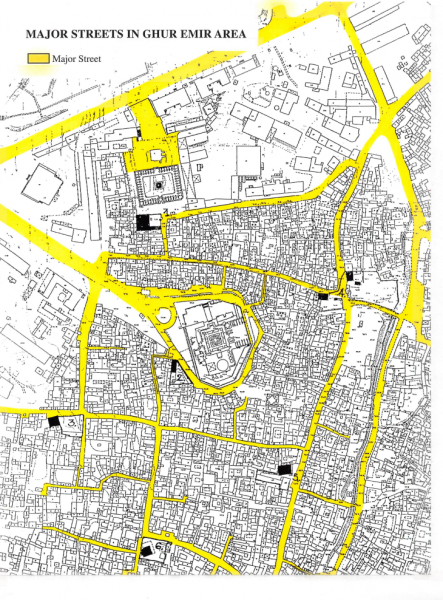
Excerpt: Color Maps: “Major Streets in Ghur Emir Area”

See related I2UD projects below

Project Year:1994
Project Type:Local Rehabilitation Initiative and Technical Assistance
Geographic Regions:Samarkand, Uzbekistan
Reports:
Authors:Mona Serageldin; Boguslaw Trondowski; Sameh Wahba; Anna Zietek
Sponsors:Aga Khan Trust for Culture, Historic Cities Programme
Categories:Historic Districts
  
ID:1994_00_003

Related I2UD Projects

“Sustainable Improvement Strategies for Lower Income Urban Communities,” Upgrading Policy Plans for Amman and Aqaba (Jordan), Cairo (Egypt), and Karachi (Pakistan), 1990

Abstract

In 1990, the Unit for Housing and Urbanization undertook a project, “Sustainable Improvement Strategies for Lower Income Urban Communities,” focusing on upgrading strategies for low-income neighborhoods in Amman and Aqaba (Jordan), Cairo (Egypt), and Karachi (Pakistan).

The project was in collaboration with the Housing and Urban Development Corporation (HUDC) in Jordan and the Department of Community Health at the Aga Khan University in Karachi. Co-funded by the Ford Foundation and UNICEF, the study assessed projects in Jordan and Egypt that demonstrated successful approaches to improving environmental quality in urban neighborhoods.

The assessments focused on determining the potential for empowering lower income households to improve their economic conditions and living environments through the provision of appropriate infrastructure services. In Karachi, the Unit funded a survey of low-income communities (see “Issues Checklist”).

Documents include an overall summary of the study components and a working paper on “Sustainability of Public Spaces,” prepared by Howard Trett for the Unit in December 1990, as well as component reports by region. Supporting documents are an outline of the research agenda, a quality of life “Issues Checklist for the Reassessment of Common Spaces,” and a background report on HUDC Municipal and NGO Support Options for urban development assistance to the studied regions.


[Excerpt: “Summary of Overall Study Components,” p. 1-2]

PROBLEM DEFINITION
“The World Health Organization estimates that 5 million deaths and 2 to 3 million cases of permanent disability are caused yearly by contaminated water, poor sanitation, air pollution and overcrowding. The cumulative impact of these conditions is the most severe for children in low income urban neighborhoods. It is estimated that a child born in a squatter settlement is 40—to-50 times more likely to die before the age of five than a child in an industrialized country. According to the UN, efforts to alleviate these conditions through conventional upgrading and sites-and-services projects, has reached only ten percent of the urban poor. This investment has been concentrated in 150 projects which sought to achieve replicability through lower standards and higher levels of cost recovery.”

“These projects, which necessitate central government subsidies in one form or another, are increasingly becoming unaffordable to nations burdened by heavy foreign debts at a time when decentralization policies are shifting the responsibility of providing services to local governments.”

Municipalities in developing countries are attempting to cope with their new obligations by redefining their land development strategies, reorganizing their institutional structures and finding new methods of generating the financial resources necessary to provide and maintain urban services.”

“The ability of local government to respond to needs, and the effectiveness of the responses are linked to the capability to formulate and implement affordable improvement strategies which are also sustainable without a continuous infusion of public resources.”


PROJECT GOAL
“The research project seeks to identify, define and test strategies and methods to enable government authorities with private sector participation, to develop sustainable approaches to upgrading and maintaining urban environments in limited income communities. Special emphasis will be placed on defining strategies which have beneficial impacts on the quality of life for children and youths.”

PROJECT OBJECTIVES
– “Identify and select pragmatic approaches to sustaining environmental quality in low-income urban neighborhoods with particular emphasis on the needs of children and youths.

– Identify, select and define appropriate monitoring and evaluation criteria to appraise prevailing levels of urban environmental quality including health and sanitary conditions.

– Develop guidelines for sustainable improvement programs to be implemented by public authorities and non-government organizations.

– Train public officials and members of community organizations in assessment techniques and implementation of action programs for improving and maintaining environmental quality.”

See related I2UD projects below

Project Year:1990-1992
Project Type:Policy Plan
Geographic Regions:Amman and Aqaba, Jordan / Cairo, Egypt / Karachi, Pakistan
Reports:
Authors:John Driscoll; Mona Serageldin; Howard Trett; François Vigier
Sponsors:Ford Foundation; UNICEF; Unit for Housing and Urbanization, Harvard University Graduate School of Design; Aga Khan Trust for Culture; Housing and Urban Development Corporation (Jordan)
Categories:Informal Settlements and Urban Upgrading
  
ID:1990_01_001

Related I2UD Projects

“The Development and Morphology of Informal Housing,” Research Paper, Aga Khan Award for Architecture Seminar Proceedings, Mona Serageldin, 1988

Abstract

Mona Serageldin authored the research paper “The Development and Morphology of Informal Housing” in 1988 under the Unit for Housing and Urbanization at Harvard University’s Graduate School of Design, published as part of the proceedings for the Aga Khan Award for Architecture seminar, Architecture of Housing, held in Zanzibar, Tanzania in October 1988.

The paper relates the history of housing development processes from the 1950s through the 1980s in the Middle East, North Africa, and East Africa regions, in cities including Tunis, Tunisia; Damascus, Syria; Cairo, Egypt; Zanzibar, Tanzania; and Sana’a, Yemen. It compares the makeup of circumstances and populations, and describes housing units in each location, covering design and construction, with requirements for designing suitable housing units.


[Excerpt: I. Background: Mona Serageldin]

“The involvement of architects and planners with housing for lower income groups began in the 50’s and 60’s when national governments in the post colonial era embarked on slum eradication programs. Slum dwellers were to be rehoused in public housing estates. To the designers of these first projects, the overriding concern was decent shelter and sanitary conditions and not affordability. That their vision was influenced by prevailing international norms was the natural outcome of their professional training. Their failure to foresee the implications of demographic and economic trends over the next 2 decades invalidated their approach. Their efforts were overwhelmed by population growth, surplus labor, and an influx of rural migrants which could not be checked.

“Throughout the 60’s housing shortages increased and slums proliferated. Frustrated authorities turned to legislative controls, a politically expedient short-term remedy. The longer term impacts were devastating. Stringent controls accelerated the deterioration of the regulated stock, distorted private production, undermined the tax base, hampered residential mobility and warped occupancy patterns.

“The low cost shelter solutions advocated in the 60’s and 70’s produced a variety of expandable core housing prototypes to meet the needs of the urban poor. They were valid models in parts of Africa and Asia where the process happened to coincide with local practices as in Khartoum and Dakar. Elsewhere, the lack of enthusiasm among housing authorities for these approaches stemmed from an accurate perception of their unsuitability as a housing solution for the middle classes, the only client group of political consequence. Leverage and funding from international agencies launched projects in many countries which otherwise might have never experimented with minimal shelter programs. The improvements provided were on a scale too small to be meaningful in relation to the magnitude of the problem or noticeable in the midst of sprawling chaotic cities. By the mid 70’s their demonstration effect had lost its significance.”

“The shock waves in world economics and the resultant movements of labor and capital transformed the character of urban growth throughout the third world. By 1981, 15 million expatriate workers funneled between 25 and 35 billion dollars of foreign exchange back to their home countries. As the bulk of these remittances found their way into real estate, the urbanized area of cities doubled or tripled in extent shaped by uncontrolled housing construction on an unprecedented scale. Functionally defective and aesthetically chaotic environments became the dominant feature of cities, those annual rate of expansion of 4% to 7% outstripped the capacities of municipalities to provide urban services. As a result, their efficiency was impaired and there has been a sharp deterioration in the quality of life.”

Project Year:1988
Project Type:Research Paper
Geographic Regions:Cairo, Egypt / Damascus, Syria / Tunis, Tunisia / Sana’a, Yemen / Zanzibar, Tanzania
Reports:The Development and Morphology of Informal Housing (Mona Serageldin, September 1988)
Authors:Mona Serageldin; Samir Abdulac; Oussama Kabbani; Richard Khan
Sponsors:Aga Khan Award for Architecture
Categories:Urban Planning
  
ID:1988_09_001