
IEP 2003: “Infrastructure and Partnerships for Local Economic Development” in Pretoria and Bloemfontein, South Africa, International Education Programs, 2003

Abstract

Curriculum components from the 2003 IEP (International Education Program) “Infrastructure and Partnerships for Local Economic Development,” which was held in Pretoria and Bloemfontein, South Africa in August and September 2003.

Documents include agendas, case studies, project summaries, and reference materials. Noted work by Mona Serageldin includes “Decentralization and Urban Infrastructure Management Capacity,” a background paper for the 2001 Third Global Report on Human Settlements.

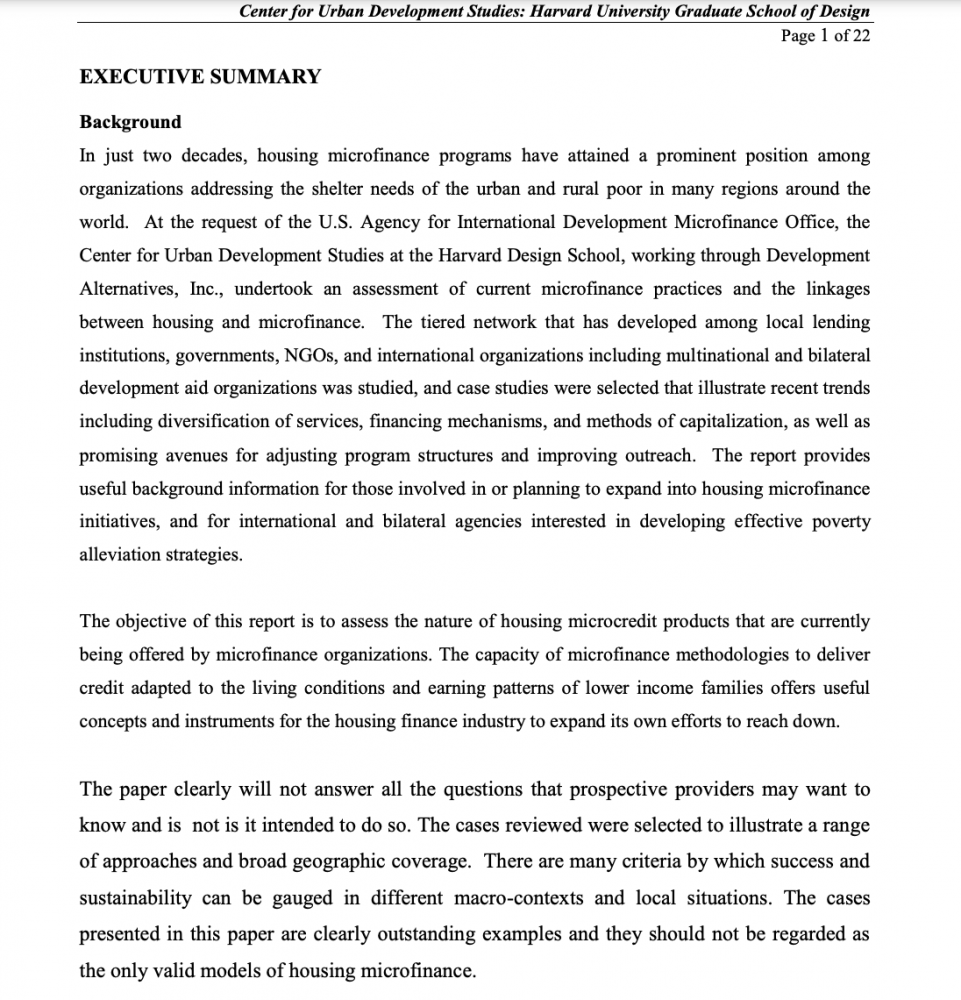
Additional contextual documents include: The “Best Practices 2001” submission for Middledrift, Eastern Cape, South Africa; an executive summary from May 2000 for the “Housing Microfinance Initiative”; a presentation of indicator reports by CUDS “Neighborhood Improvement Program, Neiva, Colombia”; and “Participant Evaluation and Comments” forms for the 2003 seminar participants.

See related I2UD projects below

Project Year:2003
Project Type:IEP; Education
Geographic Regions:Pretoria and Bloemfontein, South Africa (Program Locations) / Brazil / Boston, Massachusetts, US / South Africa / Bogotá, Colombia / Southwark, London, UK / Saint-Denis and Aubervilliers, France / Ahmedabad, India / Adjamé, Abidjan, Côte d’Ivoire / Szczecin, Poland
Reports:
Authors:CUDS Team
Sponsors:Center for Urban Development Studies, Harvard University Graduate School of Design
Categories:International Education Program; Education
  
ID:2003_08_001

Related I2UD Projects

Beginning in 1982, the Unit for Housing and Urbanization at Harvard University’s Graduate School of Design hosted International Training Programs (ITP), an annual series of 2- to 4-week summer seminars designed to strengthen the decision-making skills of senior professionals in public and private agencies responsible for urban development.

The I2UD Digital Library holds curriculum materials for ITPs from 19881991199419951997, and 1998:

The tradition of ITPs continued after 2000, when the Center for Urban Development Studies (CUDS) (a re-organization of the Unit) continued training seminars as International Education Programs (IEP) from 2000-2004:

Programs included inter-linked modules, lectures, case studies, interactive computer simulation models, site visits to urban projects, discussion groups and networking with professional counterparts from international metropolitan regions. Sessions had a modular format and structured team teaching, taught by a team of senior faculty and guest lecturers. Programs ended with a synthesis presented through a project evaluation exercise. Participants used case projects to examine strategies from the viewpoint of both public and private partners — to assess the feasibility and potential impacts of policies and projects on the community and the city. Presentations by guest speakers, representing U.S. and international agencies, NGOs, and community groups, were also integrated within the pedagogic framework of each module.

IEP 2002: “Strategic Planning for Local Development & Urban Revitalization,” Program Overview, International Education Programs, 2002

Abstract

The 2002 International Education Program “Strategic Planning for Local Development & Urban Revitalization,” addressed the range of strategies adopted by public and private organizations active at the local level to promote economic growth and urban revitalization. The course covered the challenges faced by professional urban developers, focusing on designing programs to address increasing levels of urban poverty, income inequalities and the lack of urban services. Participants explored strategies that create a supportive environment for development including:

  • Expanded access to services and economic opportunity for lower-income households;
  • Improved efficiency in the management of infrastructure and urban services; and
  • Enhanced access to financing, technology, and managerial expertise.

This document is an overview of the seminar, including overall scope, a list of guest lecturers and speakers, program faculty, and seminar components.

See related I2UD projects below

Project Year:2002
Project Type:IEP; Education
Geographic Regions:Cambridge, Massachusetts, US (Program Location)
Reports:IEP 2002 (Information Document)
Authors:CUDS Team
Sponsors:Center for Urban Development Studies, Harvard University Graduate School of Design
Categories:International Education Program; Education
  
ID:2002_01_001

Related I2UD Projects

Beginning in 1982, the Unit for Housing and Urbanization at Harvard University’s Graduate School of Design hosted International Training Programs (ITP), an annual series of 2- to 4-week summer seminars designed to strengthen the decision-making skills of senior professionals in public and private agencies responsible for urban development.

The I2UD Digital Library holds curriculum materials for ITPs from 19881991199419951997, and 1998:

The tradition of ITPs continued after 2000, when the Center for Urban Development Studies (CUDS) (a re-organization of the Unit) continued training seminars as International Education Programs (IEP) from 2000-2004:

Programs included inter-linked modules, lectures, case studies, interactive computer simulation models, site visits to urban projects, discussion groups and networking with professional counterparts from international metropolitan regions. Sessions had a modular format and structured team teaching, taught by a team of senior faculty and guest lecturers. Programs ended with a synthesis presented through a project evaluation exercise. Participants used case projects to examine strategies from the viewpoint of both public and private partners — to assess the feasibility and potential impacts of policies and projects on the community and the city. Presentations by guest speakers, representing U.S. and international agencies, NGOs, and community groups, were also integrated within the pedagogic framework of each module.

IEP August 2001: “Infrastructure Planning and Partnerships for Local Economic Development,” Pretoria, South Africa, International Education Programs, 2001

Abstract

The Center for Urban Development Studies (CUDS) at Harvard University’s Graduate School of Design developed curriculum on “Infrastructure Planning and Partnerships for Local Economic Development” for its August 2001 International Education Program (IEP) held in Pretoria, South Africa. Materials for the seminar included a workshop discussion guide and case studies and excerpts of past CUDS research. Some materials were repeated or reworked from previous IEP and ITP sessions.

See related I2UD projects below

Project Year:2001
Project Type:IEP; Education
Geographic Regions:Pretoria, South Africa (Workshop Location)
Reports:
Authors:Mona Serageldin; Sameh Wahba
Sponsors:Center for Urban Development Studies, Harvard University Graduate School of Design
Categories:International Education Program; Education
  
ID:2001_08_003

Related I2UD Projects

Beginning in 1982, the Unit for Housing and Urbanization at Harvard University’s Graduate School of Design hosted International Training Programs (ITP), an annual series of 2- to 4-week summer seminars designed to strengthen the decision-making skills of senior professionals in public and private agencies responsible for urban development.

The I2UD Digital Library holds curriculum materials for ITPs from 19881991199419951997, and 1998:

The tradition of ITPs continued after 2000, when the Center for Urban Development Studies (CUDS) (a re-organization of the Unit) continued training seminars as International Education Programs (IEP) from 2000-2004:

Programs included inter-linked modules, lectures, case studies, interactive computer simulation models, site visits to urban projects, discussion groups and networking with professional counterparts from international metropolitan regions. Sessions had a modular format and structured team teaching, taught by a team of senior faculty and guest lecturers. Programs ended with a synthesis presented through a project evaluation exercise. Participants used case projects to examine strategies from the viewpoint of both public and private partners — to assess the feasibility and potential impacts of policies and projects on the community and the city. Presentations by guest speakers, representing U.S. and international agencies, NGOs, and community groups, were also integrated within the pedagogic framework of each module.

IEP May 2001: “Infrastructure Planning and Partnerships for Local Economic Development,” Eastern Cape, South Africa, International Education Programs, 2001

Abstract

The Center for Urban Development Studies (CUDS) at Harvard University’s Graduate School of Design produced a curriculum in 2001 for their International Education Program (IEP) held in Eastern Cape, South Africa in May of that year. The seminar was titled “Infrastructure Planning and Partnerships for Local Economic Development” and included relevant case studies and excerpts pulled from previous CUDS work.

[Excerpt: Executive Summary, May 2001, p. 1]

See related I2UD projects below

Project Year:2001
Project Type:IEP; Education
Geographic Regions:Eastern Cape, South Africa
Reports:
Authors:John Driscoll; Emly Costa; Mona Serageldin; Sameh Wahba; Patrick Bodart; Yves Cabannes; Boguslaw Trondowski
Sponsors:Center for Urban Development Studies, Harvard University Graduate School of Design
Categories:International Education Program; Education
  
ID:2001_05_001

Related I2UD projects

Beginning in 1982, the Unit for Housing and Urbanization at Harvard University’s Graduate School of Design hosted International Training Programs (ITP), an annual series of 2- to 4-week summer seminars designed to strengthen the decision-making skills of senior professionals in public and private agencies responsible for urban development.

The I2UD Digital Library holds curriculum materials for ITPs from 19881991199419951997, and 1998:

The tradition of ITPs continued after 2000, when the Center for Urban Development Studies (CUDS) (a re-organization of the Unit) continued training seminars as International Education Programs (IEP) from 2000-2004:

Programs included inter-linked modules, lectures, case studies, interactive computer simulation models, site visits to urban projects, discussion groups and networking with professional counterparts from international metropolitan regions. Sessions had a modular format and structured team teaching, taught by a team of senior faculty and guest lecturers. Programs ended with a synthesis presented through a project evaluation exercise. Participants used case projects to examine strategies from the viewpoint of both public and private partners — to assess the feasibility and potential impacts of policies and projects on the community and the city. Presentations by guest speakers, representing U.S. and international agencies, NGOs, and community groups, were also integrated within the pedagogic framework of each module.

IEP 2000-2001: Seminar on Urban Planning and Local Economic Development for Romania (UPLED), for Oradea, Iasi and Focșani, Romania, International Education Programs, 2001

Abstract

CUDS developed an International Education Program (IEP) seminar for the Romanian Urban Planning and Local Economic Development Program (UPLED), in 2000 and 2001 in Romania. The programs assisted the three Cities of Oradea, Iași, and Focșani to formulate city development strategies and adopt improved urban management practices in support of local economic development in Romania.

The seminar from September 19-23, 2001 for the city of Oradea, Romania was organized in association with the Research Triangle Institute Romania and the USAID Local Government Assistance Program, with support from the Open Society Foundation and Partners Foundation for Local Development.

The seminar from March 20-23, 2001 for the city of Iași, Romania was co-organized by the City of Iasi and Harvard University Graduate School of Design, Center for Urban Development Studies, in Association with The Research Triangle Institute, and the USAID Local Government Assistance Program.

Documents include these seminar materials, and a letter from the Mayor of Iași to the USAID Mission Director regarding the UPLED seminar, and case studies.

See related I2UD projects below

Project Year:2000-2001
Project Type:IEP; Education
Geographic Regions:Romania (Oradea, Iași, and Focșani)
Reports:


Authors:David Jones; François Vigier; John Driscoll; Liviu Ianasi, Alexandru Sandu; Georgeta Stirbu; Adrian Cuperman; Cristina Costin; Carmen Grosu; Sorin Caian; Katalin Pallai; Viorica Serbu; Ion Oancea; Mircea Grigorovschi; Victor Giosan; Daniela Olaru; Violeta Balica; Robert Kehew; Oradea Mayor Petru Filip; Tanase Miculescu; Andrei Krausz; Andrei Luncan; Claudia Pamfil
Sponsors:RTI International; USAID Local Government Assistance Program; Open Society Foundation; Partners Foundation for Local Developement
Categories:International Education Program; Executive Training Program; Education
  
ID:2001_03_001

Related I2UD Projects

Beginning in 1982, the Unit for Housing and Urbanization at Harvard University’s Graduate School of Design hosted International Training Programs (ITP), an annual series of 2- to 4-week summer seminars designed to strengthen the decision-making skills of senior professionals in public and private agencies responsible for urban development.

The I2UD Digital Library holds curriculum materials for ITPs from 19881991199419951997, and 1998:

The tradition of ITPs continued after 2000, when the Center for Urban Development Studies (CUDS) (a re-organization of the Unit) continued training seminars as International Education Programs (IEP) from 2000-2004:

Programs included inter-linked modules, lectures, case studies, interactive computer simulation models, site visits to urban projects, discussion groups and networking with professional counterparts from international metropolitan regions. Sessions had a modular format and structured team teaching, taught by a team of senior faculty and guest lecturers. Programs ended with a synthesis presented through a project evaluation exercise. Participants used case projects to examine strategies from the viewpoint of both public and private partners — to assess the feasibility and potential impacts of policies and projects on the community and the city. Presentations by guest speakers, representing U.S. and international agencies, NGOs, and community groups, were also integrated within the pedagogic framework of each module.

IEP October 2000: “Seminar on Strategic Planning for Urban Revitalization and Local Development” in Pretoria, South Africa, International Education Programs, 2000

Abstract

Seminar materials represent curriculum components from the 2000 International Education Program (IEP), “Seminar on Strategic Planning for Urban Revitalization and Local Development” held October 30 through November 3, 2000 in Pretoria, South Africa. Documents include project excerpts and case studies used in the seminar, including a presentation by Mona Serageldin presented at the HABITAT II Urban Finance Conference in 1995, “Empowerment and Accountability in Local Governance: Adjame’s Community Development Experience.”

See related I2UD projects below

Project Year:2000
Project Type:IEP; Education
Geographic Regions:Pretoria, South Africa (Seminar Location)
Reports:
Authors:Mona Serageldin; John Driscoll; Sameh Wahba; Boguslaw Trondowski; Patrick Bodart; Yves Cabannes; Emily Costa
Sponsors:Center for Urban Development Studies, Harvard University Graduate School of Design
Categories:International Education Program; Education; Informal Settlements and Urban Upgrading
  
ID:2000_10_001

Related I2UD Projects

Beginning in 1982, the Unit for Housing and Urbanization at Harvard University’s Graduate School of Design hosted International Training Programs (ITP), an annual series of 2- to 4-week summer seminars designed to strengthen the decision-making skills of senior professionals in public and private agencies responsible for urban development.

The I2UD Digital Library holds curriculum materials for ITPs from 19881991199419951997, and 1998:

The tradition of ITPs continued after 2000, when the Center for Urban Development Studies (CUDS) (a re-organization of the Unit) continued training seminars as International Education Programs (IEP) from 2000-2004:

Programs included inter-linked modules, lectures, case studies, interactive computer simulation models, site visits to urban projects, discussion groups and networking with professional counterparts from international metropolitan regions. Sessions had a modular format and structured team teaching, taught by a team of senior faculty and guest lecturers. Programs ended with a synthesis presented through a project evaluation exercise. Participants used case projects to examine strategies from the viewpoint of both public and private partners — to assess the feasibility and potential impacts of policies and projects on the community and the city. Presentations by guest speakers, representing U.S. and international agencies, NGOs, and community groups, were also integrated within the pedagogic framework of each module.

IEP August 2000: “Boston, Massachusetts: Strategic Plans and Community Participation,” International Education Programs, 2000

Abstract

The Center for Urban Development Studies (CUDS) at Harvard University’s Graduate School of Design conducted an International Education Program (IEP) on “Boston, Massachusetts: Strategic Plans and Community Participation” in August 2000. The curriculum for the program included case studies and project summaries from influential offices and agencies from Boston, Massachusetts, United States. Many case studies were replicated for later years of the IEP program.

Multiple curriculum components are contained in each document. See individual cover pages for full section indexes, or the Program Reference Materials List (Volume 1 Index). For example, the document “Boston Strategic Plans and Community Participation (Case Studies)” contains multiple works:

  • A Civic Vision for Turnpike Air Rights (Strategic Development Study Committee, Boston Redevelopment Authority Boston, MA, 2000)
  • Private/Public Development of South Station (Center for Urban Development Studies, Cambridge, MA, 1995)
  • Boston 400 Guide to Community Participation (Boston Redevelopment Authority, Boston, MA, Summer 1999)
  • Choosing to Compete: A Statewide Strategy for Job Creation and Economic Growth: Executive Summary (Executive Office of Economic Affairs, Commonwealth of Massachusetts, May 1993)

See related I2UD projects below

Project Year:2000
Project Type:IEP; Education
Geographic Regions:Boston, Massachusetts, US / Providence, Rhode Island, USA / New York Metropolitan Area, USA / Paris, France / Szczecin, Poland / Tirana, Albania / St. Petersburg, Russia
Reports:
Authors:François Vigier; Mona Serageldin; John Driscoll; David Jones; Christopher Rogers; Kath Phelan; Linda Haar; Thomas Nally; Carol R. Johnson; Deborah Goddard; Richard Henderson; Martin Nee; Jorge Martinez; David Knowles; Margaret Thalwitz; Robert Yaro; Kimberley Wilson
Sponsors:Center for Urban Development Studies, Harvard University Graduate School of Design
Categories:International Education Program; Education
  
ID:2000_08_002

Related I2UD Projects

Beginning in 1982, the Unit for Housing and Urbanization at Harvard University’s Graduate School of Design hosted International Training Programs (ITP), an annual series of 2- to 4-week summer seminars designed to strengthen the decision-making skills of senior professionals in public and private agencies responsible for urban development.

The I2UD Digital Library holds curriculum materials for ITPs from 19881991199419951997, and 1998:

The tradition of ITPs continued after 2000, when the Center for Urban Development Studies (CUDS) (a re-organization of the Unit) continued training seminars as International Education Programs (IEP) from 2000-2004:

Programs included inter-linked modules, lectures, case studies, interactive computer simulation models, site visits to urban projects, discussion groups and networking with professional counterparts from international metropolitan regions. Sessions had a modular format and structured team teaching, taught by a team of senior faculty and guest lecturers. Programs ended with a synthesis presented through a project evaluation exercise. Participants used case projects to examine strategies from the viewpoint of both public and private partners — to assess the feasibility and potential impacts of policies and projects on the community and the city. Presentations by guest speakers, representing U.S. and international agencies, NGOs, and community groups, were also integrated within the pedagogic framework of each module.