
Abstract
The Urban Design Studio from Spring 1995, “Urban Regeneration and Housing in a Transitional Economy: Lublin, Poland” was a seminar led by Professors Mona Serageldin and David Neilson in the Spring 1994 semester at Unit for Housing and Urbanization (the Unit) at Harvard University’s Graduate School of Design. The 1995 Studio continued a series of studies on urban issues in societies undergoing economic restructuring, institutional transformation, and social change, focusing specifically on Lublin, Poland.
The 1995 topic built off a development strategy written by the Unit in 1994-1996, for the urban environment and housing situation in Lublin. See original reports: “Lublin Local Initiatives Program” & “Lublin Old Town Rehabilitation Project,” Urban Upgrading in Lublin, Poland, 1994-2000 (Project ID: 1994_08_001).
Curriculum components include an implementation strategy for public and private roles, public investment strategies, leveraging and cost-recovery options, housing typologies, street cross-sectional typologies, land use patterns, and block structures. Documents include a studio overview, syllabus, and an extensive report on “Urban Regeneration and Housing” in Lublin, Poland.
See related I2UD projects below
| Project Year: | 1995 |
| Project Type: | Urban Design Studio |
| Geographic Regions: | Lublin, Poland |
| Reports: | |
| Authors: | Mona Serageldin; François Vigier; David Neilson; Janne Comeil; Nadar M. El-Bizri; Shimpei Ago; Ott Gira; Bert Hoffman; Hiroaki Inoue; Alyn Janis; Annette Kim; Victoria Marquis; William Doebele; Sonia Hammam; Carol Johnson; Alex Krieger; Barry Shaw |
| Sponsors: | Aga Khan Program for Islamic Architecture |
| Categories: | Design Studios; Education |
| ID: | 1995_00_001 |
Related I2UD Projects
I2UD Digital Library Study Guide: Post-Conflict Reconciliation
I2UD Digital Library Study Guide: The Role of Urban Planning and Management in Post-Crisis Reconciliation and Recovery, October 2025
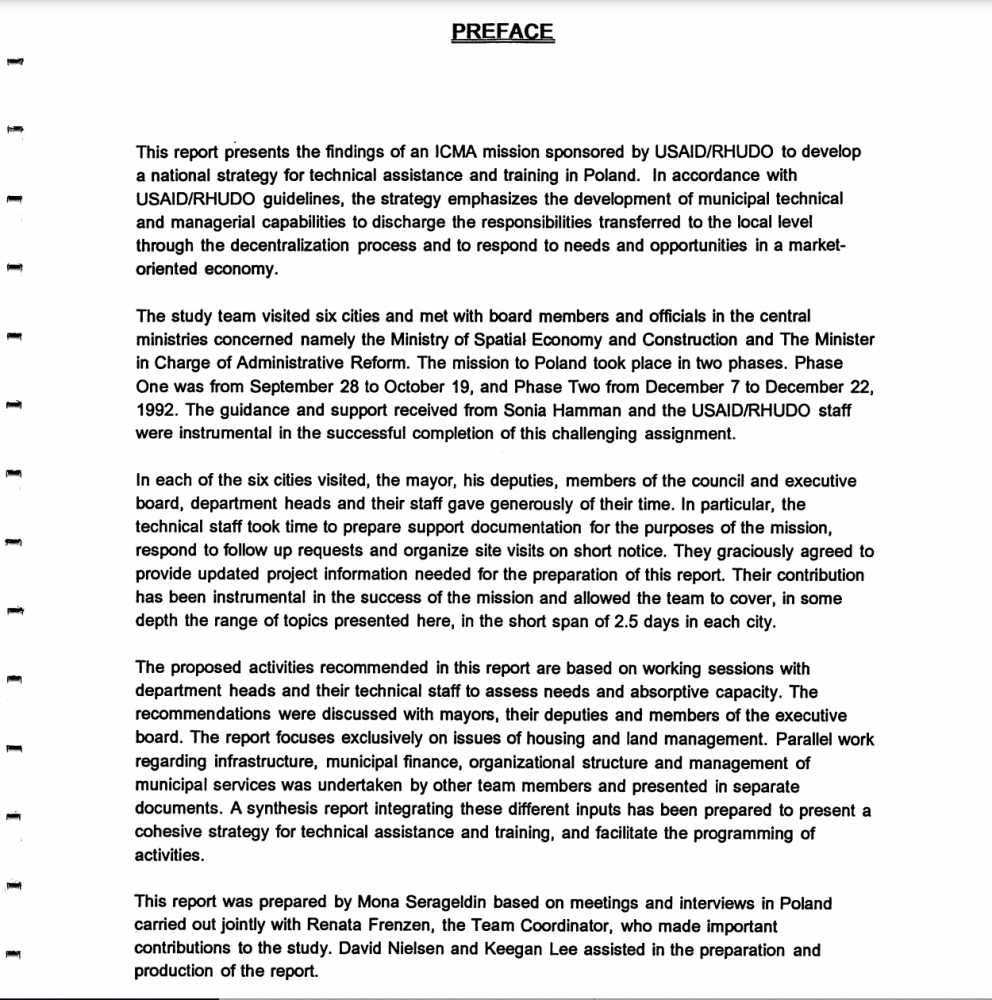
- “Strategy for Technical Assistance and Training: Housing and Land Management in Poland,” Technical Assistance Report by Mona Serageldin (Project ID: 1992_00_001)
- “Framework for Land Management and Urban Development in a Market Economy,” Mission Report with Case Studies Annexes, for Tirana, Albania (Project ID: 1994_00_001)
- “Lublin Local Initiatives Program” & “Lublin Old Town Rehabilitation Project,” Technical Assistance for Urban Upgrading in Lublin, Poland, 1994-2000 (Project ID: 1994_08_001)
- Design Studio 1995: “Urban Regeneration and Housing in a Transitional Economy: Lublin, Poland,” Seminar Curriculum (Project ID: 1995_00_001)
- Design Studio 1996: “Strategic Urban Redevelopment in a Transitional Economy in Gdansk, Poland,” Seminar Curriculum (Project ID: 1996_01_001)
- “City of Szczecin Capital Improvement Program,” Case Studies for Technical Assistance Program, Szczecin, Poland (Project ID: 1996_06_002)
- “Review of the South African Government’s Grant-Funded Municipal Infrastructure Programs,” Technical Reports, 1998-1999 (Project ID: 1998_08_001)
- “Preserving the Historic Urban Fabric in a Context of Fast Paced Change,” Cultural Heritage Essay by Mona Serageldin (Project ID: 1998_11_001)
- “Szczecin Local Initiative Program,” Urban Improvement Intervention Strategy, USAID Regional Housing and Urban Development Office, Szczecin, Poland (Project ID: 1999_05_001)
- Workshops on “Strategic Planning and Management of Municipal Infrastructure Programs,” Review of Grant-Funded MIPs in South Africa (Project ID: 1999_05_002)
- “Reconnaissance Report: Local Economic Development,” Regional Planning Survey for Bucharest, Romania (Project ID: 2000_02_001)
- IEP October 2000: “Seminar on Strategic Planning for Urban Revitalization and Local Development” in Pretoria, South Africa (Project ID: 2000_10_001)
- IEP May 2001: “Infrastructure Planning and Partnerships for Local Economic Development,” Eastern Cape, South Africa (Project ID: 2001_05_001)
- IEP August 2001: “Infrastructure Planning and Partnerships for Local Economic Development,” Pretoria, South Africa (Project ID: 2001_08_003)
- “Svishtov: A Community-Based Investment Program for Municipal Development,” Technical Assistance for Capital Investment Strategy in Svishtov, Bulgaria (Project ID: 2002_03_001)
- ICLRD: Annual Conference Reports on Urban Planning for the Island of Ireland, 2004-2017 (Project ID: 2004_05_001)
- “Cooperation and Capacity Building for Promoting Cultural, Natural and Built Heritage in Transylvania,” Technical Assistance Report, Romania (Project ID: 2004_09_001)
- “Continuity and Change” by Mona Serageldin, Topic Paper for 48th World Congress, International Federation for Housing and Planning (IFHP) (Project ID: 2004_09_002)
- “Romania Local Governance Bridge Program – Metropolitan Planning and Cooperation in Romania,” USAID-ROMANIA Report (Project ID: 2005_07_001)
- ICLRD: Spatial Strategies for Peace and Reconciliation on the Island of Ireland – Collected Reports by the International Centre for Local & Regional Development, 2006-2013 (Project ID: 2006_06_001)
- “The Atlas of the Island of Ireland: Mapping Social and Economic Change,” Publication by ICLRD, 2008 and 2015 (Project ID: 2008_00_001)
- “Shaping and Managing Cross-Border Development,” ICLRD Executive Training Program Materials for Irish Border Cities, 2010-2014 (Project ID: 2009_00_004)
- ICLRD: Urban Reconciliation Case Studies for Public Housing Estates in Ireland and Northern Ireland, 2010-2012 (Project ID: 2010_05_001)
- “Borderlands: The Journal of Spatial Planning in Ireland,” ICLRD Publication, 2011, 2013 (Project ID: 2011_00_001)
- “Technical Assistance to Lesedi Local Municipality,” Design Framework for South Africa’s Neighborhood Development Partnership Grant, Gauteng Province, South Africa (Project ID: 2011_08_001)
- ICLRD Briefing Papers 2012-2016: “Implementation of River Basin Management Plans,” “Fit for the Future: Organisational Change and Development,” and “Applying the Functional Territories Concept: Planning Beyond Borders” (Project ID: 2012_00_001)
- “The Unplanned Areas Upgrading and Employment Enhancing Programme in Egypt,” Needs Assessment and Activity Design Study for Informal Settlements, 2011-2016 (Project ID: 2012_10_004)
- World Bank MNA Urban Action Plan, Policy and Strategy Papers: “The Evolving Regional Urban Agenda: Key Challenges and Opportunities” and “From Spring to Renaissance: Repositioning the Arab Cities” (Project ID: 2013_01_001)
- UN-Habitat Spatial Regional Plan and Assessment for the Kurdistan-Iraq Region Housing Program (Project ID: 2014_06_001)
- “Economy of Historic Preservation” in Erbil, Kurdistan: Strengthening Urban & Regional Planning (SURP), UN-Habitat (Project ID: 2014_06_002)
- “World Migration Report,” Background Papers on Displacement, Migration, and Resettlement in MENA, International Organization for Migration (Project ID: 2014_09_001)
- “National Urban Strategy for Governorates in Iraq,” Development Strategy for Phase II of the United Nations Development Programme (UNDP) and Iraq Ministry of Planning Local Area Development Programme (LADP II), 2014-2018 (Project ID: 2014_11_001)
- Keynote for City Debates 2015, American University of Beirut: “The Dynamics of Neighborhood Transformation: Long Term Trends and Immediate Responses to Turmoil and Civil Unrest,” Mona Serageldin (Project ID: 2015_03_001)
- “Habitat III Regional Report for the Arab Region,” for UN-Habitat (ROAS) and United Nations (ESCWA), 2015-2016 (Project ID: 2015_10_003)
- “Integrated Development Plan in Support of the Socio-Economic Integration of Former Burundian Refugees in Tanzania,” Technical Assistance (Project ID: 2015_11_001)
- “Local Aspects of Humanitarian Response to Transit Migrants and Refugees in Croatia” (Project ID: 2016_01_001)
Related by: Design Studio Seminars (1981-2003)
- Design Studio 1981: “Housing Design in Islamic Cultures” in Algeria, Bangladesh, Egypt, Iraq, Pakistan, Saudi Arabia and Indonesia, Seminar Curriculum (Project ID: 1981_08_001)
- Design Studio 1984: “The Revitalization of a Traditional Urban Quarter” for the Medieval Darb al Ahmar District, Cairo, Egypt, Seminar Curriculum (Project ID: 1984_01_001)
- Design Studio 1984: “Design, Technology and Logistics for Large Housing Projects,” in Algeria, India, Iraq, Malaysia, Mali, and Singapore, Seminar Curriculum (Project ID: 1984_07_001)
- Design Studio 1987: “Arad New Town,” Land-Fill Development Solutions for Arad New Town, Muharraq Island, Bahrain, Seminar Curriculum (Project ID: 1987_00_001)
- Design Studio 1988: “Urban Infrastructure Planning and Programing in Developing Countries,” Chapters 1-7, Seminar Curriculum (Project ID: 1988_00_004)
- Design Studio 1989: “Rabat’s Urban Fringe,” Urbanization Analysis of Rabat, Morocco, Seminar Curriculum (Project ID: 1989_01_001)
- Design Studio 1990: “The Medina of Tunis,” Urban Regeneration for the Historic Hafsia District, Tunis, Tunisia, Seminar Curriculum (Project ID: 1990_00_002)
- Design Studio 1992: “Cairo and the Medieval City” &”Urban Regeneration in Medieval Cairo,” in Cairo, Egypt, Seminar Curriculum (Project ID: 1992_00_002)
- Design Studio 1993: “Rabat’s Urban Fringe,” Rabat, Morocco, Seminar Curriculum (Project ID: 1993_00_001)
- Design Studio 1994: “A New Urban Center for Adjamé, Abidjan, Ivory Coast,” Seminar Curriculum (Project ID: 1994_01_001)
- Design Studio 1995: “Urban Regeneration and Housing in a Transitional Economy: Lublin, Poland,” Seminar Curriculum (Project ID: 1995_00_001)
- Design Studio 1996: “Strategic Urban Redevelopment in a Transitional Economy in Gdansk, Poland,” Seminar Curriculum (Project ID: 1996_01_001)
- Design Studio 1997: “Strategic Planning and Local Development,” Seminar Curriculum (Project ID: 1997_01_001)
- Design Studio 2003: “Urban Strategies for Economic Recovery: A Revitalization Strategy for New Bedford, Massachusetts,” Seminar Curriculum (Project ID: 2003_09_001)
Related by: Work in Lublin, Poland
- “Strategy for Technical Assistance and Training: Housing and Land Management in Poland,” Report by Mona Serageldin (Project ID: 1992_00_001)
- Design Studio 1995: “Urban Regeneration and Housing in a Transitional Economy,” Lublin, Poland (Project ID: 1995_00_001)
- Habitat II Conference: “Leadership and Best Practices,” Mona Serageldin, Istanbul, Turkey (Project ID: 1996_06_001)
- International Education Program (IEP) 2000, Lublin Local Initiative Program (Case Study) (Project ID: 2000_10_001)
- International Education Program (IEP) 2000, Szczecin Local Partnership Program (Case Study) (Project ID: 2000_10_001)
- “Lublin Local Initiatives Program” & “Lublin Old Town Rehabilitation Project,” Urban Upgrading in Lublin, Poland, 1994-2000 (Project ID: 1994_08_001)
Related by: Housing
- ITP 1988: “Housing Affordability: Project Appraisal and Program Structure,” with Boston Redevelopment Authority Site Visit (Project ID: 1988_00_002)
- Design Studio 1989: “Rabat’s Urban Fringe,” Urbanization Analysis of Rabat, Morocco, Seminar Curriculum (Project ID: 1989_01_001)
- “Environmental Health Factors in Housing,” Design Study for the Rapid Urbanization of Low-Income Settlements in Urban-Fringe Districts (Project ID: 1989_07_001)
- “Second Urban Project,” Urban Development Study Proposals for Conakry, Republic of Guinea (Project ID: 1990_01_002)
- “Strategy for Technical Assistance and Training: Housing and Land Management in Poland,” Technical Assistance Report by Mona Serageldin (Project ID: 1992_00_001)
- “Review of Ongoing USAID Shelter Sector Activities in Morocco,” Report by Mona Serageldin for USAID/Morocco Office of Housing and Urban Programs, 1992-1998 (Project ID: 1992_00_004)
- Design Studio 1993: “Rabat’s Urban Fringe,” Rabat, Morocco, Seminar Curriculum (Project ID: 1993_00_001)
- “The Use of Land and Infrastructure in the Self-Improvement Strategies of Urban Lower Income Families,” Paper by Mona Serageldin, UN-Habitat Fourteenth Commission Report (Project ID: 1993_05_001)
- Design Studio 1994: “A New Urban Center for Adjame, Abidjan, Ivory Coast,” Seminar Curriculum (Project ID: 1994_01_001)
- Design Studio 1995: “Urban Regeneration and Housing in a Transitional Economy: Lublin, Poland,” Seminar Curriculum (Project ID: 1995_00_001)
- “Community-Based Urbanization and Favelas Rehabilitation Processes,” Case Study for Fortaleza, Brazil (Project ID: 1995_00_006)
- “Community Based Credit for Housing, Infrastructure, and Microenterprises,” Micro-Finance Housing Shortage Study for Quito, Ecuador (Project ID: 1995_03_003)
- Design Studio 1996: “Strategic Urban Redevelopment in a Transitional Economy in Gdansk, Poland,” Seminar Curriculum (Project ID: 1996_01_001)
- ITP 1997: “South Boston Metropolitan Area Community Housing,” Case Studies from Boston, Massachusetts (Project ID: 1997_00_002)
- City of Boston’s “Neighborhood Partnership Initiative” & “Main Street Program,” Urban Revitalization for Roslindale and West Roxbury, Boston, United States (Project ID: 1997_05_001)
- “Housing Microfinance Initiatives,” Case Study for USAID Microenterprise Best Practices Initiative, 1999-2000 (Project ID: 1999_00_001)
- “Migration, Remittances and Housing in Sub-Saharan Africa,” Study on Senegal, Kenya, and South Africa with SIDA, 2007-2008 (Project ID: 2007_07_001)
- Executive Education Program 2007: “Strategic Planning for Sustainable Human Settlements,” Pretoria, South Africa (Project ID: 2007_11_001)
- “Improvement Strategies for Affordable Housing in Yerevan, Armenia,” Development Strategy (Project ID: 2008_01_001)
- “Township Development Strategy for Emfuleni Municipality,” Technical Assistance to Sedibeng, Gauteng, South Africa (Project ID: 2009_03_001)
- ICLRD: Urban Reconciliation Case Studies for Public Housing Estates in Ireland and Northern Ireland, with Study Profile on the Basel Metropolitan Area, 2010-2012 (Project ID: 2010_05_001)
- UN-Habitat Spatial Regional Plan and Assessment for the Kurdistan-Iraq Region Housing Program (Project ID: 2014_06_001)
Related by: Directed by ICLRD
- ICLRD: Annual Conference Reports on Urban Planning for the Island of Ireland, 2004-2017 (Project ID: 2004_05_001)
- ICLRD: Spatial Strategies for Peace and Reconciliation on the Island of Ireland – Collected Research Reports (Project ID: 2006_06_001)
- “The Atlas of the Island of Ireland: Mapping Social and Economic Change,” ICLRD Publication (Project ID: 2008_00_001)
- “Shaping and Managing Cross-Border Development,” ICLRD Executive Training Program Materials, for Irish Border Cities (Project ID: 2009_00_004)
- ICLRD: Urban Reconciliation Case Studies for Public Housing Estates in Ireland and Northern Ireland (Project ID: 2010_05_001)
- “Borderlands: The Journal of Spatial Planning in Ireland,” ICLRD Publication (Project ID: 2011_00_001)
- ICLRD Briefing Papers 2012-2016: “Implementation of River Basin Management Plans” and “Applying the Functional Territories Concept: Planning Beyond Borders” (Project ID: 2012_00_001)