
“Urban Resiliency & the Challenge of Coordinating Climate Adaptation Strategies at Different Scales,” Assessment and Presentation, Zofnass Program for Sustainable Infrastructure Workshop on Infrastructure Resilience II, April 2016

Abstract

In 2016, Mona Serageldin and I2UD developed the workshop presentation “Urban Resiliency & the Challenge of Coordinating Climate Adaptation Strategies at Different Scales.” The workshop on Infrastructure Resilience II: Advancing Planning and Design Tools was organized by the Zofnass Program for Sustainable Infrastructure under the Harvard University Graduate School of Design. Documents include the presentation and presentation text.

Learn more about current research on climate resiliency improvement strategies at I2UD’s main site: “AI Climate: A Decision Making Tool for Climate Resilience: Using AI to Identify Climate Change Hazards in the Cities of the Global South.”


[Excerpt: Presentation Text, by Mona Serageldin, for “Urban Resiliency & the Challenge of Coordinating Climate Adaptation Strategies at Different Scales”]

“Urban Resilience is a cornerstone of the UN 2030 Sustainable Development Goals and will be at the center of the discussions at the Habitat III conference. Climate experts and environmentalists are developing tools to assess the regional manifestations of climate change, but reliable prediction tools at the local level are still lacking. Professor Charles Kennel and his colleagues have demonstrated that multiple environmental stress factors interact with local micro-climate and ecological systems to produce different effects at different locations and hence different levels of exposure. They advocate regional assessments as a basis for local action.”

“Settlements in risk areas will differ in location, urban patterns, social characteristics, sources of livelihood and cultural particularities which in combination will shape vulnerabilities to climate change related effects. The focus on informal settlements will highlight the social dimension of exposure to the risks associated with climate change, which are often aggravated by human action. We will present two cases, Arusha, Tanzania and Cartagena, Colombia to illustrate the challenge of resilience building.”

“City and community responses to past weather events provide a good indication of the technical and managerial capacity of local authorities and the ability of vulnerable groups to protect themselves and their assets. Local resilience requires dynamic urban planning and management and an observatory capable of monitoring change in selected environmental indicators and mapping the spatial configuration of affected areas and systems. This task is facilitated by access to aerial photography and GIS. Land issues are critical to the effectiveness of local adaptation strategies, but their impacts tend to be underestimated.”

Project Year:2016
Project Type:Workshop; Presentation
Geographic Regions:Arusha, Tanzania / Cartagena, Colombia
Reports:
Authors:Mona Serageldin; Alejandra Mortarini; Barbara Summers
Sponsors:Zofnass Program for Sustainable Infrastructure, Harvard University Graduate School of Design
Categories:Climate Change and Resilience Building
  
ID:2016_04_001

7th Africities Conference, Johannesburg, South Africa, November 29th, 2015: Presentations, Case Studies, Workshop Documents

Abstract

Beginning in July 2015, Mona Serageldin, Daniel Tsai, and Barbara Summers from I2UD prepared presentation materials for the 7th Africities Conference, held on November 29, 2015, in Johannesburg, South Africa.

Conference presentations include an Inception Report, and workshop documents and agendas from July 2015, in French and English. Case studies from July and November 2015 discuss Cairo and Khartoum. A final presentation, “Looking Back, Looking Forward: Johannesburg,” was given by Phillip Harrison (SA Research Chair for Spatial Analysis & City Planning of Johannesburg).


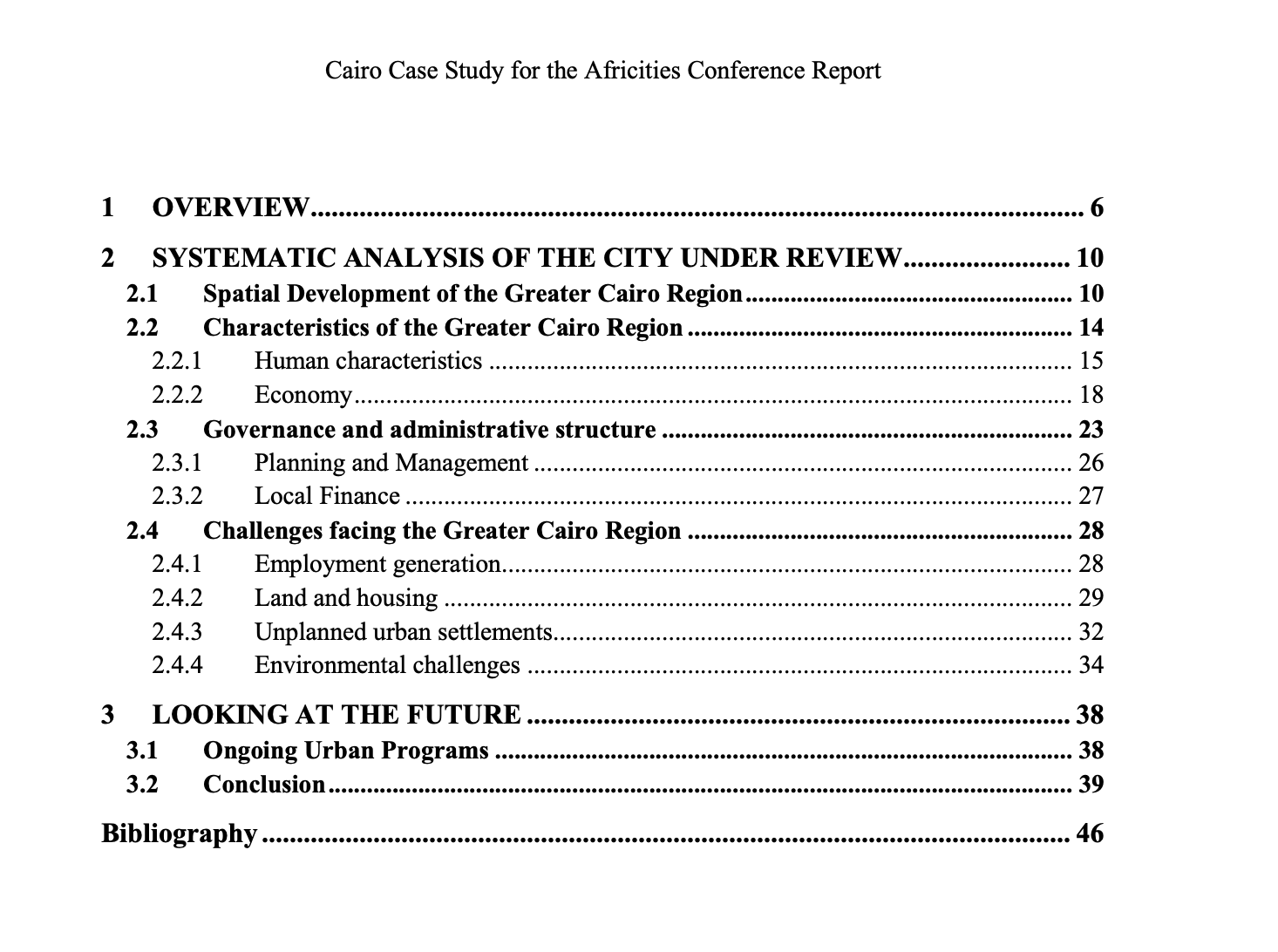
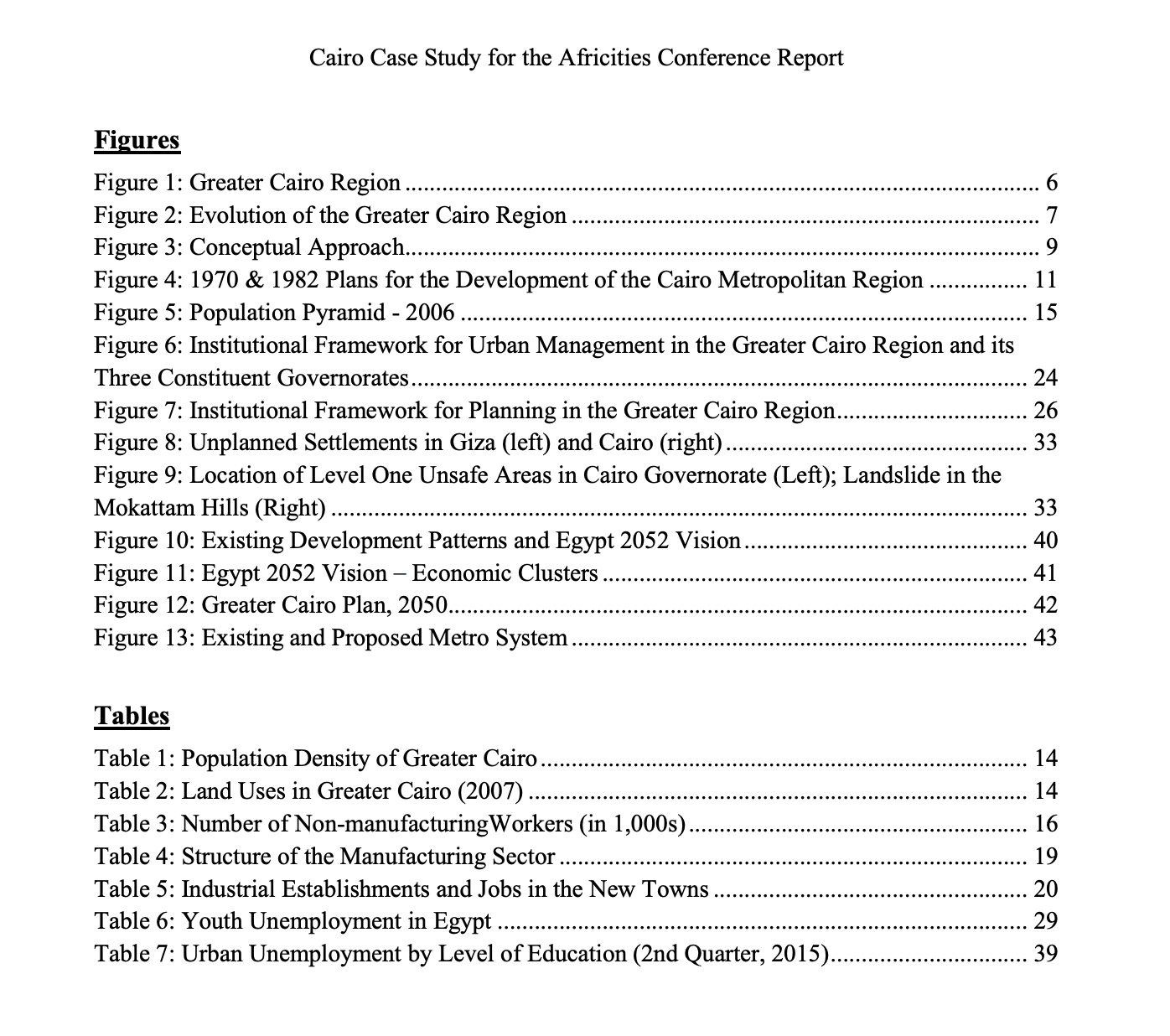
[Excerpt: Index and List of Figures for “Cairo Case Study for the Africities Conference Report,” I2UD, 2015]

Project Year:2015
Project Type:Conference; Workshop
Geographic Regions:Cairo, Egypt / Khartoum, Sudan / Johannesburg, South Africa
Reports:
Presentations:
Authors:Mona Serageldin; François Vigier; Daniel Tsai; Barbara Summers; Tarek Waly; Maren Larsen; Oriol Monfort; Philip Harrison
Sponsors:South African Cities Network (SACN); United Cities and Local Governments of Africa (UCLG-A)
Categories:Urban Planning
  
ID:2015_07_001

Related I2UD Projects

“National Urban Strategy for Governorates in Iraq,” Development Strategy for Phase II of the United Nations Development Programme (UNDP) and Iraq Ministry of Planning Local Area Development Programme (LADP II), 2014-2018

Abstract

The 2014-2018 project “National Urban Strategy for Governorates in Iraq” was part of the UN-Habitat’s second phase of the United Nations Development Programme (UNDP) with the Iraq Ministry of Planning Local Area Development Programme (LADP II).

The goal of Iraq’s LADP II project was to increase the capacity for monitoring and coordination between all levels of Iraqi government, with an aim of localizing urban development strategies, sectoral/spatial planning, and structural planning at the Governorate level. These changes would ideally result in improved planning practices, higher budget execution and service delivery for Iraqi communities.

To facilitate the achievement of these goals, an I2UD team prepared a 5-part presentation for the Workshop on Strategic Urban Development Framework held from February-March 2016 in Erbil, Iraq. The project goals included analysis of the UN Sustainable Development Goals for 2030.

Documents include sections of preliminary, interim, and final reports from 2015 through 2018:

  • A summary presentation of the UN Habitat role in the Local Area Development Programme II project, followed by a GDP Computation Report and Presentation, and I2UD’s proposal for a National Urban Strategy Outline.
  • Parts 1-5 of the main Project elements: Participatory Planning Platform, Demographic Projections, Economic Analysis, Infrastructure Systems and Resource Management.
  • Interim reports, ending with a presentation to the UN Working Group from February 2017: “Presentation to the UN Working Group on Decentralisation and Service Delivery.”
  • Presentations and reports on Iraq’s Governorate “clusters”: Southern Cluster, Pilgrimage Cluster, and Central Cluster.
  • A final presentation from March 2018.

See related I2UD projects below

Project Year:2014-2018
Project Type:Development Strategy
Geographic Regions:Erbil, Southern Kurdistan, Iraq (Workshop Location) / Iraq Governorates
Reports:
Preliminary Reports:

Presentations Parts 1-5:

Interim Reports:

Cluster Reports:
Authors:Mona Serageldin; Daniel Tsai; Tarek Waly; Alejandra Mortarini; Saad Mahdi; Johann Friedl; Barbara Summers; Anna Soave; Bozhan Hawizy; Rania Kamel; Erfan Ali
Sponsors:UN Habitat; United Nations Development Programme (UNDP); European Union Local Area Development Programme (LADP-EU)
Categories:Urban Planning
  
ID:2014_11_001

Related I2UD Projects

“Belize Municipal Development Plan,” Urban Growth Plans, 2012-2014

Abstract

Between 2012-2014, the I2UD team worked to improve the urban planning capacity of Belize, by developing Municipal Development Plans (MDPs) for seven municipal governments: Corozal, Orange Walk, Benque Viejo, San Ignacio & Santa Elena, Belmopan, Dangriga, and Punta Gorda. The project was sponsored by the World Bank and the Belize Social Investment Fund.

The method of the project was based on the 2015 UN-Habitat Cities and Climate Change Initiative: Planning for Climate Change Toolkit. I2UD’s contributions outlined baseline social and economic data, used to generate cadastral and land utilization databases. The plans supported building urban planning skills among local authorities to upkeep infrastructure development plans over time, with examples from economic capital improvement programs. Key goals included:

  • To Develop comprehensive municipal development plans to improve land use planning and livability within their territories;
  • To Identify strategies that promote the development of local economic activities;
  • To Improve local revenue generation to finance public improvements through an efficient collection of locally based fees and taxes;
  • To Improve the efficiency of local financial management; and
  • To Engage the participation of stakeholders and community groups to ensure that proposed plans and investments targeted priority needs.

Documents include expression of interest, inception reports, strategy reports, workshops and presentations, progress reports, and guidance manual reports from 2012 through 2014.

Project Year:2012-2014
Project Type:Comprehensive Plans
Geographic Regions:Belize
Reports:

Supporting Documents:

Templates:

First, Second, and Third National Workshops:

Progress Reports:
Authors:Marion Cayetano; Lucien Chung; John Driscoll; David Dunbar; James Kostaras; Maren Larsen; Borja Lopez; John McGill; Jan Meerman; Ian Morrison; Juan Pablo Bocarejo; Mona Serageldin; Linda Shi; Elda Solloso; François Vigier
Sponsors:World Bank; Social Investment Fund (Belize)
Categories:Urban Planning; Urban Finance; Informal Settlements and Urban Upgrading
  
ID:2012_10_003

“GCC Regional Spatial Strategy – Elements and Considerations,” Urban Development Plan, UN-Habitat Gulf States Regional Office Workshops, 2013

Abstract

The “GCC Regional Spatial Strategy” is an urban development plan presented by Mona Serageldin, along with I2UD, as part of a series of regional workshops for high-level municipal officials organized by the Gulf States Regional Office of UN-Habitat.

Serageldin authored another report, “Elements and Considerations,” and a presentation the workshops held in Amman, Jordan in June 2013. Workshops discussed challenges and priorities for regional urban development among GCC countries. Topics stressed the importance of national and regional spatial development strategies for individual member countries, and aimed to utilize growth centers and development corridors to achieve better economic and social integration.

Documents include the general planning process framework from October 2010, a regional summary memo, a presentation on “Regional Spatial Strategy Experiences from China and South Africa,” as well as the “Elements and Considerations” paper by Serageldin.

See related I2UD projects below

Project Year:2010-2013
Project Type:Regional Report
Geographic Regions:Gulf Cooperation Council (Bahrain, Kuwait, Oman, Qatar, Saudi Arabia, and the United Arab Emirates)
Reports:
Authors:Mona Serageldin
Sponsors:UN-Habitat Regional Office for Arab States (ROAS)
Categories:Urban Planning
  
ID:2010_10_001

Related I2UD Projects

Executive Education Program 2007: “Strategic Planning for Sustainable Human Settlements,” Pretoria, South Africa

Abstract

In 2007, the Institute for International Urban Development (I2UD) organized a 4-day Executive Training Program workshop, “Strategic Planning for Sustainable Human Settlements,” held in Pretoria, South Africa.

Topics included:

  1. Globalization and local development;
  2. Meeting the challenge of development in Africa;
  3. Promoting sustainability in human settlements;
  4. Building sustainability in housing projects;
  5. Local revenue generation;
  6. Financing local capital improvements;
  7. Partnerships for local development; and
  8. Indicators of local development.

Documents feature a workshop schedule, followed by detailed case studies on development projects around the globe.

See related I2UD projects below

Executive Training Course 2006: “Strategic Planning for Sustainable Infrastructure Development,” Workshop Curriculum with Case Studies, Pretoria, South Africa, 2006

Abstract

In November 2006, the Institute for International Urban Development (I2UD) organized a week-long Executive Training Program on “Strategic Planning for Sustainable Infrastructure Development” for local leaders and municipal officials in Pretoria, South Africa. The workshop covered four main topics:

  1. Sustainability of infrastructure projects;
  2. Impact of migration on housing and service delivery;
  3. Infrastructure and municipal finance; and
  4. Infrastructure and the millennium development goals (MDGs).

Case studies from past I2UD projects used as background reference in the workshop profile the cities of Southwark, London, UK; Szczecin, Poland; Santo André, São Paulo, Brazil; Saint-Denis, France; Ahmedabad, India; Middledrift, South Africa; Cuenca, Ecuador; Cotonou, Benin; Belo Horizonte, Brazil; Bogotá, Colombia; and Barcelona, Spain. Documents include presentation slides, with a workshop overview, schedule, and bibliography – followed by case studies.

[Excerpt: Sustainability Presentation:
Discussion Topics]


INTEGRATED DEVELOPMENT PLAN

REVITALIZATION OF SMALL TOWN CENTERS

SUSTAINABLE DEVELOPMENT

HOUSING AND INFRASTRUCTURE

SUSTAINING MUNICIPAL FINANCE


Workshops defined inter-linkages between topics:

– Finance

– Local economic development

– Social inclusion

– Partnerships

– Sustainability

– Institutional framework

– Management for performance indicators

See related I2UD projects below

Project Year:2006
Project Type:IEP; Education
Geographic Regions:Pretoria, South Africa (Workshop Location)
Reports:

Case Studies:
Authors:Barry Shaw; Clare Wright; Mona Serageldin; Raj Rewal; Suzanne Kim; Sameh Wahba
Sponsors:Institute for International Urban Development (I2UD)
Categories:International Education Program; Executive Training Program; Education
  
ID:2006_11_001

Related I2UD Projects

Beginning in 1982, the Unit for Housing and Urbanization at Harvard University’s Graduate School of Design hosted International Training Programs (ITP), an annual series of 2- to 4-week summer seminars designed to strengthen the decision-making skills of senior professionals in public and private agencies responsible for urban development.

The I2UD Digital Library holds curriculum materials for ITPs from 19881991199419951997, and 1998:

The tradition of ITPs continued after 2000, when the Center for Urban Development Studies (CUDS) (a re-organization of the Unit) continued training seminars as International Education Programs (IEP) from 2000-2004:

Programs included inter-linked modules, lectures, case studies, interactive computer simulation models, site visits to urban projects, discussion groups and networking with professional counterparts from international metropolitan regions. Sessions had a modular format and structured team teaching, taught by a team of senior faculty and guest lecturers. Programs ended with a synthesis presented through a project evaluation exercise. Participants used case projects to examine strategies from the viewpoint of both public and private partners — to assess the feasibility and potential impacts of policies and projects on the community and the city. Presentations by guest speakers, representing U.S. and international agencies, NGOs, and community groups, were also integrated within the pedagogic framework of each module.