
“World Migration Report,” Background Papers on Displacement, Migration and Resettlement in MENA (Middle East and North Africa), International Organization for Migration, 2014

Abstract

In 2014, an I2UD research team produced a set of background research materials for the International Organization for Migration’s 2015 “World Migration Report,” addressing issues of displacement, migration and resettlement in the Middle East and North African (MENA) geographic region. In the Background Paper, the MENA region is further delineated as the Mashreq, Maghreb, Gulf Cooperation Council, and Southern Tier regions.

I2UD staff prepared of a series of case studies and facilitation of training course for Iraqi officials, discussing durable shelter solutions for internal displaced persons (IDPs) and returnees in Iraq, Syria, Spain, Italy, Sudan, and Yemen. The project aimed to: support local authority’s capacity to deal with migration patterns, review shelter needs for refugees, address reforms and challenges for accommodating migrants, and offer support for returnees.

Documents include a MENA Background Paper and a corresponding outline and work plan from 2014. Supporting materials include a display of “Project Statistics and Refugee Camps” in the region, a “Provincial Action Plan” for Van, Turkey, and an outline of “Durable Housing Solutions and Livelihoods for Georgian IDPs.”

Project Year:2014
Project Type:Research Paper
Geographic Regions:Middle East and North Africa / Van, Turkey / Georgia / France / Spain / Italy / Germany / United Kingdom
Reports:
Authors:Mona Serageldin; François Vigier; Maren Larsen; Barbara Summers; Sheelah Gobar
Sponsors:International Organization for Migration (IOM)
Categories:Reconciliation and Development
  
ID:2014_09_001

Related I2UD Projects

“Economy of Historic Preservation” in Erbil, Kurdistan, Report for Strengthening Urban & Regional Planning (SURP), UN-Habitat, 2014

Abstract

Mona Serageldin directed a report series titled “Economy of Historic Preservation” in 2014, in collaboration with the Ministry of Municipalities and Tourism (MOMT) and the Iraqi-Kurdistan Erbil Governorate. The project fulfilled a UN-Habitat program “Strengthening Urban and Regional Planning” (SURP), with support from François Vigier and Barbara Summers.

The report examines the interrelationship of cultural heritage preservation and urban development, in light of globalization, urbanization shifts, and technological innovation. The analysis aligned with the SURP program goals, which support the capacity of officials in Erbil, the capital city of the Kurdistan Region of Iraq, to stimulate financing for local infrastructure, and promote land value capture and community participatory processes.

Documents include the main report in two sections, an outline, slides for the full presentation, and supporting presentations with photographs. Case studies cover cultural heritage sites in the Medina of Tunis, Tunisia; Icheri Sheher in Baku, Azerbaijan; and in Quito, Ecuador.

See also: “National Urban Strategy for Governorates in Iraq,” Development Strategy for Phase II of the United Nations Development Programme (UNDP) and Iraq Ministry of Planning Local Area Development Programme (LADP II), 2014-2018 (Project ID: 2014_11_001)

See related I2UD projects below

Project Year:2014
Project Type:Capacity Building Project
Geographic Regions:Erbil, Southern Kurdistan, Iraq (also Medina of Tunis, Tunisia; Icherisheher, Baku, Azerbaijan; and Quito, Ecuador)
Reports:

Authors:Mona Serageldin; François Vigier; Barbara Summers; David C. Jones
Sponsors:United Nations Centre for Human Settlements (UN-Habitat)
Categories:Historic Districts
  
ID:2014_06_002

Related I2UD Projects

“Inclusive Cities and Access to Land, Housing, and Services in Developing Countries,” Urban Development Series: Knowledge Papers, World Bank’s Social, Urban, Rural & Resilience Global Practice, 2016

Abstract

I2UD produced a research paper titled “Inclusive Cities and Access to Land: Housing and Services in Developing Countries.” The World Bank-supported project addressed how global disparities in income, wealth, and opportunity, experienced worldwide, have contributed to social exclusion and spatial segregation in cities in the Middle East, North Africa, Latin America, Central America, and Western Asia.

The final report—authored by Mona Serageldin and I2UD staff, and published in 2016 by the World Bank—documented examples of successful inclusionary policies, programs, and initiatives by public agencies and NGOs with a special focus on cities in Latin America and the Middle East. The report discussed the difficulty in organizing integrative projects. It underscored the shortcomings arising from acting on one dimension of inclusion while ignoring others.

Documents include a workshop presentation from January 2014, with a final draft from April 2014, along with the final report from February 2016.


[Excerpt: Index for the Final Report: “Inclusive Cities and Access to Land, Housing, and Services in Developing Countries.”]

The Growing Importance of Inclusion in Urban Areas
1.1 Defining Inclusion
1.2 Measuring the Dimensions of Exclusion: São Paulo’s Exclusion/Inclusion Indicator Mapping

2. Trends Affecting Social Inclusion in Urban Areas
2.1 Demographics
2.2 Mobility and Migration

3. Infrastructure and Public Services: A Powerful Tool to Promote Social Inclusion
3.1 Rethinking the Approach to Slum Upgrading and Regularization of Informal Settlements
3.2 South Africa’s Municipal Infrastructure Grant Program (MIG)
3.3 Access to Public Services: Social Missions in the the República Bolivariana de Venezuela

4. Restoring the Social Function of Public Space
4.1 Rio de Janeiro’s Favela Bairro Program

5. Access to Land: A Critical Factor at the Core of Inclusion and Exclusion
5.1 Regularizing Tenure in Informal Settlements: Impacts on Social Inclusion
5.2 Impacts of Property Registration on the Inclusion of Informal Settlers
5.3 Integrated Projects to improve the Living Environment: The Role of State Agencies 16
5.4 Egypt’s Informal Settlements Development Facility (ISDF)

6. The Erosion of Inclusive Options for Affordable Housing
6.1 Affordable Housing and Spatial Segregation in Chile
6.2 Looking to Rental Markets as Instruments of Inclusion

7. Generating Revenues to Finance Urban Improvements: Land-Based Financing
7.1 Cuenca’s Improve Your Neighborhood Program

8. The Right to the City
8.1 Implementing the Right to the City in Brazil
8.2 National Legislation and Local Implementation: Colombia’s Policies of Decentralizing the Improvement of Lower Income Settlements
8.3 An Emerging Urban Agenda in the Middle East
8.4 Recife, Brazil (ZEIS)

9. NGOs and CBOs as Strategic Partners in Driving the Implementation of Inclusionary Programs
9.1 Grassroots Initiatives: A Rights-Based Approach
9.2 SEWA
9.3 CODI, Thailand

Concluding Remarks
References
Appendix 1: Indicators of Urban Exclusion and Inclusion in São Paulo, Brazil
Appendix 2: Property Tax and Registration in Middle Eastern Countries
Appendix 3: Statistical Appendix
Appendix 4: Resources

See related I2UD projects below

Project Year:2014-2016
Project Type:Research Paper
Geographic Regions:Latin America and Middle East / Venezuela / Recife and São Paulo, Brazil / Chile / Colombia / Mexico / Syria / Egypt / Morocco / Tunisia / South Africa / Thailand
Reports:

Authors:Mona Serageldin; Sheelah Gobar; Warren Hagist; Maren Larsen
Sponsors:World Bank
Categories:Informal Settlements and Urban Upgrading
  
ID:2014_04_001

Related I2UD Projects

World Bank MNA Urban Action Plan – Policy and Strategy Papers: “The Evolving Regional Urban Agenda: Key Challenges and Opportunities” and “From Spring to Renaissance: Repositioning the Arab Cities,” 2013

Abstract

In 2013, I2UD researchers co-wrote material for the 2013 “World Bank MNA Urban Action Plan,” an urban development policy and strategy plan for the Middle East and North Africa (MNA/MENA) region.

I2UD gave a preliminary presentation in October 2012 at a special meeting of the urban sector team at the World Bank. Team members presented priority issues at the in-person session, and from the field via video conferencing. Inputs and comments were solicited from all MNA colleagues, to enrich urban challenge assessments, and proposals presented in the Urban Action Plan.

Documents include an Executive Summary by Mona Serageldin, a March 2013 presentation titled “The Evolving Regional Urban Agenda: Key Challenges and Opportunities,” and a January 2013 working paper, “From Spring to Renaissance: Repositioning the Arab Cities.” Supporting materials include a statistical annex, country spatial profiles, and a slideshow compendium. The draft paper and PowerPoint slides were forwarded to the whole MNA urban group, for review and commentary.


[Excerpt: October 1st, 2012 MNA Urban Action Plan, Executive Summary by Mona Serageldin.]

“This inception report expands on the four themes presented in the Key Pillars of the MNA urban strategy and identifies the development priorities that must be addressed to implement MNA’s Action Plan. The objective is to raise issues for discussion and solicit inputs and comments from MNA colleagues in order to expand on the assessment of key urban challenges and enrich the proposals to be presented in the action plan. The region is 62% urbanized and has one of the World’s most rapidly expanding populations. By 2030, the region will have experienced a 45% increase of its urban population with over 106 million additional urban inhabitants. Some countries will see their urban populations double between 2030 and 2050: Egypt, Djibouti, Kuwait, Iraq, OPT, Syria and Yemen.”

“A long history of settlement, along the great rivers, smaller watercourses and the main oases, has led to imbalances in the geographical distribution of urban development, income and wealth. These patterns have been reinforced by the focus of colonial governments on the export of commodities and port cities and, in the post-colonial period, by the migration of rural populations caused by the increasing severity of droughts. The development of oil, gas and petrochemical industries has favored the industrial dominance of coastal cities.”

“The region’s urban dynamics and relatively weak institutions, particularly at the local level, have resulted in unplanned and often chaotic urban growth. Few national spatial development strategies have been elaborated and most regional development plans suffer from a lack of coherence among sectoral investments. The sub-national plans that have been prepared are project-driven with a bias towards primary urban centers and locations where real estate development is lucrative. There is an urgent need for the elaboration of national urban development frameworks and the preparation of integrated regional development strategies to guide and structure growth along development corridors and nodes in order to open up opportunities in the hinterland. Coordinated investments in transport and water supply are critical to start alleviating regional disparities.”

See related I2UD projects below

Project Year:2013
Project Type:Policy Papers; Presentations; Urban Action Plan
Geographic Regions:Middle East / North Africa
Reports:
Supporting Materials:
Authors:Mona Serageldin; Sheelah Gobar; Warren Hagist; Carolina Morgan
Sponsors:World Bank
Categories:Reconciliation and Development
  
ID:2013_01_001

Related I2UD Projects

State of Arab Cities, UN-Habitat Report & Conference, “Challenges of Urban Transition: Municipal Management and Urban Development Conference for Sustainability in Arab States,” 2012

Abstract

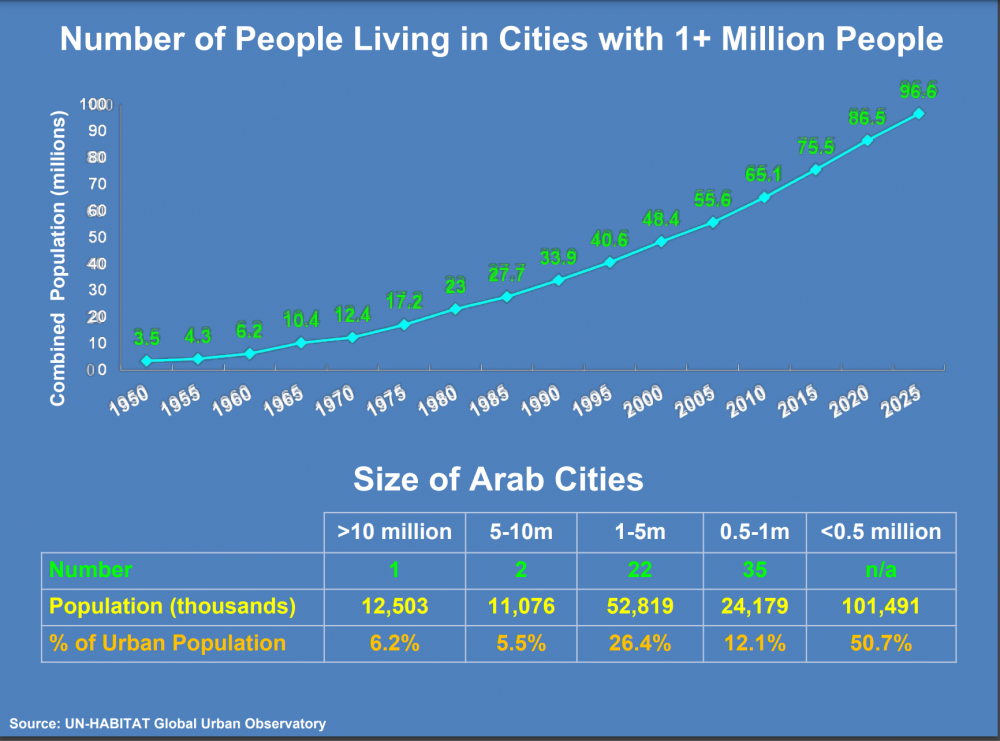
In 2012, UN-Habitat launched the first State of Arab Cities report and conference to address urbanization trends and challenges in the four major Arab and Middle Eastern regions: Mashreq, Maghreb, Gulf Cooperation Council, and the Southern Tier Countries (defined below). With Mona Serageldin as team leader, I2UD contributed a significant body of research for the conference, “Challenges of Urban Transition: Municipal Management and Urban Development Conference for Sustainability in Arab States.” The conference was hosted by the UN-Habitat Regional Office for Arab States (ROAS) and the Kuwait Knowledge Development Regional Centre.

The I2UD team compiled urban housing and demographic data for nations in Maghreb and Mashreq. The I2UD team reviewed 180 documents for each region, covering topics such as the following:

  • “Population and Urbanization;”
  • “Growing Role of Economic Cities;”
  • “Urban Development and Housing Conditions;”
  • “Transportation and Mobility;”
  • “Urban Environmental Challenges;”
  • “Urban Governance Systems;”
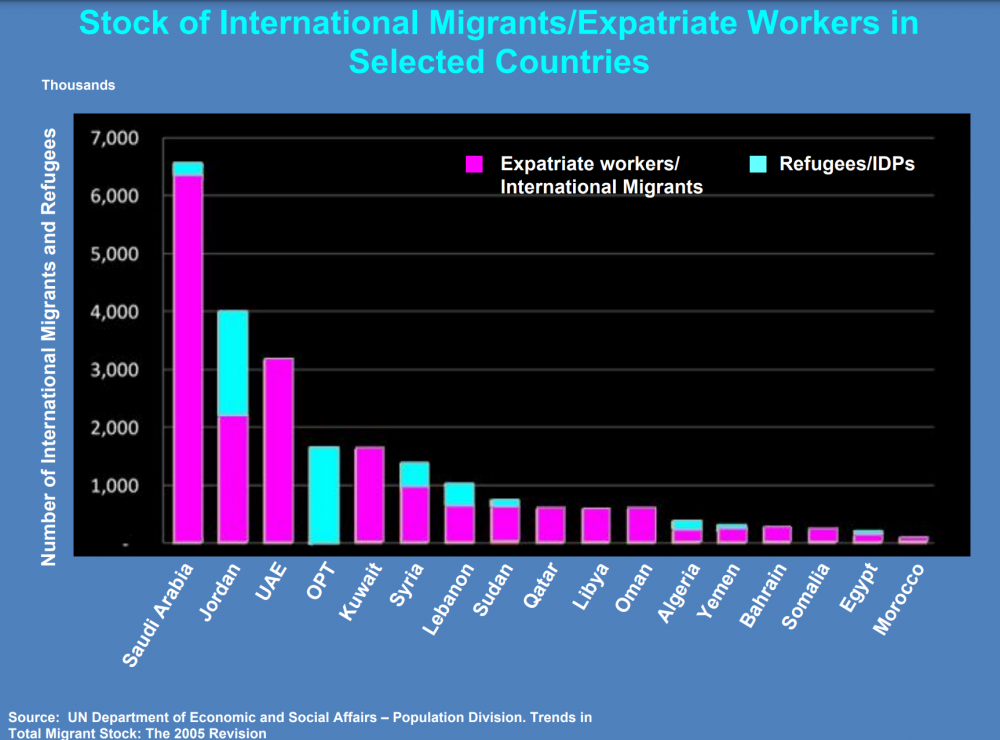
  • “Transnational Migration;” and
  • “Emerging Urban Issues and Innovations.”

Documents include I2UD’s inception report, progress report, a I2UD board meeting presentation on the project, and a conference presentation (from the “Municipal Management and Urban Development Conference for Sustainability in Arab States,” from Kuwait, May 2012). The final report for the 2012 UN-Habitat State of Arab Cities lays out urban development and migration issues in the Middle East and North Africa, including I2UD’s contributions. Additional materials include data on regional food and water security, energy security, and air pollution.

Maghreb includes Algeria, Libya, Morocco and Tunisia; Mashreq includes Egypt, Jordan, Lebanon, Palestine, Syria; the Gulf Cooperation Council includes Bahrain, Kuwait, Oman, Qatar, Saudi Arabia, and the United Arab Emirates; the Southern Tier includes Comoros, Djibouti, Mauritania, Somalia, Sudan, and Yemen.

Excerpts, Final Report, “State of Arab Cities,” December 2012
Project Year:2010-2012
Project Type:Regional Report
Geographic Regions:Middle East / North Africa
Reports:
Authors:François Vigier; Mona Serageldin; María-Luisa Fernández; Kendra Leith; Linda Shi
Sponsors:UN-Habitat Regional Office for Arab States (ROAS)
Categories:Urban Planning
  
ID:2010_07_001

Related I2UD Projects

“State of African Cities,” Research for Regional Chapter on North African Cities for UN-Habitat Reports, 2008 and 2010

Abstract

In 2008, a team from I2UD prepared research for regional chapters on Northern Africa for the first UN-Habitat “State of African Cities” report. Topics covered demographics and urban growth, cities as engines of economic growth, urban poverty and housing conditions, environmental challenges in urban areas, and urban governance. Countries addressed in the North Africa regional chapter included Algeria, Egypt, Libya, Mauritania, Morocco, Tunisia, and Sudan.

Documents include I2UD’s North Africa regional report for the 2008 State of African Cities report, as well as two full State of African Cities documents from 2008 and 2010.

Project Year:2008-2010
Project Type:Research Paper
Geographic Regions:North Africa
Reports:

Authors:Mona Serageldin; François Vigier; Christa Lee-Chuvala; Erick Guerra
Sponsors:United Nations Centre for Human Settlements (UN-Habitat)
Categories:Urban Planning
  
ID:2008_03_001

Related I2UD Projects

“The Use of Land and Infrastructure in the Self-Improvement Strategies of Urban Lower Income Families,” Paper by Mona Serageldin, UN-Habitat Fourteenth Commission Report, May 1993

Abstract

A landmark paper by Mona Serageldin, “The Use of Land and Infrastructure in the Self-Improvement Strategies of Urban Lower Income Families,” was included in the the Fourteenth Commission UNCHS/Habitat Report and presented to the Commission in Nairobi, Kenya in May 1993.

This work presented the self-improvement strategies of families dealing with challenging living conditions as an “intricate and dynamic” part of urban development, conditions which planners should respect. Serageldin’s report drew on her long history of research on urban development in cities globally, using short narrative examples and photos to illustrate specific households in: Abidjan, Amman, Cairo, Jakarta, Karachi, Kinshasa, Quito, Mexico City, Rabat, Surabaya, Tunis, and Boston. The report was sponsored by USAID’s Family and Development Program and Office of Housing and Urban Programs.

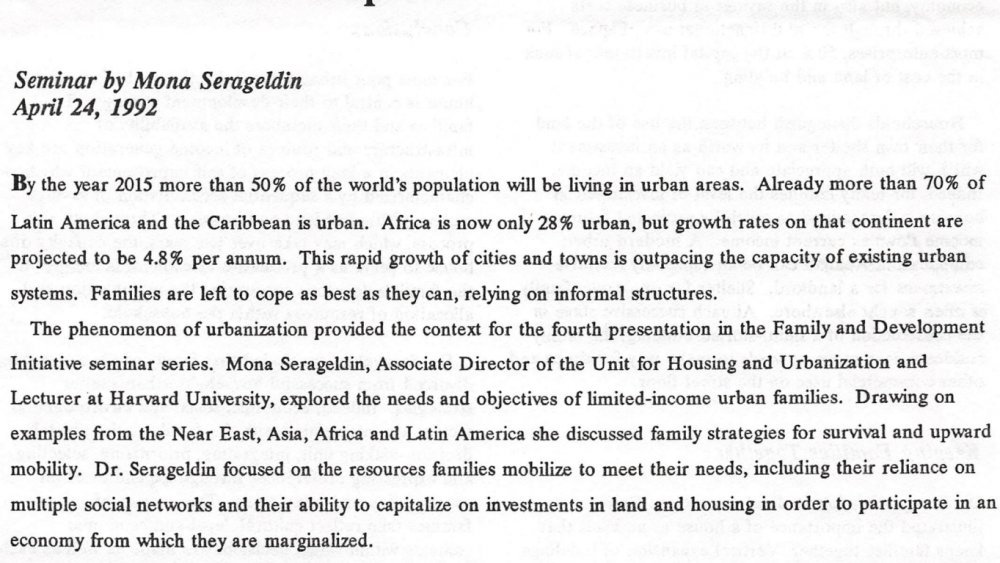
Another essay on the same topic was published as USAID Seminar Brief No. 4, “How Urban Families use Infrastructure and Housing in their own Development,” in June 1992. This document summarized Serageldin’s seminar presentation for the USAID Family and Development Initiative Series in April 1992, relaying her indication of trends toward informal housing developments emerging in reaction to rapid urbanization in city populations and housing shortages increasingly becoming a critical issue for low-income families.


[Excerpt: USAID Seminar No. 4. “How Urban Families use Infrastructure and Housing in their own Development,” June 1992.]

Keeping Families Together: Dr. Serageldin’s longitudinal research in Cairo illustrated the importance of a house as an asset that keeps families together. Vertical expansion of buildings provides space which can be used to house less fortunate family members, such as the elderly, at advantageous terms to all parties. In one case, the rental income saved by a widowed mother living on a relative’s top floor was spent on her children’s school fees while the income generated by this family member from a ground floor shop covered the family’s living expenses.”

Project Year:1993, 1992
Project Type:Research Paper
Geographic Regions:Abidjan, Côte d’Ivoire / Amman, Jordan / Cairo, Egypt / Jakarta and Surabaya, Indonesia / Karachi, Pakistan / Kinshasa, Democratic Republic of the Congo / Quito, Ecuador / Mexico City, Mexico / Rabat, Morocco / Tunis, Tunisia / Boston, Massachusetts, USA
Reports:
Authors:Mona Serageldin; John Driscoll; María-Luisa Fernández
Sponsors:UN-Habitat; USAID
Categories:Informal Settlements and Urban Upgrading
  
ID:1993_05_001

Related I2UD Projects

ITP 1991: “Development Strategies for Urban Regeneration of Old Urban Fabric,” Case Studies and Seminar Curriculum, International Training Programs, 1991

Abstract

The 1991 International Training Program (ITP), hosted by the Unit for Housing and Urbanization (the Unit) at Harvard University’s Graduate School of Design, addressed strategies of re-manipulating old urban fabric, including plans to restructure central zones, recapture the development potential of strategically located parcels, and preserve valued urban and architectural heritage.

Case studies addressed a range of old urban zones needing restructure:

  • Redeveloping obsolete and dilapidated zones (London Docklands);
  • Reshaping deteriorating central zones (Boston’s Waterfront);
  • Halting the degradation of the physical environment (Hafsia district in Tunis, Tunisia); and
  • Preserving the distinctive character of historical areas (Vieux Carré in New Orleans).

Documents represent curriculum components from the 1991 ITP, including case studies, project summaries, newspaper and journal articles, and module overviews. Some materials may be replicated in other years of the ITP programs.

See related I2UD projects below

Project Year:1991
Project Type:ITP; Education
Geographic Regions:Waterfront, Boston, USA / London Docklands, UK / Hafsia, Tunis, Tunisia / Vieux Carré, New Orleans, USA / Kreuzberg, Berlin, Germany / Maarouf, Cairo, Egypt / Walled City of Lahore, Pakistan / Ij Waterfront, Amsterdam, Netherlands
Reports:
Authors:François Vigier; Mr Victor Karen; Barry Shaw
Sponsors:Unit for Housing and Urbanization, Harvard University Graduate School of Design
Categories:International Training Program; Education
  
ID:1991_07_001

Related I2UD Projects

Beginning in 1982, the Unit for Housing and Urbanization at Harvard University’s Graduate School of Design hosted International Training Programs (ITP), an annual series of 2- to 4-week summer seminars designed to strengthen the decision-making skills of senior professionals in public and private agencies responsible for urban development.

The I2UD Digital Library holds curriculum materials for ITPs from 19881991199419951997, and 1998:

The tradition of ITPs continued after 2000, when the Center for Urban Development Studies (CUDS) (a re-organization of the Unit) continued training seminars as International Education Programs (IEP) from 2000-2004:

Programs included inter-linked modules, lectures, case studies, interactive computer simulation models, site visits to urban projects, discussion groups and networking with professional counterparts from international metropolitan regions. Sessions had a modular format and structured team teaching, taught by a team of senior faculty and guest lecturers. Programs ended with a synthesis presented through a project evaluation exercise. Participants used case projects to examine strategies from the viewpoint of both public and private partners — to assess the feasibility and potential impacts of policies and projects on the community and the city. Presentations by guest speakers, representing U.S. and international agencies, NGOs, and community groups, were also integrated within the pedagogic framework of each module.

“The Abidjan Experience”- Four Research Reports on Community-Based Urban Development in Adjamé, Abidjan, Côte d’Ivoire, 1990-1995

Abstract

Between 1990 and 1995, the Unit for Housing and Urbanization (later the Center for Urban Development Studies, or CUDS) at Harvard University’s Graduate School of Design prepared four research reports on the commune district of Adjamé in Abidjan, Côte d’Ivoire (Ivory Coast). As a collection, these materials present a detailed analysis of urban housing trends in Côte d’Ivoire from the 1990s, covering economic, historical, architectural, financial and socio-geographical elements.

First, in September 1990, the Unit produced a major research endeavor, “Urban Infrastructure on Municipal Revenues and the Integration of Informal Sector Activities: The Abidjan Experience.” The report was produced for the USAID Office of Housing and Urban Programs in Washington D.C.

Second, in January 1994, Mona Serageldin and François Vigier wrote “Designing for Urban Growth, Abidjan Ivory Coast,” covering the socio-geography of Abidjan/Côte d’Ivoire in 5 detailed sections on National Context, Landscape, The Urban Landscape, Housing Typologies, and a detailed condition analysis of the Commune of Adjamé.

Third, in September 1994, the Unit presented “Community Based Development Lessons from Experience Across Cities” for a forum on “Enabling Sustainable Community Development” at the 2nd World Bank Conference. The presentation built on the Unit’s previous research on Adjamé among other cities, sponsored by the USAID’s Office of Environment and Urban Programs.

Fourth, in October 1995, Mona Serageldin and CUDS wrote a Working Paper, “Successful Institutionalization of Community Based Development of Adjamé, Abidjan.” The paper built off all previous research on Abidjan, covering six international case studies from Abidjan, Boston, Cairo, Lima, Lublin, and Tunis, selected because of their innovative character.


[Excerpt: “Community Based Development: Lessons from Experience Across Cities,” for the 2nd World Bank Conference, September 1994, Introduction, by Mona Serageldin for the Unit, 09/1994]/

“The ESD Conference, just completed yesterday, saw a remarkable unnamity on two points of relevance, to a discussion of cross-cutting lessons.

First, that community involvement is paramount for any meaningful action to reduce poverty and improve the urban environment; and Second, that there is no single formula to do it. The diversity of cities and their local context entail that concepts be adapted to the particularities of the local context.

Yet, there is a lot to be learned from the sharing of experiences. In spite of the diversity, there are common threads. The issue of empowerment was eloquently discussed this morning. Other issues have been discussed by the previous speakers. My presentation will highlight principles which structure interfaces between communities and municipalities in order to foster community based development approaches.”

Project Year:1990-1995
Project Type:Urban Development Research
Geographic Regions:Abidjan, Côte d’Ivoire (also Boston, United States; Cairo, Egypt; Lima, Perú; Lublin, Poland; and Tunis, Tunisia)
Reports:
Authors:Mona Serageldin; François Vigier; Samir Abdulac; Howard Trett; Wafaa Abdalla; Jeanine Anderson; Nader El Bizri; Janne Corniel; John Driscoll; Denis Lesage; Sherif Lotfi; David Neilson; Tarek Sweilim
Sponsors:Unit for Housing and Urbanization, Harvard University Graduate School of Design; World Bank; USAID
Categories:Urban Planning
  
ID:1990_09_001

Related I2UD Projects

Design Studio 1990: “The Medina of Tunis,” Urban Regeneration for the Historic Hafsia District, Tunis, Tunisia, Seminar Curriculum

Abstract

The Design Studio from Spring 1990, led by Professors François Vigier and Mona Serageldin, focused on urban regeneration in the Medina of Tunis, Tunisia. This studio addressed issues of revitalization of older urban districts of Tunis.

Documents include an overview of urban development, urban housing conditions, institutional frameworks, and government housing policies to outline the urban context of Tunisia. Reports detail the development site of the Hafsia District, and outline phases and plans for the revitalization project, including graphics and maps.


[Excerpt: “Urban and Housing Conditions,” Design Studio 1990]

Urban and Housing Conditions
“Rapid urbanization has generated a large demand for housing and add to intensive unregulated construction activity. As a result, housing stock has increased at an annual average rate of 4 percent, and conditions improved somewhat during the 80’s. However, throughout the decade, the demand for housing and urban services has outpaced the public sector’s ability to keep up with urban growth. Almost half of all dwellings built since 1975 have bypassed urban development regulations and were instead undertaken by the informal sector in areas lacking adequate utilities and relying on low-cost construction methods. To alleviate this problem, the supply of suitably located serviced land at prices affordable to the poorest segments of the population must be expanded.”
….

The Hafsia Revitalization Project
The objective of the project sponsored by the World Bank is to revitalize and renovate the area, and demonstrate the feasibility of upgrading medinas without dividing populations and by involving the private sector in the development process. The specific objectives are:

1. To revitalize the economic base with a look to the future while promoting employment opportunities for its present residents.

2. To upgrade the urban environment with minimum disruption of social cohesion and community life.

3. To structure a replicable self-financing, revitalization process given the lack of public resources. In other words, components of the proposal whose capital cost are not likely to be fully recovered (eg., housing for poorer households, infrastructure improvements, new community facilities) will have to be cross-subsidized by other revenue producing components.

4. To reverse development trends destructive to the character of the medina.”

See related I2UD projects below

Project Year:1990
Project Type:Urban Design Studio
Geographic Regions:Medina of Tunis, Tunisia
Reports:1990 Design Studio: Tunisia Urban Development
Authors:François Vigier; Mona Serageldin
Sponsors:Aga Khan Program for Islamic Architecture
Categories:Design Studios; Education
  
ID:1990_00_002

Related I2UD Projects

“The Development and Morphology of Informal Housing,” Research Paper, Aga Khan Award for Architecture Seminar Proceedings, Mona Serageldin, 1988

Abstract

Mona Serageldin authored the research paper “The Development and Morphology of Informal Housing” in 1988 under the Unit for Housing and Urbanization at Harvard University’s Graduate School of Design, published as part of the proceedings for the Aga Khan Award for Architecture seminar, Architecture of Housing, held in Zanzibar, Tanzania in October 1988.

The paper relates the history of housing development processes from the 1950s through the 1980s in the Middle East, North Africa, and East Africa regions, in cities including Tunis, Tunisia; Damascus, Syria; Cairo, Egypt; Zanzibar, Tanzania; and Sana’a, Yemen. It compares the makeup of circumstances and populations, and describes housing units in each location, covering design and construction, with requirements for designing suitable housing units.


[Excerpt: I. Background: Mona Serageldin]

“The involvement of architects and planners with housing for lower income groups began in the 50’s and 60’s when national governments in the post colonial era embarked on slum eradication programs. Slum dwellers were to be rehoused in public housing estates. To the designers of these first projects, the overriding concern was decent shelter and sanitary conditions and not affordability. That their vision was influenced by prevailing international norms was the natural outcome of their professional training. Their failure to foresee the implications of demographic and economic trends over the next 2 decades invalidated their approach. Their efforts were overwhelmed by population growth, surplus labor, and an influx of rural migrants which could not be checked.

“Throughout the 60’s housing shortages increased and slums proliferated. Frustrated authorities turned to legislative controls, a politically expedient short-term remedy. The longer term impacts were devastating. Stringent controls accelerated the deterioration of the regulated stock, distorted private production, undermined the tax base, hampered residential mobility and warped occupancy patterns.

“The low cost shelter solutions advocated in the 60’s and 70’s produced a variety of expandable core housing prototypes to meet the needs of the urban poor. They were valid models in parts of Africa and Asia where the process happened to coincide with local practices as in Khartoum and Dakar. Elsewhere, the lack of enthusiasm among housing authorities for these approaches stemmed from an accurate perception of their unsuitability as a housing solution for the middle classes, the only client group of political consequence. Leverage and funding from international agencies launched projects in many countries which otherwise might have never experimented with minimal shelter programs. The improvements provided were on a scale too small to be meaningful in relation to the magnitude of the problem or noticeable in the midst of sprawling chaotic cities. By the mid 70’s their demonstration effect had lost its significance.”

“The shock waves in world economics and the resultant movements of labor and capital transformed the character of urban growth throughout the third world. By 1981, 15 million expatriate workers funneled between 25 and 35 billion dollars of foreign exchange back to their home countries. As the bulk of these remittances found their way into real estate, the urbanized area of cities doubled or tripled in extent shaped by uncontrolled housing construction on an unprecedented scale. Functionally defective and aesthetically chaotic environments became the dominant feature of cities, those annual rate of expansion of 4% to 7% outstripped the capacities of municipalities to provide urban services. As a result, their efficiency was impaired and there has been a sharp deterioration in the quality of life.”

Project Year:1988
Project Type:Research Paper
Geographic Regions:Cairo, Egypt / Damascus, Syria / Tunis, Tunisia / Sana’a, Yemen / Zanzibar, Tanzania
Reports:The Development and Morphology of Informal Housing (Mona Serageldin, September 1988)
Authors:Mona Serageldin; Samir Abdulac; Oussama Kabbani; Richard Khan
Sponsors:Aga Khan Award for Architecture
Categories:Urban Planning
  
ID:1988_09_001