
Executive Training Course 2006: “Strategic Planning for Sustainable Infrastructure Development,” Workshop Curriculum with Case Studies, Pretoria, South Africa, 2006

Abstract

In November 2006, the Institute for International Urban Development (I2UD) organized a week-long Executive Training Program on “Strategic Planning for Sustainable Infrastructure Development” for local leaders and municipal officials in Pretoria, South Africa. The workshop covered four main topics:

  1. Sustainability of infrastructure projects;
  2. Impact of migration on housing and service delivery;
  3. Infrastructure and municipal finance; and
  4. Infrastructure and the millennium development goals (MDGs).

Case studies from past I2UD projects used as background reference in the workshop profile the cities of Southwark, London, UK; Szczecin, Poland; Santo André, São Paulo, Brazil; Saint-Denis, France; Ahmedabad, India; Middledrift, South Africa; Cuenca, Ecuador; Cotonou, Benin; Belo Horizonte, Brazil; Bogotá, Colombia; and Barcelona, Spain. Documents include presentation slides, with a workshop overview, schedule, and bibliography – followed by case studies.

[Excerpt: Sustainability Presentation:
Discussion Topics]


INTEGRATED DEVELOPMENT PLAN

REVITALIZATION OF SMALL TOWN CENTERS

SUSTAINABLE DEVELOPMENT

HOUSING AND INFRASTRUCTURE

SUSTAINING MUNICIPAL FINANCE


Workshops defined inter-linkages between topics:

– Finance

– Local economic development

– Social inclusion

– Partnerships

– Sustainability

– Institutional framework

– Management for performance indicators

See related I2UD projects below

Project Year:2006
Project Type:IEP; Education
Geographic Regions:Pretoria, South Africa (Workshop Location)
Reports:

Case Studies:
Authors:Barry Shaw; Clare Wright; Mona Serageldin; Raj Rewal; Suzanne Kim; Sameh Wahba
Sponsors:Institute for International Urban Development (I2UD)
Categories:International Education Program; Executive Training Program; Education
  
ID:2006_11_001

Related I2UD Projects

Beginning in 1982, the Unit for Housing and Urbanization at Harvard University’s Graduate School of Design hosted International Training Programs (ITP), an annual series of 2- to 4-week summer seminars designed to strengthen the decision-making skills of senior professionals in public and private agencies responsible for urban development.

The I2UD Digital Library holds curriculum materials for ITPs from 19881991199419951997, and 1998:

The tradition of ITPs continued after 2000, when the Center for Urban Development Studies (CUDS) (a re-organization of the Unit) continued training seminars as International Education Programs (IEP) from 2000-2004:

Programs included inter-linked modules, lectures, case studies, interactive computer simulation models, site visits to urban projects, discussion groups and networking with professional counterparts from international metropolitan regions. Sessions had a modular format and structured team teaching, taught by a team of senior faculty and guest lecturers. Programs ended with a synthesis presented through a project evaluation exercise. Participants used case projects to examine strategies from the viewpoint of both public and private partners — to assess the feasibility and potential impacts of policies and projects on the community and the city. Presentations by guest speakers, representing U.S. and international agencies, NGOs, and community groups, were also integrated within the pedagogic framework of each module.

IEP 2003: “Infrastructure and Partnerships for Local Economic Development” in Pretoria and Bloemfontein, South Africa, International Education Programs, 2003

Abstract

Curriculum components from the 2003 IEP (International Education Program) “Infrastructure and Partnerships for Local Economic Development,” which was held in Pretoria and Bloemfontein, South Africa in August and September 2003.

Documents include agendas, case studies, project summaries, and reference materials. Noted work by Mona Serageldin includes “Decentralization and Urban Infrastructure Management Capacity,” a background paper for the 2001 Third Global Report on Human Settlements.

Additional contextual documents include: The “Best Practices 2001” submission for Middledrift, Eastern Cape, South Africa; an executive summary from May 2000 for the “Housing Microfinance Initiative”; a presentation of indicator reports by CUDS “Neighborhood Improvement Program, Neiva, Colombia”; and “Participant Evaluation and Comments” forms for the 2003 seminar participants.

See related I2UD projects below

Project Year:2003
Project Type:IEP; Education
Geographic Regions:Pretoria and Bloemfontein, South Africa (Program Locations) / Brazil / Boston, Massachusetts, US / South Africa / Bogotá, Colombia / Southwark, London, UK / Saint-Denis and Aubervilliers, France / Ahmedabad, India / Adjamé, Abidjan, Côte d’Ivoire / Szczecin, Poland
Reports:
Authors:CUDS Team
Sponsors:Center for Urban Development Studies, Harvard University Graduate School of Design
Categories:International Education Program; Education
  
ID:2003_08_001

Related I2UD Projects

Beginning in 1982, the Unit for Housing and Urbanization at Harvard University’s Graduate School of Design hosted International Training Programs (ITP), an annual series of 2- to 4-week summer seminars designed to strengthen the decision-making skills of senior professionals in public and private agencies responsible for urban development.

The I2UD Digital Library holds curriculum materials for ITPs from 19881991199419951997, and 1998:

The tradition of ITPs continued after 2000, when the Center for Urban Development Studies (CUDS) (a re-organization of the Unit) continued training seminars as International Education Programs (IEP) from 2000-2004:

Programs included inter-linked modules, lectures, case studies, interactive computer simulation models, site visits to urban projects, discussion groups and networking with professional counterparts from international metropolitan regions. Sessions had a modular format and structured team teaching, taught by a team of senior faculty and guest lecturers. Programs ended with a synthesis presented through a project evaluation exercise. Participants used case projects to examine strategies from the viewpoint of both public and private partners — to assess the feasibility and potential impacts of policies and projects on the community and the city. Presentations by guest speakers, representing U.S. and international agencies, NGOs, and community groups, were also integrated within the pedagogic framework of each module.

IEP August 2000: “Boston, Massachusetts: Strategic Plans and Community Participation,” International Education Programs, 2000

Abstract

The Center for Urban Development Studies (CUDS) at Harvard University’s Graduate School of Design conducted an International Education Program (IEP) on “Boston, Massachusetts: Strategic Plans and Community Participation” in August 2000. The curriculum for the program included case studies and project summaries from influential offices and agencies from Boston, Massachusetts, United States. Many case studies were replicated for later years of the IEP program.

Multiple curriculum components are contained in each document. See individual cover pages for full section indexes, or the Program Reference Materials List (Volume 1 Index). For example, the document “Boston Strategic Plans and Community Participation (Case Studies)” contains multiple works:

  • A Civic Vision for Turnpike Air Rights (Strategic Development Study Committee, Boston Redevelopment Authority Boston, MA, 2000)
  • Private/Public Development of South Station (Center for Urban Development Studies, Cambridge, MA, 1995)
  • Boston 400 Guide to Community Participation (Boston Redevelopment Authority, Boston, MA, Summer 1999)
  • Choosing to Compete: A Statewide Strategy for Job Creation and Economic Growth: Executive Summary (Executive Office of Economic Affairs, Commonwealth of Massachusetts, May 1993)

See related I2UD projects below

Project Year:2000
Project Type:IEP; Education
Geographic Regions:Boston, Massachusetts, US / Providence, Rhode Island, USA / New York Metropolitan Area, USA / Paris, France / Szczecin, Poland / Tirana, Albania / St. Petersburg, Russia
Reports:
Authors:François Vigier; Mona Serageldin; John Driscoll; David Jones; Christopher Rogers; Kath Phelan; Linda Haar; Thomas Nally; Carol R. Johnson; Deborah Goddard; Richard Henderson; Martin Nee; Jorge Martinez; David Knowles; Margaret Thalwitz; Robert Yaro; Kimberley Wilson
Sponsors:Center for Urban Development Studies, Harvard University Graduate School of Design
Categories:International Education Program; Education
  
ID:2000_08_002

Related I2UD Projects

Beginning in 1982, the Unit for Housing and Urbanization at Harvard University’s Graduate School of Design hosted International Training Programs (ITP), an annual series of 2- to 4-week summer seminars designed to strengthen the decision-making skills of senior professionals in public and private agencies responsible for urban development.

The I2UD Digital Library holds curriculum materials for ITPs from 19881991199419951997, and 1998:

The tradition of ITPs continued after 2000, when the Center for Urban Development Studies (CUDS) (a re-organization of the Unit) continued training seminars as International Education Programs (IEP) from 2000-2004:

Programs included inter-linked modules, lectures, case studies, interactive computer simulation models, site visits to urban projects, discussion groups and networking with professional counterparts from international metropolitan regions. Sessions had a modular format and structured team teaching, taught by a team of senior faculty and guest lecturers. Programs ended with a synthesis presented through a project evaluation exercise. Participants used case projects to examine strategies from the viewpoint of both public and private partners — to assess the feasibility and potential impacts of policies and projects on the community and the city. Presentations by guest speakers, representing U.S. and international agencies, NGOs, and community groups, were also integrated within the pedagogic framework of each module.

“Szczecin Local Initiative Program,” Urban Improvement Intervention Strategy, for the USAID Regional Housing and Urban Development Office, Szczecin, Poland, 1999

Abstract

The USAID Regional Housing and Urban Development Office (RHUDO) sponsored a 1999 project addressing the Szczecin Local Initiatives Program for Szczecin, Poland. The program sought to develop a supportive framework linking neighborhood revitalization and economic development. The contract involved funding partnerships between residents, the private sector, and non-governmental organizations (NGOs).

Team members, led by John Driscoll and Mona Serageldin, worked towards the development of local initiative programs with community-based organizations in Szczecin, Poland. The project also tapped a network of local universities, foundations, civic institutions and other non-profit organizations to improve the physical and social conditions in lower-income neighborhoods in Poland.

Project Year:1999
Project Type:Urban Improvement Intervention Strategy
Geographic Regions:Szczecin, Poland
Reports:
Authors:John Driscoll; Mona Serageldin; Dominik Górski; Anna Stepień; Pawel Szczyrski; Janusz Szewczuk
Sponsors:USAID Regional Housing and Urban Development Office
Categories:Informal Settlements and Urban Upgrading
  
ID:1999_05_001

“City of Szczecin Capital Improvement Program,” Case Studies for Technical Assistance Program, Szczecin, Poland, 1996

Abstract

In 1996, the Unit for Housing and Urbanization at Harvard University’s Graduate School of Design collaborated with the Local Economic Professionals Association (Szczecin, Poland) to prepare capital improvement program for the city of Szczecin, Poland.

The program emphasized linking land management strategies to the provision and financing of infrastructure. The development of public/private partnership identified in the strategy documents included methods of packaging projects in order to build rehabilitation and neighborhood improvements.

This technical assistance project was later used to prepare a teaching case for an Executive Seminar on Urban Planning and Local Economic Development taught in Iasi, Romania on March 20-23, 2001, organized by the Unit in association with the Research Triangle Institute, and as part of the USAID Local Government Assistance Program. Documents include case studies and 5 tables containing detailed outlines of strategic goals.


[Excerpt: The Capital Improvement Program, City of Szczecin: (Case Study), page 7]

Supportive Policies and Strategies: A series of strategy documents within key development sectors were produced and used as a guide for the development of the capital investment plan. These include:

  • A renovation strategy for commercial and residential buildings in city center;
  • A housing policy for the entire city.
  • Master Plan for central heating;
  • Master Plan for waste management;
  • Master Plan for water supply and sewage management.

“Other reports and studies pertaining to the Capital Investment Program (CIP) included transport studies for Szczecin and an analysis of the city’s regional and macro-regional functions and responsibilities. The reports have generated a valuable database outlining the range of investment requirements in individual sectors. These reports also formed the basis for a more extensive review of the Conditions and Directions Of Urban Planning for The City of Szczecin and a City Development Strategy.

“These reports identified investment priorities that would promote balanced development for the city. The most important of them will be the specifications of investment projects graded according to their priority. Together, these Strategies and Master Plans provide analysis of effective sectoral management methods for the city.”

See related I2UD projects below

Project Year:1996
Project Type:Technical Assistance
Geographic Regions:Szczecin, Poland
Reports:
Authors:John Driscoll; Mona Serageldin
Sponsors:Local Economic Professionals Association (Szczecin, Poland); Center for Urban Development Studies, Harvard University Graduate School of Design
Categories:Informal Settlements and Urban Upgrading
  
ID:1996_06_002

Related I2UD Projects

“Lublin Local Initiatives Program” & “Lublin Old Town Rehabilitation Project,” Technical Assistance for Urban Upgrading in Lublin, Poland, 1994-2000

Abstract

Between 1994 and 2000, the Unit for Housing and Urbanization (the Unit) and its successor, the Center for Urban Development Studies (CUDS), at Harvard University’s Graduate School of Design, worked on the Lublin Local Initiatives Program to promote urban development in Lublin, Poland. The program focused on rehabilitation and revitalization in Lublin’s neighborhoods to improve the quality of life by introducing the involvement of citizens in the planning process through participatory and empowerment strategies and the mobilization of local resources.

The Unit/CUDS subcontracted for the consulting firm Planning and Collaborative Development International (PADCO), and USAID/RHUDO Warsaw funded the mission to prepare guidelines for the development of Lublin’s municipal, technical, and managerial capabilities. The project included tenant participation and housing rehabilitation components. This work by the Unit and CUDS earned a Best Practice Award for excellence in improving the living environment at the Habitat II Conference in Istanbul in June 1996.

Documents fall into three main groups:

  • First, the Lublin Neighborhood Partnership Initiative documents (1995), including a Program Review mission, a Final Report, an Organizational Framework and Work Plan, a Strategy and Impact Assessment Impact Table, a paper on “Local Government Finance” by David Jones, and a Summary on “Initiating Neighborhood Partnerships” by Mona Serageldin and Ewa Kipta.
  • Second, a “Lublin Old Town Rehabilitation Project” proposal for the community supported upgrading plans for the historic Old Town region of Lublin, with Summary by Mona Serageldin from July 1996, “Lublin Seminar on City Revitalization: Revitalization of Distressed Urban Neighborhoods.”
  • Finally, a “Program Review Mission Field Report” November 1996 for the Polish cities of Szczecin and Lublin, with a “Lublin Field Report” from January 1997.

CUDS, later becoming I2UD, continued to rework Lublin-related documentation throughout the 2000-2010s for educational case studies or presentations. See two examples below for the Lublin Local Initiatives Program: Institutionalization of Community Based Development (Case Study, March 1997) and Lublin Local Initiatives Program: A Success Story (Report, October 2000).

See related I2UD projects below

Project Year:1994-2000
Project Type:Technical Assistance
Geographic Regions:Lublin, Poland
Reports:


Authors:Mona Serageldin; Janne Corneil; John Driscoll; Ewa Kipta; David C. Jones; David Neilson; Richard Shortt; Bogue Trondowski; Anna Zietek
Sponsors:USAID Regional Housing and Urban Development Office
Categories:Reconciliation and Development
  
ID:1994_08_001

Related I2UD Projects

“Strategy for Technical Assistance and Training: Housing and Land Management in Poland,” Technical Assistance Report by Dr. Mona Serageldin, for Gdańsk, Gdynia, Kraków, Lublin, Poznań and Szczecin, Poland, 1992

Abstract

The paper “Strategy for Technical Assistance and Training: Housing and Land Management, Poland” was prepared in 1993 by Mona Serageldin, in her capacity as consultant to the International City Management Association (ICMA). Serageldin’s report was based on interviews and meetings with urban infrastructure officials in 6 Polish cities from 1992 (Gdańsk, Gdynia, Kraków, Lublin, Poznań, and Szczecin). The report covers issues relating to housing and land management, strategic planning, infrastructure finance, real estate development, privatization, and the promotion of private sector participation in urban development in Poland. The analysis concluded with a framework for structuring effective local relations to address major municipal finance concerns.

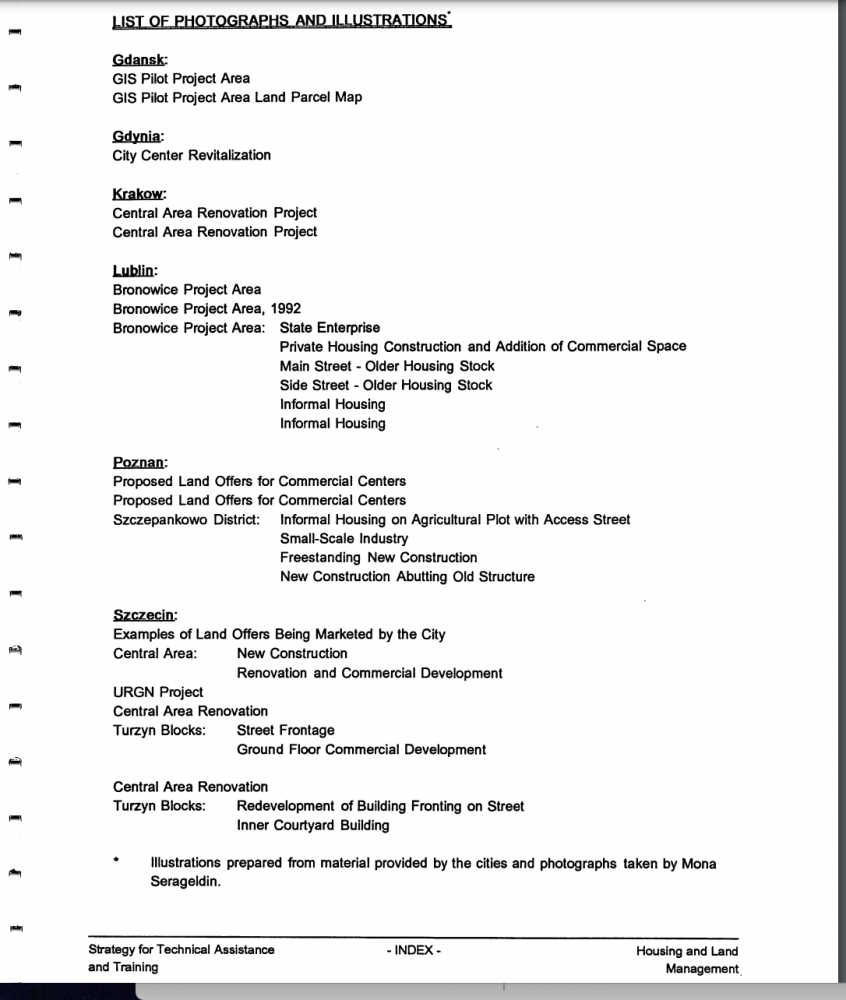
[Excerpt: Preface, page 6; List of Photographs and Illustrations]

See related I2UD projects below

Project Year:1992
Project Type:Technical Assistance Report
Geographic Regions:Poland (Gdańsk, Gdynia, Kraków, Lublin, Poznań, and Szczecin)
Reports:
Strategy for Technical Assistance and Training: Housing and Land Management, Poland (Mona Serageldin, January 1993)
Authors:Mona Serageldin
Sponsors:USAID Regional Housing and Urban Development Office; International City/County Management Association (ICMA)
Categories:Urban Planning
  
ID:1992_00_001

Related I2UD Projects